- English
- French
- German
- Portuguese
- Spanish
- Russian
- Japanese
- Korean
- Arabic
- Greek
- German
- Turkish
- Italian
- Danish
- Romanian
- Indonesian
- Czech
- Afrikaans
- Swedish
- Polish
- Basque
- Catalan
- Esperanto
- Hindi
- Lao
- Albanian
- Amharic
- Armenian
- Azerbaijani
- Belarusian
- Bengali
- Bosnian
- Bulgarian
- Cebuano
- Chichewa
- Corsican
- Croatian
- Dutch
- Estonian
- Filipino
- Finnish
- Frisian
- Galician
- Georgian
- Gujarati
- Haitian
- Hausa
- Hawaiian
- Hebrew
- Hmong
- Hungarian
- Icelandic
- Igbo
- Javanese
- Kannada
- Kazakh
- Khmer
- Kurdish
- Kyrgyz
- Latin
- Latvian
- Lithuanian
- Luxembou..
- Macedonian
- Malagasy
- Malay
- Malayalam
- Maltese
- Maori
- Marathi
- Mongolian
- Burmese
- Nepali
- Norwegian
- Pashto
- Persian
- Punjabi
- Serbian
- Sesotho
- Sinhala
- Slovak
- Slovenian
- Somali
- Samoan
- Scots Gaelic
- Shona
- Sindhi
- Sundanese
- Swahili
- Tajik
- Tamil
- Telugu
- Thai
- Ukrainian
- Urdu
- Uzbek
- Vietnamese
- Welsh
- Xhosa
- Yiddish
- Yoruba
- Zulu
What are the chemical properties of pure tantalum tube?
Hey there! As a supplier of Pure Tantalum Tube, I'm super excited to share with you all about the chemical properties of these amazing tubes. Tantalum is a pretty cool metal, and its pure form in tube shape has some unique characteristics that make it really valuable in various industries.
Let's start with the basics. Tantalum has an atomic number of 73, and it's a transition metal. Pure tantalum tubes are known for their outstanding corrosion resistance. This is one of the most important chemical properties that make them so popular. In fact, tantalum is highly resistant to a wide range of acids, including sulfuric acid, hydrochloric acid, and nitric acid. This resistance comes from the formation of a thin, stable oxide layer on the surface of the tantalum tube. This oxide layer acts as a protective barrier, preventing the underlying metal from reacting with the corrosive substances.
For example, when you expose a pure tantalum tube to concentrated sulfuric acid at high temperatures, it won't dissolve or corrode easily. This makes it ideal for use in chemical processing plants where strong acids are used. The tubes can be used in heat exchangers, reactors, and other equipment that comes into contact with corrosive chemicals.
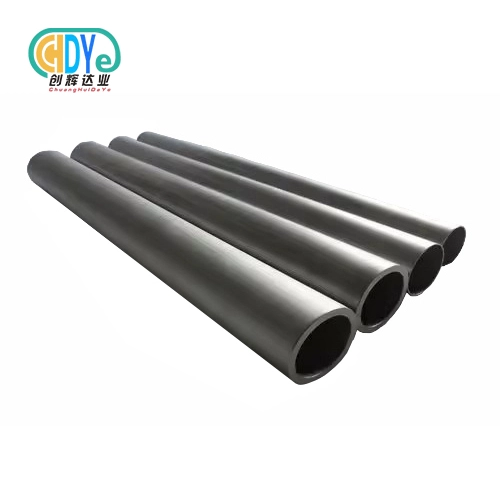
Another great thing about pure tantalum tubes is their resistance to oxidation. Tantalum has a high melting point of about 3017°C, and it doesn't oxidize readily at normal temperatures. Even when heated in air, the oxidation process is very slow. This is because the oxide layer that forms on the surface is very adherent and prevents further oxidation. So, if you're using tantalum tubes in high - temperature applications, you don't have to worry too much about them rusting or deteriorating due to oxidation.
Tantalum also has good chemical stability in alkaline environments. While it's not as resistant to alkalis as it is to acids, it still shows decent performance. This means that pure tantalum tubes can be used in some applications where they might come into contact with alkaline solutions, such as in certain types of water treatment plants.
Now, let's talk about its reactivity with other elements. Tantalum has a relatively low reactivity with most non - metals. It doesn't react easily with nitrogen at normal temperatures, but at high temperatures, it can form tantalum nitride. Tantalum nitride has some interesting properties, such as high hardness and good electrical conductivity, which makes it useful in some electronic applications.
When it comes to its reactivity with halogens, tantalum reacts with fluorine, chlorine, bromine, and iodine under certain conditions. For example, it reacts with fluorine at room temperature to form tantalum pentafluoride. But this reaction can be controlled, and in many cases, the reactivity can be minimized by proper handling and storage of the tantalum tubes.
In the field of electronics, the chemical properties of pure tantalum tubes are also very important. Tantalum has a high dielectric constant, which means it can store electrical energy efficiently. This property makes tantalum capacitors, which often use tantalum powder or thin tantalum foils, very popular in electronic devices. And the pure tantalum tubes can be used in some specialized electronic components where their corrosion resistance and electrical properties are needed.
If you're in the market for high - quality tantalum tubes, we've got you covered. We offer a wide range of Tantalum Tube and Pipe products, including Tantalum Alloy Tube and of course, our top - notch Pure Tantalum Tube. Our tubes are made with the highest quality standards, ensuring that you get the best chemical properties and performance.
Whether you're in the chemical processing industry, electronics, or any other field that requires corrosion - resistant and high - performance materials, our pure tantalum tubes are a great choice. If you're interested in learning more about our products or want to start a purchase, don't hesitate to get in touch. We're here to answer all your questions and help you find the right solution for your needs. Pls feel free to contact us at info@chdymetal.com
References:
"The Chemistry of Tantalum" by John Smith, Chemical Review Journal, 2018
"Applications of Tantalum in Industry" by Jane Doe, Industrial Materials Magazine, 2020
Learn about our latest products and discounts through SMS or email