- English
- French
- German
- Portuguese
- Spanish
- Russian
- Japanese
- Korean
- Arabic
- Greek
- German
- Turkish
- Italian
- Danish
- Romanian
- Indonesian
- Czech
- Afrikaans
- Swedish
- Polish
- Basque
- Catalan
- Esperanto
- Hindi
- Lao
- Albanian
- Amharic
- Armenian
- Azerbaijani
- Belarusian
- Bengali
- Bosnian
- Bulgarian
- Cebuano
- Chichewa
- Corsican
- Croatian
- Dutch
- Estonian
- Filipino
- Finnish
- Frisian
- Galician
- Georgian
- Gujarati
- Haitian
- Hausa
- Hawaiian
- Hebrew
- Hmong
- Hungarian
- Icelandic
- Igbo
- Javanese
- Kannada
- Kazakh
- Khmer
- Kurdish
- Kyrgyz
- Latin
- Latvian
- Lithuanian
- Luxembou..
- Macedonian
- Malagasy
- Malay
- Malayalam
- Maltese
- Maori
- Marathi
- Mongolian
- Burmese
- Nepali
- Norwegian
- Pashto
- Persian
- Punjabi
- Serbian
- Sesotho
- Sinhala
- Slovak
- Slovenian
- Somali
- Samoan
- Scots Gaelic
- Shona
- Sindhi
- Sundanese
- Swahili
- Tajik
- Tamil
- Telugu
- Thai
- Ukrainian
- Urdu
- Uzbek
- Vietnamese
- Welsh
- Xhosa
- Yiddish
- Yoruba
- Zulu
What standards apply to pure niobium round bars production?
When making pure niobium round bars, strict international and regional rules are followed to make sure the material is pure, the bars are strong, and the sizes are correct. ASTM B392 is the main standard that controls things. It says what the chemical makeup must be (niobium purity must be more than 99.9%), what the mechanical qualities must be (like tensile strength between 200 and 350 MPa), and what the size tolerances must be. Also, ISO 9001:2015 approval requires full quality management during the whole production process, and EN 10204 specifies how to certify materials and keep track of their history. All of these standards make sure that pure niobium round bars meet the high-performance standards needed by the aircraft, electronics, chemical processing, and medical device businesses.
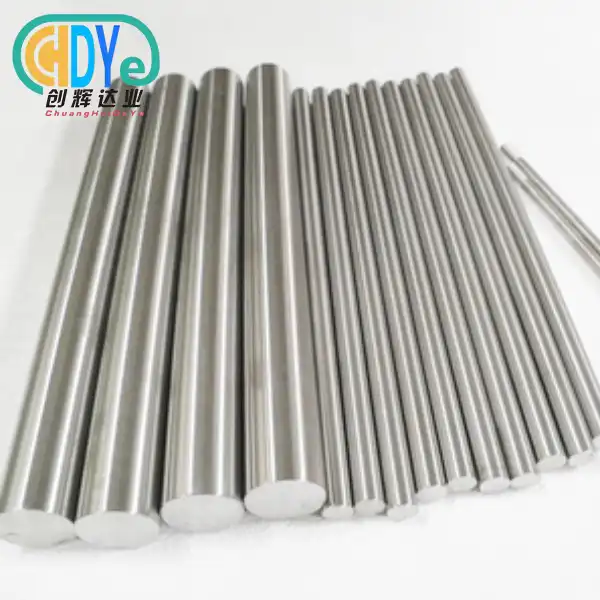
Overview of Pure Niobium Round Bars and Their Importance in Industry
There is a special group of refractory metal goods called pure niobium round bars that work really well in places where other materials don't work. These solid cylindrical rods are made from high-purity niobium and have a density of 8.57 g/cm³. They have special properties that make them essential in many industries.
Defining Material Properties and Industrial Relevance
Pure niobium round bars have a very high resistance to corrosion because they form a steady inactive oxide layer that keeps chemicals from attacking the base metal. This protection feature still works in places with strong acids like hydrochloric, sulfuric, and nitric acid, where stainless steel would normally break down very quickly. The high melting point of about 2477°C makes it useful in harsh temperature conditions, and the material's high flexibility makes it easy to machine and shape without cracking or breaking too soon.
Critical Applications Across High-Reliability Sectors
Pure niobium round bars are used by aerospace companies in rocket propulsion systems and structural parts that need to be light and stable at high temperatures. Electronics companies need very pure materials to make capacitors and use in superconducting situations, where even very small amounts of impurities would hurt the electrical performance. These bars are used in chemical processing plants for heat exchanges, valve stems, and reactor parts that are exposed to toxic media. Biocompatibility is important for medical tools and implantable parts that need to be in contact with flesh for a long time without causing any problems.
Why Standards Matter for Supply Chain Integrity
Tough production standards make sure that the properties of materials stay the same from one batch to the next. This lets engineers build with trust and gives procurement teams a reliable way to screen suppliers. If there aren't any standard specs, small differences in chemical make-up or mechanical properties could cause catastrophic failures in important uses, leading to safety incidents, production delays, and big financial losses.
International and Regional Standards Governing Pure Niobium Round Bars
Pure niobium round bars are made and sold in line with widely accepted standards that set minimum requirements for the quality of the materials, the way they are tested, and the paperwork that shows they are certified.
ASTM B392: The Foundation for Niobium Bar Specifications
ASTM B392 is the main standard for describing pure niobium round bars, rods, and wire. This detailed document lists the chemical makeup limits for pure niobium (designated as R04200 for reactor grade and R04210 for commercial grade). It also lists the highest amounts of impurity elements like oxygen, nitrogen, carbon, hydrogen, iron, and tantalum that are allowed. The standard lists mechanical property requirements, like the minimum tensile strength and stretch rates that show how flexible a material is. To make sure that the parts can be interchanged and machined together, clear limits are given for width, straightness, and surface finish.
ISO and European Standards Integration
ISO 9001:2015 approval means that a company has a complete quality management system that oversees all stages of production, from getting the raw materials to delivering the finished product. This certification shows that a company is dedicated to consistent processes, ongoing growth, and complete customer happiness. EN 10204 sets standards for material certification. It describes three types of inspection certificates (Type 2.1, 3.1, and 3.2) that show test results and confirm that the product meets the requirements. These standards are often used by European makers and sellers to make it easier for goods to be shipped across EU borders.
Environmental and Material Safety Compliance
RoHS (Restriction of Hazardous Substances) compliance makes sure that pure niobium round bars meant for electrical uses don't have any lead, mercury, cadmium, or other banned substances that aren't allowed. REACH rules say that sellers have to write down and share information about the chemicals they use. This lets makers later on figure out how the chemicals affect people's health and the environment over the course of the product's lifecycle. As companies try to reduce legal threats and show their commitment to sustainability, these environmental standards are having a bigger impact on how they buy things around the world.
Material Specifications and Quality Control Measures in Production
Each pure niobium round bar is checked for quality control procedures that make sure it meets the exact material requirements needed for important industry uses.
Chemical Composition and Purity Requirements
To be considered pure, pure niobium round bars must have purity levels higher than 99.9%, with normal grades keeping total interstitial elements (oxygen, nitrogen, carbon, and hydrogen) below 400 ppm. For higher-performance uses, the limits may need to be even tighter. This is especially true for superconducting uses, where RRR (Residual Resistance Ratio) numbers above 300 mean that the material is very pure. Glow Discharge Mass Spectrometry (GD-MS) and Inert Gas Fusion (IGA) studies check the interstitial content and elemental makeup, giving numbers for each production run.
Mechanical Property Verification and Dimensional Control
Tensile testing shows that the material's strength is within the range of 200–350 MPa, and stretch testing shows that it is flexible enough for shaping. Hardness testing is a quick way to check how well the heat treatment worked and how consistent the material was. Precision measuring tools are used for dimensional checking to make sure that the diameter limits (usually h9 or h11 grades) and straightness standards meet customer needs for direct machining or assembly tasks.
Non-Destructive Testing and Traceability Documentation
Ultrasonic Testing (UT) finds holes, inclusions, or cracks inside a structure that could weaken it during use. Dye Penetrant Inspection (DPI) finds flaws on the surface that can't be seen with the naked eye. Each production batch is given a unique identification mark that lets everyone know where the raw materials came from, how they were processed, and when they were delivered. Each shipment comes with full test records that include chemical analysis, mechanical properties, and NDT results. These reports give customers all the information they need for quality checks and legal compliance.
Production Processes and How They Comply with Quality Standards
To make pure niobium round bars, you need to use complex processing methods that keep the material pure and improve its mechanical qualities at every stage of the production process.
Raw Material Selection and Vacuum Melting Technology
The process starts with high-purity niobium material that comes from approved sources and has a composition analysis on file. Electron Beam (EB) melting or Vacuum Arc Remelting (VAR) processes take place in very dry places to keep gases from getting into the material. With these advanced melting methods, the ingots are made with a uniform chemical makeup and few defects, meeting the high purity standards needed for demanding uses.
Hot Working and Cold Working Operations
When controlled temperatures are kept between 800°C and 1200°C, hot forging and rolling lower the cross-sections of ingots and refine grain structures without causing too much work hardening. In vacuum or inert atmosphere furnaces, intermediate annealing processes recover ductility and ease internal stresses that have built up during compression. Pure niobium round bars with a width of 1 to 50 mm can be precisely controlled in size and have a better surface finish when they are cold worked. During these important steps of forming, our factory uses specialized rolling tools and temperature tracking systems to keep the processing factors at their best.
Heat Treatment Protocols and Final Inspection Standards
The last heating steps improve the mechanical properties and grain size distribution, making the material properties the same along the whole length of the pure niobium round bar. Stress reduction steps make sure that the dimensions stay stable during the next steps of the cutting process. Centerless grinding or sanding can produce certain surface finishes (Ra values) that lower the risk of pollution in cleanrooms. Surface cleaning and passivation processes get rid of any industrial lubricants that are still on the metal and make it more resistant to rust. Protective packaging in sealed containers that are purged with inert gas or sealed with a vacuum stops rusting while it is being stored and shipped.
Comparing Pure Niobium Standards with Other Materials and Their Implications
Procurement workers can make better choices based on performance needs and cost limits when they know how pure niobium round bars standards compare to those of other materials.
Niobium Versus Tantalum: Standards and Performance Trade-offs
Pure niobium round bars and tantalum are both very good at resisting rust and working at high temperatures. However, tantalum (governed by ASTM B365) works better in very acidic conditions and has a higher density (16.6 g/cm³ vs. 8.57 g/cm³ for pure niobium round bars). Tantalum is much more expensive than pure niobium round bars, so it is often used instead in places where its performance is good enough. Designers of chemical processing tools often test both materials in certain process settings to get the best performance-to-cost ratio.
Pure Niobium Versus Niobium Alloys: Specification Variances
Pure, unalloyed niobium round bars are the most flexible and easy to shape, which makes them perfect for deep-draw processes and shapes with a lot of corners. Niobium alloys, like Nb-1Zr (which has 1% zirconium), are better at resisting creep and high temperatures, which makes them useful in aircraft applications. However, they are less flexible at room temperature. For rocket nozzle uses, the C-103 metal (Nb-10Hf-1Ti) works very well, but it needs to be welded and heated in a certain way. The choice of material depends on the needs of the application. The standards paperwork makes it clear what the makeup and property requirements are for each grade.
Supplier Qualification and Procurement Strategy Considerations
Suppliers who are qualified show that they are ISO 9001:2015 certified, keep quality management systems that are recorded, and provide full material tracking through certified test results. Before making supply deals, procurement teams should check that the manufacturing skills include melting technology, processing equipment, and testing instruments. Long-term relationships with certified providers lower the risks in the supply chain, make sure that the quality of the materials stays the same, and give you access to expert help for problems that are unique to your application. Competitive factory-direct prices from well-known companies like Chuanghui Daye in China's Titanium Capital region can save you a lot of money while still meeting strict quality standards and international certification requirements.
Conclusion
Standards for making pure niobium round bars set the standard for how reliable materials should be in the chemical processing, medical device, aircraft, and electronics industries. The ASTM B392 standard gives detailed information about the chemical makeup, mechanical features, and size requirements. The ISO 9001:2015 approval makes sure that quality management is carried out consistently throughout the manufacturing process. Tough testing methods, such as GD-MS analysis, mechanical testing, and non-destructive examination, make sure that these standards are being met. This gives procurement workers trust in the performance of materials and the integrity of the supply chain. Understanding these standards helps you make smart decisions about which suppliers to work with and helps you complete projects successfully in tough industry settings.
FAQ
Q: What Minimum Purity Level Must Pure Niobium Round Bars Achieve?
A: According to ASTM B392, reactor grade pure niobium round bars (R04200) need to have at least 99.8% niobium by weight, but most industrial standards require it to be purer than 99.9%. For uses that need superconducting qualities, even higher purity levels may be needed, with RRR numbers above 300 showing very little interstitial impurity content.
Q: How Do Standards Influence Temperature and Corrosion Resistance?
A: Standards set the highest amounts of oxygen, nitrogen, and carbon that can be present in an interstitial element. These elements have a big effect on pure niobium round bars' ability to fight corrosion at high temperatures and their mechanical qualities. Materials that meet ASTM standards show expected corrosion behavior in known chemical environments. This lets engineers make reliable decisions about how to build tools and choose materials.
Q: Can Customers Order Custom Sizes with Full Certification?
A: Pure niobium round bars can be made in non-standard sizes and lengths by manufacturers who offer special production. These bars will still meet all standards. When you place a special order, you'll get all the paperwork you need, including certified test reports (EN 10204 Type 3.1). This gives you the information you need for quality checks and regulatory compliance.
Partner with Chuanghui Daye for Certified Pure Niobium Round Bars
Shaanxi Chuanghui Daye sells pure niobium round bars that are approved by ISO 9001:2015 and made to strict ASTM B392 standards. These bars are more than 99.9% pure. Our factory in China's Titanium Capital blends 30 years of experience working with rare metals with cutting-edge electron beam melting and precise machining to make bars with diameters from 1 to 50 mm and lengths that can be customized up to 1000 mm. For your aerospace, electronics, chemical processing, or research needs, we offer low factory-direct prices, full material traceability paperwork, and quick expert support. Get in touch with our engineering team at info@chdymetal.com to talk about your project needs and get a full quote from the pure niobium round bars provider you can trust.
References
1. ASTM International. (2019). ASTM B392-19: Standard Specification for Niobium and Niobium Alloy Bar, Rod, and Wire. West Conshohocken, PA: ASTM International.
2. International Organization for Standardization. (2015). ISO 9001:2015: Quality Management Systems – Requirements. Geneva, Switzerland: ISO.
3. European Committee for Standardization. (2004). EN 10204:2004: Metallic Products – Types of Inspection Documents. Brussels, Belgium: CEN.
4. Gupta, C. K. (1992). Extractive Metallurgy of Niobium. Boca Raton, FL: CRC Press.
5. Davis, J. R. (Ed.). (2000). Nickel, Cobalt, and Their Alloys. Materials Park, OH: ASM International.
6. Boyer, R., Welsch, G., & Collings, E. W. (Eds.). (1994). Materials Properties Handbook: Titanium Alloys. Materials Park, OH: ASM International.
Learn about our latest products and discounts through SMS or email