- English
- French
- German
- Portuguese
- Spanish
- Russian
- Japanese
- Korean
- Arabic
- Greek
- German
- Turkish
- Italian
- Danish
- Romanian
- Indonesian
- Czech
- Afrikaans
- Swedish
- Polish
- Basque
- Catalan
- Esperanto
- Hindi
- Lao
- Albanian
- Amharic
- Armenian
- Azerbaijani
- Belarusian
- Bengali
- Bosnian
- Bulgarian
- Cebuano
- Chichewa
- Corsican
- Croatian
- Dutch
- Estonian
- Filipino
- Finnish
- Frisian
- Galician
- Georgian
- Gujarati
- Haitian
- Hausa
- Hawaiian
- Hebrew
- Hmong
- Hungarian
- Icelandic
- Igbo
- Javanese
- Kannada
- Kazakh
- Khmer
- Kurdish
- Kyrgyz
- Latin
- Latvian
- Lithuanian
- Luxembou..
- Macedonian
- Malagasy
- Malay
- Malayalam
- Maltese
- Maori
- Marathi
- Mongolian
- Burmese
- Nepali
- Norwegian
- Pashto
- Persian
- Punjabi
- Serbian
- Sesotho
- Sinhala
- Slovak
- Slovenian
- Somali
- Samoan
- Scots Gaelic
- Shona
- Sindhi
- Sundanese
- Swahili
- Tajik
- Tamil
- Telugu
- Thai
- Ukrainian
- Urdu
- Uzbek
- Vietnamese
- Welsh
- Xhosa
- Yiddish
- Yoruba
- Zulu
Where Can You Find Certified Pure Niobium Plate Manufacturers?
If you are looking for a certified pure niobium plate supplier, first look for suppliers who have been certified to ISO 9001:2015, who comply with ASTM B393 requirements, and who have complete material traceability paperwork. Direct factory suppliers from the Baoji area of China, established European metal wholesalers, and North American rare metal ex,perts Shaanxi Chuanghui Daye Metal Material Co., Ltd. is a direct manufacturer for Nb >99.9% purity plates with customized size, price advantage, and more than 30 years of rare metal production experience.
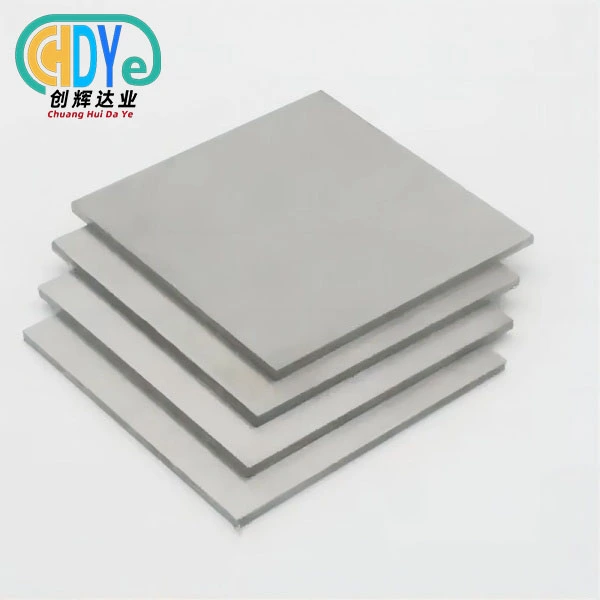
Understanding Pure Niobium Plates: Properties and Industrial Uses
What Makes Niobium Plate Unique Among Refractory Metals
Niobium belongs to a special group of refractory metals. It has a density of 8.57 g/cm³ and melts at around 2,468°C, offering an appealing strength-to-weight ratio that exceeds that of several heavier materials, such as tantalum. It has a tensile strength of between 200 and 350 MPa and a coefficient of thermal expansion as low as 7.3 µm/(m·K); hence, it is dimensionally stable during thermal cycling. The real difference between niobium and other materials is its natural passivation layer, Nb2O5, which develops spontaneously on contact with air. This oxide layer is very resistant to nitric acid, hydrochloric acid, and even aqua regia under normal circumstances. It is still attacked by hydrofluoric acid at any concentration. This is an important consideration for chemical engineers to keep in mind when choosing liner materials.
Industrial Applications Driving Demand
The main end-use markets for certified niobium sheet and plate products with stable demand are:
- Aerospace and defense: Niobium plates have the ability to retain their structural properties in high-temperature environments; hence, they are used in thermal shielding elements, as well as high-vacuum assemblies where the outgassing of materials must be carefully regulated.
- Chemical processing equipment: Manufacturers utilize niobium as explosion-bonded cladding or loose linings in reaction tanks and heat exchangers handling hot sulfuric or hydrochloric acids, where it outperforms zirconium in certain oxidizing situations.
- Superconducting RF cavities: High-energy physics facilities such as CERN and Fermilab need ultra-high-purity niobium with a Residual Resistance Ratio (RRR) greater than 300 for the preservation of superconductivity at cryogenic temperatures without thermal quench occurrences.
- Synthetic diamond production: Niobium is used as a seed-holding material in High-Pressure, High-Temperature (HPHT) presses because of its chemical inertness at ~1,400°C and resistance to carbon contamination.
These application areas immediately translate into what procurement teams need to specify when making orders: purity grade, grain size according to ASTM E112, interstitial oxygen concentration below 150 ppm, and surface roughness Ra regulated below 0.8 µm for pure niobium plate vacuum-grade components.
Why Certification Matters When Choosing Pure Niobium Plate Manufacturers
ISO 9001:2015 and ASTM B393 as Procurement Gatekeepers
ISO 9001:2015 and ASTM B393 as Procurement Gatekeepers Certification is not a formality; it is a procurement precaution. ASTM B393 recognizes two major commercial grades: Type 1 (Reactor Grade RO4200, stringent control of tantalum impurities for nuclear applications); and Type 2 (Commercial Grade RO4210, for broad industrial usage where larger tantalum content is acceptable and cost-efficient). But knowing which grade applies to your project immediately impacts performance results and budget.ISO 9001:2015 certification guarantees a firm has documented control of every step of the manufacturing process from receipt of the raw material to vacuum melting, rolling, heat treatment, and final dimensional verification. Without it, customers risk obtaining material with uneven grain shapes, higher interstitial impurity levels, or concealed compositional abnormalities that only become apparent during downstream processing.
Quality Control Checkpoints You Should Verify
For purchasers in the know, three key quality control vectors should be checked from reputable manufacturers before making an order:
- Interstitial impurity analysis: Oxygen concentration less than 150 ppm, via Inert Gas Fusion (IGF) and combustion analysis. Excess oxygen decreases both ductility and RRR, and hence directly compromises component performance in vacuum or cryogenic settings.
- Microstructure integrity: Metallographic examination should indicate a completely recrystallized grain structure of ASTM E112 No. 6 or finer. Surface flaws and expensive scrap rates are caused by uneven grain development during deep drawing processes.
- Non-destructive testing (NDT): Ultrasonic testing may discover internal laminations or voids that originate from the ingot stage. Surface inspection is done to check for pits, folds or impurities that might undermine the vacuum integrity.
Together, these criteria will decide whether your niobium metal plate is reliable for your application or will fail prematurely under operating stress.
How to Select the Best Pure Niobium Plate Manufacturer: Criteria and Comparisons
Evaluating Suppliers Across Geographies
There are three main places to get pure niobium plate items from throughout the world. North American and European distributors will usually give fast domestic shipping and local technical assistance, but normally at a substantial price premium since they buy mill items from Asia and repackage them. Asian producers, especially in China’s Baoji High-Tech Development Zone, have facilities that combine melting, forging, rolling, and machining in one location, which shortens lead times and removes middleman markups. Use these criteria to evaluate and compare providers:
- Production capability: Can the provider roll plates to your thickness range (0.5–50 mm) and size (width up to 1000 mm, length up to 3000 mm) in-house?
- Purity grade availability: Are commercial grade (99.9% min), high-purity grade (99.95% min), and ultrahigh purity grade (99.99% min) available as separate, documented product lines from the supplier?
- Certification documentation: The ISO 9001:2015 certificate is current and may be validated. Does the supplier offer mill test results per ASTM B393 and comprehensive material traceability records?
- Customization flexibility: Can the supplier manage small-batch R&D orders while still maintaining high-volume manufacturing runs without sacrificing lead-time commitments?
Applying these criteria to your project needs offers you a defined framework for qualifying suppliers rather than just choosing the cheapest.
Streamlining Your Procurement Process for Pure Niobium Plates
The procurement failures most easily avoided are those caused by inadequate communication of specifications. Please include your goal purity grade, needed dimensions, surface finish specification (Ra value), applicable standard (ASTM B393 Type 1 or Type 2), and NDT criteria when seeking a quotation for pure niobium plate. If your application includes welding, specify that all joining must take place in a high-vacuum electron beam chamber or an argon/helium glove box—niobium aggressively absorbs oxygen and nitrogen beyond 200°C, and open-air welding makes the material brittle.
If your application includes heavy cold working to a reduction of more than 90%, obtain evidence that the supplier is performing stress-relief or complete recrystallization annealing in a high vacuum environment of 10⁻⁴ Torr or better at temperatures between 1,000°C and 1,200°C. This restores ductility and assures formability downstream. By establishing payment terms, inspection criteria, and packing requirements ahead of time, it avoids conflicts and protects the interests of both parties over the course of the supply.
Trusted Pure Niobium Plate Manufacturers and Suppliers: Where to Start Your Search
Shaanxi Chuanghui Daye Metal Material Co., Ltd. is located in Baoji High-Tech Development Zone, Shaanxi Province, the Titanium Capital of China, and one of the areas in the world with the highest concentration of rare metal processing professionals. The firm was founded by an industry veteran with over 30 years of expertise. It has modern melting, forging, rolling, and machining equipment, including electron beam furnaces, annealing furnaces, and precision rolling machines.
Chuanghui Daye can provide niobium plates with purity Nb >99.9%, thickness from 0.5 mm to 50 mm, width up to 1,000 mm, and length up to 3,000 mm. The firm is ISO 9001:2015 certified and offers complete mill test reports, raw material traceability records, and third-party inspection assistance upon request.
Production infrastructure is geared for large-volume orders for commercial-grade chemical processing linings or ultra-high-purity material for superconducting cavity research, as well as adaptable small-batch prototypes.
Conclusion
The search for certified pure niobium plate material involves more than a reasonable price; it requires verified certificates, established quality control procedures, and a source with real production capabilities. The details count: purity grade, dimensional tolerance, grain structure, interstitial impurity management – they all have a direct impact on the performance of your end-product. Buyers who take the effort to qualify their suppliers upfront are protecting their production continuity and avoiding expensive quality problems subsequently. Chuanghui Daye brings more than 30 years of rare metal experience, ISO 9001:2015 certification and factory-direct pricing to the table – a legitimate starting point for any serious procurement review.
FAQ
Q: What is the difference between RO4200 and RO4210 niobium plates?
A: RO4200 is reactor-grade with strictly controlled tantalum impurities, used in nuclear and energy applications. RO4210 is Commercial Grade, where higher tantalum content is acceptable, offering a cost advantage for general industrial and chemical use.
Q: Can a niobium plate be welded in open air?
A: No. Niobium absorbs oxygen and nitrogen above 200°C, causing brittleness. All welding must occur in a high-vacuum electron beam chamber or a controlled inert gas enclosure.
Q: Which industries benefit most from certified niobium plates?
A: Aerospace, chemical processing, particle physics research, synthetic diamond manufacturing, and semiconductor fabrication all rely on certified niobium sheet and plate products for performance-critical components.
Q: How do I verify a supplier's certification?
A: Request the original ISO 9001:2015 certificate, confirm the certification body is accredited, and ask for ASTM B393-compliant mill test reports with full material traceability documentation.
Request a Quote from Chuanghui Daye — Your Certified Pure Niobium Plate Supplier
Shaanxi Chuanghui Daye delivers factory-direct niobium plate for sale with Nb >99.9% purity, custom dimensions, and full ISO 9001:2015 documentation. Whether your project demands tight tolerances or flexible small-batch production, our technical team is ready to support your specifications. Contact us today at info@chdymetal.com or visit www.chdymetal.com to request a quote and start a reliable, long-term supply partnership.
References
1. ASTM International. ASTM B393: Standard Specification for Niobium and Niobium Alloy Strip, Sheet, and Plate. ASTM International, 2019.
2. Sims, Chester T., Norman S. Stoloff, and William C. Hagel. Superalloys II: High-Temperature Materials for Aerospace and Industrial Power. Wiley-Interscience, 1987.
3. Savitzky, B. H., et al. "Refractory Metal Processing and Applications in High-Temperature Environments." Journal of Materials Engineering and Performance, ASM International, 2021.
4. International Organization for Standardization. ISO 9001:2015 Quality Management Systems — Requirements. ISO, 2015.
5. Brandes, E. A., and G. B. Brook, eds. Smithells Metals Reference Book, 7th ed. Butterworth-Heinemann, 1992.
6. Hebda, John. "Niobium Alloys and High-Temperature Applications." Proceedings of the International Symposium on Niobium, TMS, 2001.
Learn about our latest products and discounts through SMS or email