- English
- French
- German
- Portuguese
- Spanish
- Russian
- Japanese
- Korean
- Arabic
- Greek
- German
- Turkish
- Italian
- Danish
- Romanian
- Indonesian
- Czech
- Afrikaans
- Swedish
- Polish
- Basque
- Catalan
- Esperanto
- Hindi
- Lao
- Albanian
- Amharic
- Armenian
- Azerbaijani
- Belarusian
- Bengali
- Bosnian
- Bulgarian
- Cebuano
- Chichewa
- Corsican
- Croatian
- Dutch
- Estonian
- Filipino
- Finnish
- Frisian
- Galician
- Georgian
- Gujarati
- Haitian
- Hausa
- Hawaiian
- Hebrew
- Hmong
- Hungarian
- Icelandic
- Igbo
- Javanese
- Kannada
- Kazakh
- Khmer
- Kurdish
- Kyrgyz
- Latin
- Latvian
- Lithuanian
- Luxembou..
- Macedonian
- Malagasy
- Malay
- Malayalam
- Maltese
- Maori
- Marathi
- Mongolian
- Burmese
- Nepali
- Norwegian
- Pashto
- Persian
- Punjabi
- Serbian
- Sesotho
- Sinhala
- Slovak
- Slovenian
- Somali
- Samoan
- Scots Gaelic
- Shona
- Sindhi
- Sundanese
- Swahili
- Tajik
- Tamil
- Telugu
- Thai
- Ukrainian
- Urdu
- Uzbek
- Vietnamese
- Welsh
- Xhosa
- Yiddish
- Yoruba
- Zulu
Where to Buy Titanium Alloy Wire from a Reliable Supplier
Sourcing titanium alloy wire from a dependable supplier requires understanding where quality meets compliance and performance. Buyers in aerospace, medical, chemical processing, and electronics sectors should prioritize manufacturers with ISO 9001:2015 certification, proven production capabilities, and adherence to international standards like ASTM B863 and AMS 4954. Direct manufacturers located in established titanium production hubs—such as Baoji, China, often called the "Titanium Capital"—offer advantages including factory-direct pricing, custom alloy formulations, rapid prototyping, and traceable quality documentation. Partnering with suppliers who maintain stock inventory enables delivery within one to three days for standard sizes, while their technical teams provide application-specific guidance for critical projects.
Understanding Titanium Alloy Wire and Its Business Value
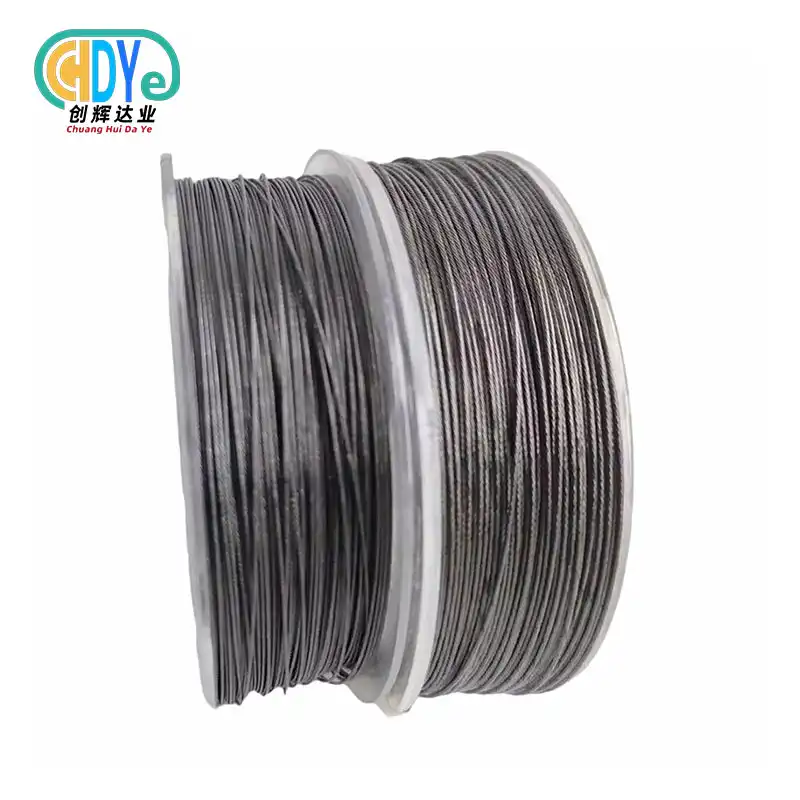
Titanium alloy wire is a high-performance metal that can be used in places where other metals can't. Aluminum and vanadium are added to these wires to make them stronger, more stable at high temperatures, and longer-lasting. Titanium doesn't rust on its own. Most of the time, Grade 5 Ti-6Al-4V is used. It can be stretched between 895 and 1100 MPa and is only 4.43 g/cm³ dense, which is about 60% of steel. It has an unbeatable ratio of strength to weight because of this. People in many fields, from aircraft to medical devices, count on these wires because they don't break down at very low temperatures (-250°C) or very high service temperatures (400°C). Spacecraft fasteners, jet engine parts, and petrochemical heat exchangers all need them because they can handle high temperatures. An oxide layer (TiO₂) forms on the wire and heals itself on the wire. This layer protects it from chloride stress corrosion cracking in saltwater and acidic industrial processes. This isn't always true for stainless steel and nickel alloys.
Material Composition and Performance Characteristics
When alloying, the balance of the different elements is carefully checked to make sure the desired outcome is reached. When you add aluminum to metal, it gets stronger and lighter. Vanadium stabilizes the beta phase structure, which makes it easier to bend and join. When it comes to specialized metals, molybdenum is better at stopping creep at high temperatures, and palladium is better at stopping corrosion in reducing acids. The procurement managers can choose materials that are perfect for the business needs when they know about these differences in composition. Two ways to make things are vacuum arc remelting (VAR) and electron beam melting (EBM). These get rid of impurities and nonmetallic inclusions that hurt the fatigue performance. By running wire through precise dies more than once, the sizes stay the same, within ±0.01 mm. Vacuum heating in the middle lowers the pressure inside and evens out the grain structure. This means that the wire can reliably behave mechanically when loaded and unloaded many times. This is very important for springs, dental archwires, and surgical sutures.
Business Case for Premium Materials
At first, titanium alloy wire costs more than copper or stainless steel, but when you add up all the costs, they are better in tough situations. This means that you won't have to repair things as often or take as many breaks for upkeep. Also, better corrosion protection means that you don't need protective coatings. Companies that make medical equipment should look for biocompatibility that meets ISO 5832-3 standards. This makes sure they follow the rules and keeps patients safe. People who buy aerospace get lighter planes, which save fuel and make it possible to carry more cargo over many years of use.
Criteria for Selecting a Reliable Titanium Alloy Wire Supplier
How good the product is, how quickly the job gets done, and how well the business does in the long run all depend on choosing the right provider. When making a purchase, people shouldn't just look at the price. They should also look at credentials that can be checked, production skills, and proven experience. Suppliers who are ISO 9001:2015 certified have set up quality management systems that check the raw materials, the process of making the product, and the finished product. This makes sure that each batch of goods meets the standards. If a product is certified to ASTM B863, it means it meets the standards that many businesses in North America use for its chemical make-up, mechanical properties, and sizes. Standards that are specific to aerospace, like higher purity levels and more testing methods, are covered by AMS 4954 certification. A third party regularly checks the suppliers who keep these certifications. This makes sure that they follow the rules all the time, not just once.
Production Capabilities and Customization Services
For potential sources, you should check more than just certificates. You should also see if they have the right production equipment for your project's size. For very pure melting, modern facilities should have electron beam furnaces, precision drawing tools with built-in dimensional tracking, and vacuum annealing systems that manage the atmosphere's makeup and the temperature profiles. With these skills, we can make metals that are the right size, have the right ratios, and have the right surface finish (such as bright-annealed, oxide-free, or centerless-ground). It's very important to be able to change how much you order. Research groups and prototyping teams, for instance, need small amounts that can be made quickly, while companies that make things need a steady supply of larger amounts. When suppliers keep common types like commercially pure titanium, Ti-6Al-4V, and Ti-6Al-4V ELI in ready-to-ship inventory, they can send out standard sizes in one to three days. This cuts down on the time it takes to finish projects and the money it costs to keep inventory on hand.
Reputation and Technical Support
A supplier's image isn't just what they say in their ads; it also includes records of how well they've done in the past that can be checked. Ask for written case studies that show how supply has helped businesses like the one you want to work with. Customer reviews from aerospace OEMs, medical device makers, or chemical processing companies show that the business is technically sound and can be counted on when things go wrong. Great providers are different from average ones because they offer strong expert help. If you can talk to metallurgical engineers who know about transformation temperatures, phase diagrams, and how materials change when heated, you can pick the best materials. If a seller gives you a free sample, you can see for yourself how the surface finishes, how strong it is, and how well it welds before you buy a lot of it. For regulated businesses, being able to track things is very important. This is possible with full test paperwork like chemical analysis certificates, tensile test records, and ultrasonic inspection results.
Comparing Titanium Alloy Wire Options: What to Consider Before Buying
To pick the right material, you need to think about how much it costs, how biocompatible it is, how strong it is, and how well it resists rust. Titanium alloys are unique because they perform better than other options when a lot of different property needs come together. Titanium doesn't rust as easily as stainless steel does. 316L stainless steel, for example, doesn't rust very well most of the time, but it fails in seawater and hypochlorite, where titanium stays strong.
Grade Selection for Specific Applications
Grades 1 through 4 of commercially pure titanium are the strongest and least likely to rust. As long as they look good over time, they're good for use in chemical processing equipment, purification plants, and buildings. Because it is easy to form and has a tensile strength of about 345 MPa, Grade 2 CP titanium is good for heat exchanger tubes and screws that won't rust. Titanium alloy wire is also available for applications where specific strength, flexibility, and forming characteristics are required. High-strength structures and airplanes are most often made of Ti-6Al-4V (Grade 5). It's easy to join and doesn't wear down quickly. Its tensile strength is over 900 MPa. Because of its dual-phase architecture, it is strong and flexible at the same time. This makes it a good material for making pressure tanks, landing gear parts, and turbine blades. Level 23 Extra Low Interstitial (Ti-6Al-4V ELI) cuts down on the amount of oxygen, nitrogen, and carbon in the material. This makes it more flexible and less likely to break. When it comes to medical implants like heart stents, spinal rods, and orthopedic cables, this is very important. Specialized metals are made to meet certain needs. Ti-0.2Pd (Grade 7) can handle reducing acids like sulfuric acid and hydrochloric acid, which helps it last longer in chemical processes. Beta-titanium metals are better at springback when it comes to orthodontic archwires and glasses frames. If you know these differences, you won't choose too many expensive metals when cheaper grades will do, or too few materials that break down too quickly in use.
Heat Treatment and Processing Considerations
The alloy that the wire is made of and how it has been thermomechanically processed in the past affect how well it works. When compared to annealed conditions, cold-drawn wire is stronger in a mechanical sense but less flexible. When you need to shape wire a lot, like when you're making coil springs or medical mesh, annealed wire with stretch values above 15% is best. When making fasteners, on the other hand, the conditions may need to be cold-worked in order to get the required proof loads without adding more heat treatment. The finish on the outside changes how it looks and how well it works. It is better for surfaces to carry energy and have less frictional resistance when they have been bright-annealed and made to look like mirrors. To get rid of oxides from a surface, chemical grinding or electropolishing can be used. These surfaces are needed for the best weld fusion and to keep the area where semiconductors are made as clean as possible. With centerless grinding, you can get the exact measurements you need for automatic feeding systems and cutting at high speeds.
Where to Buy Titanium Alloy Wire: Trusted Markets and Suppliers
Most of the world's supply lines for titanium alloy wire are based in well-established production areas that have a lot of experience working with metal and are linked to other supply networks. Purchasing managers can find the best suppliers in terms of quality, lead time, and price by learning about the benefits of each location. It is known all over the world as the "Titanium Capital," and many of the factories that melt, process, and make titanium are in the Baoji region of China. This means that companies like Shaanxi Chuanghui Daye Metal Material Co., Ltd. can easily get high-quality titanium sponge, the latest heating technology, and trained metalworkers. When things are specialized in a certain area, they always get better, costs stay low, and quality standards stay in line with world standards.
Direct Manufacturers versus Distributors
It should be clear in the plan for how to buy things, whether to buy directly from producers or work with distributors or trade companies. When you work directly with manufacturers, you can change the composition of alloys and their mechanical properties, solve technical issues more quickly, do factory audits to see how well production is going, and get clear pricing that shows the actual costs of production without any markups for distribution. Distributors can help you find small amounts of different alloy types, regional stock for situations, or ways to work around differences in language and time zones. Most of the time, though, talking to the maker directly is better because you can get more technical help and make changes. This is especially important for mission-critical apps that need to keep an eye on specifications and have lots of information.
Certification and Compliance Verification
You can trust suppliers who have certifications that include standards unique to their business as well as basic quality management standards. Basic quality systems are set up by ISO 9001:2015, and AS9100 certification shows that a company knows a lot about the aerospace business. Manufacturers of medical devices should have ISO 13485 certification. This shows that they can follow government rules about the materials used in inserted devices. Make sure that the suppliers can fully track the materials they use. This will allow you to connect a lot of finished wire to the melting places where the raw materials came from. Not only should Certificates of Conformance say "the product meets the requirements," but they should also list specific test standards (for example, ASTM E8 for tensile testing or ASTM E1409 for chemical analysis using Inductively Coupled Plasma methods) and the values that were actually measured. When checking out new sources or when big projects are at stake, having testing done by a third party in a well-known lab gives the check more freedom.
How to Procure Titanium Alloy Wire with Confidence: Step-by-Step Process
It is better to deliver value and lower risk at the same time when you use structured buying processes. Making clear requirements at the start makes sure that the technical needs and the supplier's skills match up.
Specification Development and Requirement Definition
Make a list of all the material needs, including the alloy grade or chemical composition limits, the standards that apply (ASTM B863, AMS 4928, AWS A5.16), the mechanical property goals (tensile strength, yield strength, elongation), the dimensional needs (diameter range, straightness tolerance, coil versus cut lengths), the surface finish needs (bright-annealed, pickled, ground), the quantity needs, and when the materials need to be delivered. Make it clear what the application is for so that the supplier's expert teams can give you the best options. For a vascular guidewire, titanium alloy wire should be evaluated with flexibility, resistance to kinks, and even spring temper as the most important characteristics. On the other hand, a manufacturer producing fasteners needs strong wire that can be cold-headed. If suppliers know exactly what the product will be used for, they can offer better ways to optimize the process, as well as different grades that may perform better or cost less.
Supplier Evaluation and Sample Testing
Make a short list of qualified suppliers and check their certifications, production capabilities, and customer references very carefully. Learn about the different metals that are available, the sizes that they come in, how much they can make, how long the lead time is usually, and how many units you need to place an order. Check out the quality management paperwork, which includes process flow maps, inspection and test plans, and records of how the important measurement tools were set up. Sample testing shows how something will work in the real world before committing to making it. Ask for full test results and test questions that meet your needs. As much as possible, get independent tests done to make sure everything is correct. These could be tensile tests, microhardness tests, metallographic studies, or trial processing through your factory sequence. Filler metal tests with sample wire are used to make sure it works with the base materials and the process settings. Coiled springs are put through tests that see how they bend and how they handle extra stress.
Negotiation and Contract Terms
Discuss in detail the deals that cover things like prices, payment terms, delivery dates with fines for being late, quality standards, and warranty terms. Make it clear who pays for testing, how to get the material back, and when to replace it. This will help you deal with non-conforming material with ease. People who buy from you should be able to see the sites and production records of your suppliers. It should cost as much to buy as it does to make. This includes the cost of ingredients, processing, testing, packing, freight, and any customs taxes that need to be paid. In allocation situations, promises to buy a certain amount of something may let you get better prices while still making sure that supply comes first. You could set up a framework that deals with scheduled releases to find the best balance between the costs of keeping stock and the benefits of buying in bulk and knowing you'll always have a supply.
Conclusion
To get high-quality titanium alloy wire, you should carefully consider the supplier's background, the material's specs, and the ways it is checked for quality. When buyers choose manufacturers that are certified to ISO 9001:2015, follow ASTM and AMS standards, and have a history of good technical knowledge, they set themselves up for long-term relationships that work out well. You can customize products, get things stocked quickly, and get in touch with metallurgical support teams when you work directly with makers in well-established production centers. Structured buying processes, such as making detailed specifications, testing samples, and negotiating a full contract, all work together to lower risk and raise value. It will become more and more important for businesses to stay competitive to choose suppliers who are committed to quality, openness, and constant improvement, as long as they need products that work reliably in harsh circumstances.
FAQ
Q: What certifications should a reliable titanium wire supplier maintain?
A: Providers you can trust have quality management systems that are approved by ISO 9001:2015. This is proof that they officially oversee the making process. Certifications that are specific to a field, like AS9100 for aerospace or ISO 13485 for medical devices, show that a company knows how to do things in that field. Getting products certified to ASTM B863, AMS 4954, or AWS A5.16 standards makes sure they meet the needs for their chemical make-up and mechanical features. When asked, suppliers should give full records that can be traced back to the source. These records should include chemical analyzes that are specific to heat, mechanical test results, and inspection records that have been checked by a third party.
Q: How does titanium wire compare to stainless steel for corrosion resistance?
A: The titanium forms a layer of passive titanium dioxide that fixes itself when it gets hurt. This keeps it safe from stress corrosion cracking and pitting caused by chloride, which can happen in seawater, bleach solutions, and other acidic places. Titanium does a better job in biological fluids, strong acids, and high-temperature oxidizing environments than 316L stainless steel does in slightly corrosive ones. Because the parts are more resistant, they last longer and don't need coatings to protect them. This means that maintenance and replacement will happen less often, which makes up for the higher cost of the materials at first.
Q: What are typical lead times for international titanium wire orders?
A: Commercially pure titanium in standard sizes is one of the kinds that is always kept in stock. From stock, these grades ship in one to three days. You have to plan your production ahead of time if you need custom metal formulas, weird sizes, or special surface treatments. This could add two to six weeks to the wait time, depending on how involved the order is and how busy the seller is. If you need it quickly, you might be able to get it faster, but you'll usually have to pay more. Having framework agreements with set release dates helps find a good balance between how much it costs to keep inventory and how reliable the supply chain is.
Ready to Source Premium Titanium Alloy Wire?
Shaanxi Chuanghui Daye Metal Material Co., Ltd. can help you buy titanium wire. Their materials are carefully designed to meet the standards set by ASTM B863 and AMS 4954. We are in Baoji, which is known as the center for making titanium products. We've been working with rare metals for thirty years and have quality processes that are ISO 9001:2015 approved. We can provide wire grades ranging from commercially pure titanium to specialized alloys like Ti-6Al-4V ELI. Standard sizes can be delivered within one to three days thanks to our ready-stock inventory, and we can also make custom alloys and draw them exactly to meet your needs. We give free practice tests that come with all the paperwork for the full test. This way, you can check that the material works before you start making it. Send an email to info@chdymetal.com to talk to our experts about your needs and get quotes from a trustworthy titanium alloy wire manufacturer. You will get better results if you work with a service that cares about quality, honesty, and getting things to you on time.
References
1. American Society for Testing and Materials. (2021). ASTM B863-21: Standard Specification for Titanium and Titanium Alloy Wire. ASTM International, West Conshohocken, PA.
2. Aerospace Material Specification. (2019). AMS 4954J: Titanium Alloy, Welding Wire 6Al-4V, Annealed. SAE International, Warrendale, PA.
3. Donachie, M.J. (2000). Titanium: A Technical Guide, 2nd Edition. ASM International, Materials Park, Ohio.
4. Peters, M., Kumpfert, J., Ward, C.H., and Leyens, C. (2003). "Titanium Alloys for Aerospace Applications." Advanced Engineering Materials, Vol. 5, No. 6, pp. 419-427.
5. Schutz, R.W. and Watkins, H.B. (1998). "Recent Developments in Titanium Alloy Application in the Energy Industry." Materials Science and Engineering A, Vol. 243, Issues 1-2, pp. 305-315.
6. International Organization for Standardization. (2016). ISO 5832-3:2016: Implants for Surgery—Metallic Materials—Part 3: Wrought Titanium 6-Aluminium 4-Vanadium Alloy. ISO, Geneva, Switzerland.
Learn about our latest products and discounts through SMS or email