- English
- French
- German
- Portuguese
- Spanish
- Russian
- Japanese
- Korean
- Arabic
- Greek
- German
- Turkish
- Italian
- Danish
- Romanian
- Indonesian
- Czech
- Afrikaans
- Swedish
- Polish
- Basque
- Catalan
- Esperanto
- Hindi
- Lao
- Albanian
- Amharic
- Armenian
- Azerbaijani
- Belarusian
- Bengali
- Bosnian
- Bulgarian
- Cebuano
- Chichewa
- Corsican
- Croatian
- Dutch
- Estonian
- Filipino
- Finnish
- Frisian
- Galician
- Georgian
- Gujarati
- Haitian
- Hausa
- Hawaiian
- Hebrew
- Hmong
- Hungarian
- Icelandic
- Igbo
- Javanese
- Kannada
- Kazakh
- Khmer
- Kurdish
- Kyrgyz
- Latin
- Latvian
- Lithuanian
- Luxembou..
- Macedonian
- Malagasy
- Malay
- Malayalam
- Maltese
- Maori
- Marathi
- Mongolian
- Burmese
- Nepali
- Norwegian
- Pashto
- Persian
- Punjabi
- Serbian
- Sesotho
- Sinhala
- Slovak
- Slovenian
- Somali
- Samoan
- Scots Gaelic
- Shona
- Sindhi
- Sundanese
- Swahili
- Tajik
- Tamil
- Telugu
- Thai
- Ukrainian
- Urdu
- Uzbek
- Vietnamese
- Welsh
- Xhosa
- Yiddish
- Yoruba
- Zulu
Which niobium titanium tube Specifications Fit Your Application?
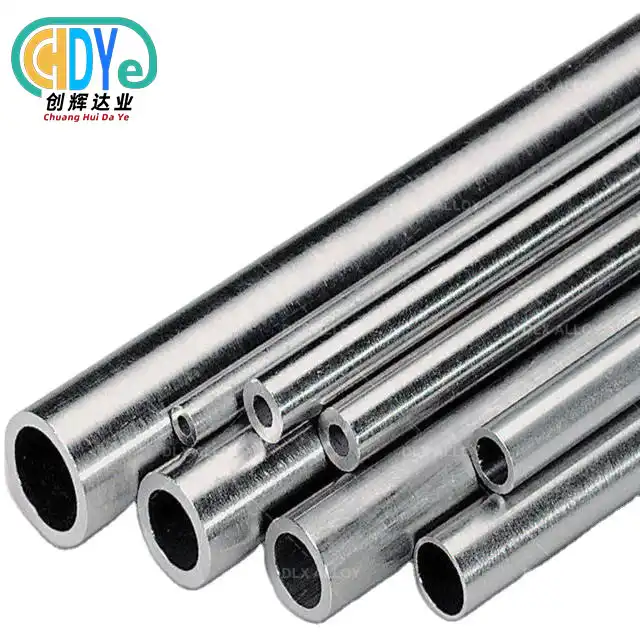
There is no single answer to the specification of niobium-titanium tube to choose from. Your working environment – from cryogenic superconducting systems to aeronautical hydraulic assemblies to biocompatible medical implants – will dictate the proper alloy grade, outer diameter, wall thickness, and surface condition. Nb-Ti seamless niobium titanium tubes are available in OD ranges of 1 to 200 mm, wall thickness ranges of 0.2 to 10 mm, and lengths up to 3,000 mm. This is the key to a good purchase selection and understanding how these criteria relate to your application needs.
Understanding Niobium Titanium Tubes: Properties and Applications
What Makes Nb-Ti Alloy Exceptional?
Nb-Ti alloy is produced by sintering alloyed powder and melting in a vacuum electrode arc furnace or in an electron-beam furnace. The obtained material has a density of 8.6-8.7 g/cm$^3$, a superconducting transition temperature in the range of 8 K to 10 K, and a tensile strength of more than 480 MPa. In addition, the addition of trace elements to the base alloy may further improve the superconducting performance, giving it a flexible platform for demanding engineering environments.
The most common grades are Nb-47Ti and Nb-50Ti, each designed for different service circumstances. The alloy is also available as sheet, bar, wire, and sputtering targets, in addition to tubes, which is crucial to know if you are planning a multi-component procurement strategy.
Where Nb-Ti Tubes Are Used
The tube form factor helps overcome the structural rigidity problems associated with pure niobium components and provides a cost-competitive alternative to tantalum in corrosive processing settings. The main application areas are:
- Seamless Nb-Ti tubes for aerospace structural components. Excellent strength-to-weight ratio for hydraulic lines and propulsion supports when every gram counts. Their moderate heat resistance and dimensional stability under cyclic stress are a solid option for flight-critical systems.
- Surgical equipment and medical implants: Titanium has excellent biocompatibility due to the natural oxide layer. This feature is retained in the Nb-Ti alloy form with increased mechanical strength, which enables the creation of load-bearing implants that must work reliably over decades inside the human body.
- Production of superconducting magnets: Nb-Ti tubes are used as diffusion barrier sleeves during the production of multifilamentary billets for MRI machines, NMR spectrometers, and particle accelerators such as the LHC to avoid copper contamination and preserve the superconducting architecture.
These three application clusters make up the bulk of the world market for Nb-Ti tubular products. Each cluster has particular expectations on dimensional tolerances and surface condition.
Comparing Niobium Titanium Tubes with Other Materials
Material selection for procurement teams often narrows down to stainless steel, pure titanium, copper, or pure niobium. Each option has a valid place in the correct situation. None matches the whole performance profile of the Nb-Ti alloy.
Stainless steel is denser, does not superconduct, and corrodes in halide-rich conditions. Pure titanium has good biocompatibility but has reduced tensile strength at high cyclic stress. Copper is the material of choice for thermal and electrical conductivity applications, but it cannot be used as a structural tube in high-pressure or high-temperature systems. Pure niobium titanium tube has a larger density than Nb-Ti alloy and a lower upper critical magnetic field, so it is less appropriate for high-field magnet applications.
The titanium concentration in Nb-Ti alloy yields a self-passivating oxide coating that is resistant to assault by nitric and hydrochloric acid. This feature pushes the alloy ahead of pure niobium in chemical processing settings. In addition, the workability advantage of the alloy compared to pure refractory metals allows cold drawing and precise shaping, therefore lowering the manufacturing costs throughout the component lifespan. For procurement managers looking to optimize total cost of ownership rather than unit pricing, Nb-Ti seamless tubes are always a strong value case.
Selecting the Right Niobium Titanium Tube Specifications for Your Application
Core Dimensional Parameters
The selection procedure for specifications starts with the four measurable parameters: outer diameter, wall thickness, length, and alloy grade. Available OD from 1 mm to 200 mm. Wall thickness from 0.2 mm to 10 mm. Cut lengths up to 3,000 mm. Getting the wall thickness right is very important – smaller walls save weight and enhance flexibility for medical catheter assemblies, while thicker walls provide the burst pressure rating necessary in aircraft hydraulic circuits.
Alloy Grade and Surface Condition
Nb-47Ti and Nb-50Ti are the two main grades. Nb-50Ti has a slightly greater critical current density and is hence the material of choice for high-field magnet operations. Nb-47Ti has somewhat greater ductility, which is useful in applications involving deep-draw forming or welded structures. Corrosion initiation resistance and weld preparation needs depend on the surface state (bright annealed, pickled, or manually polished). Medical-grade parts usually need a polished inner bore to prevent particle retention.
Certification and Compliance Requirements
The most generally cited standards in aerospace procurement for qualifying superconducting alloys are AMS and ASTM B884. Medical equipment providers often request ISO 10993 biocompatibility paperwork and complete material traceability. Chemical composition verification using ICP-OES or GDMS is carried out to guarantee that interstitial impurities (O, N, H, C) are less than 150 ppm to avoid embrittlement in service. Confirming that your supplier has these certifications before placing an order prevents expensive qualification delays downstream.
Procurement Insights: How to Source High-Quality Nb-Ti Tubing
But catalog availability is just part of the story of reliable sourcing. ISO 9001:2015-certified suppliers have documented control over raw material inspection, melting and forging settings, machining tolerances, and final packing, with each step traceable back to the initial heat number. Aerospace Prime Contractors and Medical OEMs are under regulatory assessment, and this traceability chain is non-negotiable.
The pricing of Nb-Ti seamless niobium titanium tubes is influenced by the volatility of raw material costs, the complexity of dimensions, and the number of orders. Smaller OD ranges and tighter wall tolerances need longer drawing schedules and so attract higher per-unit expenses. Blanket-order contracts with a reputable manufacturer may help you lock in price for multi-quarter procurement cycles, while ensuring production slot priority. Logistics lead times vary by the complexity of specifications. Standard measurements normally ship in four to six weeks; special alloy compositions or extreme dimensional ranges may take eight to twelve weeks after order confirmation.
Case Studies: Successful Applications of Niobium Titanium Tubes
Material datasheets are a good start, but there is no substitute for real-world performance data to support specification choices. A European aerospace integrator purchased seamless Nb-Ti tubes with an OD of 25 mm and a wall thickness of 2 mm for high-pressure hydraulic manifolds for a regional aircraft program. Weight savings over stainless steel alternatives topped 18%, within the program mass budget, and with no sacrifice in burst pressure certification.
A future-generation spinal implant system medical device maker requested Nb-50Ti tubing with a 6 mm OD and 0.5 mm wall thickness. The alloy’s biocompatibility and its fatigue tolerance to cyclic spinal stress lowered device failure rates during bench testing by a considerable margin over the historical pure-titanium design.
Nb-Ti barrier tubes were employed as cladding sleeves for a multifilamentary billet fabricated by a research institution in the area of scientific instruments for a small superconducting magnet. The dimensional consistency of the tubes, determined by laser micrometer and eddy current testing, guaranteed a consistent filament geometry after drawing, with a direct positive impact on the homogeneity of the magnet at the working field.
Conclusion
The proper specification of niobium titanium tube is driven by the dimensional requirements, alloy grade, surface finish, and certifications for your application’s mechanical, thermal, and regulatory requirements. When you are procuring aircraft parts, medical implants, or superconducting systems, the specification choices you make early in the procurement cycle have a direct influence on downstream performance and compliance. If you work with a company that controls the whole production chain from ingot melting to final inspection, you remove unpredictability and safeguard your program timetable.
FAQ
Q1. What is the density of niobium-titanium alloy tubes?
A: Nb-Ti alloy tubes have a density of 8.6–8.7 g/cm³, which is considerably lower than pure niobium at 8.57 g/cm³ when accounting for the titanium dilution effect, and significantly lighter than comparable stainless steel tubing.
Q2. What wall thickness range is available?
A: Standard production covers wall thicknesses from 0.2 mm to 10 mm. Thinner walls suit medical catheter and cryogenic sleeve applications; thicker walls address high-pressure structural requirements in aerospace and chemical processing.
Q3. Can these tubes be welded?
A: Yes. Electron beam welding or TIG welding inside a vacuum or high-purity inert gas chamber is mandatory. Exposure to ambient oxygen or nitrogen during welding causes immediate embrittlement that compromises structural integrity.
Q4. How are dimensions verified before shipment?
A: Dimensional verification uses laser micrometers for OD and wall thickness, ultrasonic testing per ASTM E213 for internal integrity, and eddy current testing per ASTM E426 for surface condition.
Q5. What certifications should I request from my supplier?
A: Request ISO 9001:2015 quality management documentation, ASTM B884 compliance records for superconducting grades, full chemical composition reports, and material traceability certificates linking each tube to its original melt heat.
Partner with Chuanghui Daye for Your Next Nb-Ti Tube Order
Shaanxi Chuanghui Daye supplies precision-manufactured niobium titanium tube products directly from our facility in Baoji—China's recognized center of titanium and refractory metal production. As an ISO 9001:2015-certified niobium titanium tube manufacturer with over 30 years of industry expertise, we offer seamless construction, full traceability documentation, and flexible order quantities from prototype to production scale. Send your dimensional requirements and application details to info@chdymetal.com to request a quote today.
References
1. Collings, E. W. Applied Superconductivity, Metallurgy, and Physics of Titanium Alloys. Plenum Press, 1986.
2. Lee, P. J. "Niobium-Titanium Superconducting Alloys." ASM Handbook, Volume 2: Properties and Selection: Nonferrous Alloys and Special-Purpose Materials. ASM International, 1990.
3. Banno, N. "Recent Development of Nb-Ti and Nb₃Sn Superconducting Wires." IEEE Transactions on Applied Superconductivity, 2012.
4. ASTM International. ASTM B884: Standard Specification for Unalloyed Niobium-Titanium Alloy Wire for Superconducting Applications. ASTM International, 2021.
5. Lütjering, G., and Williams, J. C. Titanium. 2nd ed. Springer, 2007.
6. Bruzzone, P., et al. "High Field Magnets on the Roadmap of Superconductivity Applications." Superconductor Science and Technology, 2018.
Learn about our latest products and discounts through SMS or email