- English
- French
- German
- Portuguese
- Spanish
- Russian
- Japanese
- Korean
- Arabic
- Greek
- German
- Turkish
- Italian
- Danish
- Romanian
- Indonesian
- Czech
- Afrikaans
- Swedish
- Polish
- Basque
- Catalan
- Esperanto
- Hindi
- Lao
- Albanian
- Amharic
- Armenian
- Azerbaijani
- Belarusian
- Bengali
- Bosnian
- Bulgarian
- Cebuano
- Chichewa
- Corsican
- Croatian
- Dutch
- Estonian
- Filipino
- Finnish
- Frisian
- Galician
- Georgian
- Gujarati
- Haitian
- Hausa
- Hawaiian
- Hebrew
- Hmong
- Hungarian
- Icelandic
- Igbo
- Javanese
- Kannada
- Kazakh
- Khmer
- Kurdish
- Kyrgyz
- Latin
- Latvian
- Lithuanian
- Luxembou..
- Macedonian
- Malagasy
- Malay
- Malayalam
- Maltese
- Maori
- Marathi
- Mongolian
- Burmese
- Nepali
- Norwegian
- Pashto
- Persian
- Punjabi
- Serbian
- Sesotho
- Sinhala
- Slovak
- Slovenian
- Somali
- Samoan
- Scots Gaelic
- Shona
- Sindhi
- Sundanese
- Swahili
- Tajik
- Tamil
- Telugu
- Thai
- Ukrainian
- Urdu
- Uzbek
- Vietnamese
- Welsh
- Xhosa
- Yiddish
- Yoruba
- Zulu
Why are pure niobium round bars used in medical technology?
Due to their exceptional biocompatibility, superb corrosion resistance in bodily fluids, and mechanical stability, pure niobium round bars have become essential in medical technology. These very pure niobium rods, which are usually more than 99.9% pure, don't get rejected by the immune system and keep their shape in the complex chemical environment of the human body. Pharmaceutical companies are using niobium more and more for implantable devices, surgical tools, and testing equipment because it is lightweight enough to keep patients comfortable and strong enough to last for a long time.
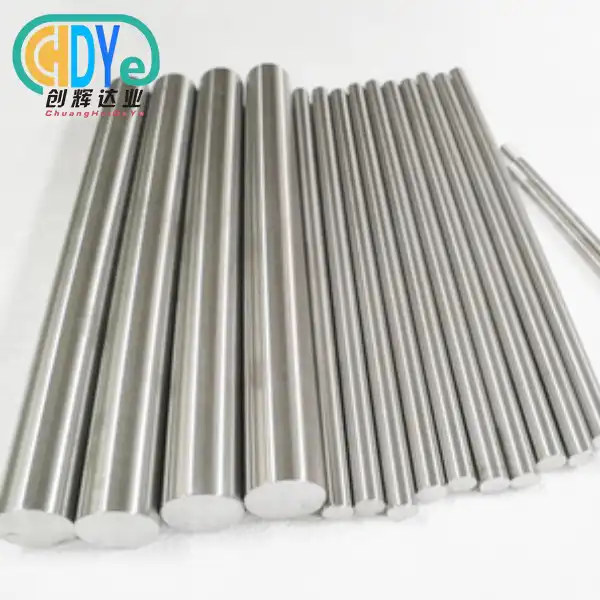
Understanding Pure Niobium Round Bars and Their Properties
Composition and Manufacturing Excellence
When electron beam melting methods are used to make pure niobium round bars for medical uses, they have to follow strict production standards. This high-tech vacuum melting method keeps the amount of interstitial impurity below 400 ppm, which has a direct effect on how flexible and biocompatible the material is. We use cutting-edge heating, casting, and rolling equipment at Shaanxi Chuanghui Daye Metal Material Co., Ltd. to make niobium bars that are purer than 99.9%. Careful monitoring during casting and rolling keeps the grain structure at its best, usually at or below ASTM No. 5 size. This microstructural uniformity ensures that each bar has the same mechanical properties. This is very important for medical uses where the behavior of the material needs to be stable and predictable.
From inspecting the raw materials to the final packing, our production method has several quality checkpoints that are in line with ISO 9001:2015 standards. Glow Discharge Mass Spectrometry is used to check the interstitial impurity content of every production batch. This makes sure that the levels of oxygen, nitrogen, hydrogen, and carbon stay within accepted ranges for biomedical uses.
Critical Physical and Chemical Characteristics
Niobium has a density of 8.57 g/cm³, which makes it much lighter than tantalum while still having about the same level of corrosion protection in many living settings. This density benefit means that the implants are lighter, which makes them more comfortable for patients who have to wear them for long periods of time. When it comes to load-bearing uses, tensile strengths between 200 and 350 MPa are strong enough without being too fragile like ceramics or too heavy like heavier metals.
Niobium is very resistant to rusting in body fluids that contain chlorides, proteins, and different pH levels. Niobium has a steady passive oxide layer that heals itself when it gets harmed, unlike some types of stainless steel that can show pitting corrosion or crevice corrosion in physiological settings. This ability to fix itself is very important for implants that are meant to work for decades inside the body.
The material's high flexibility makes it easier to machine, which is needed to make complicated shapes for current medical devices. Surface finishes can be chosen from polished to as-rolled, based on the needs of the application. Polished surfaces are better for keeping germs from sticking to them.
Regulatory Compliance and Certification Standards
Medical-grade niobium has to pass strict biocompatibility tests according to ISO 10993 guidelines. These thorough tests look at cytotoxicity, sensitivity, irritation, systemic toxicity, and effects on insertion. When compared to other options, niobium constantly shows great performance across these factors, with almost no tissue inflammation and almost no metal ion release.
Each production lot comes with traceability paperwork, which helps medical device makers keep full material pedigree records as needed by regulatory bodies like the FDA and the European Medicines Agency. There are certificates of chemical composition, test reports for mechanical properties, and records of heat treatment in this paperwork trail.
Why Pure Niobium Round Bars Are Preferred in Medical Technology
Superior Biocompatibility and Tissue Integration
The biological inertness of high-purity niobium represents its most valuable attribute for medical applications. Clinical tests show that niobium implants cause a much weaker foreign body reaction than stainless steel or cobalt-chromium devices, with a much smaller fibrous capsule forming around them. This good tissue reaction makes implants last longer and lowers the risks of problems related to chronic inflammation.
Niobium's oxide layer, which is mostly Nb₂O₅, behaves chemically steadily in pH ranges that are normal for living things. This stability stops the metal ions from slowly dissolving, which could lead to sensitization responses or worries about systemic buildup. People who are sensitive to metals can usually handle niobium implants without any problems. This means that people who are allergic to nickel or chromium now have more treatment choices.
Mechanical Properties Enabling Precise Customization
The material's excellent formability permits the creation of intricate geometries essential for modern medical devices. Cardiovascular stents, orthopedic pins, and dental implant components benefit from pure niobium round bars being able to undergo cold working without excessive springback or work hardening. This malleability reduces manufacturing complexity and associated costs while enabling design innovations that improve clinical outcomes.
Thermal stability allows niobium components to withstand repeated sterilization cycles without dimensional changes or property degradation. Autoclaving, gamma irradiation, and ethylene oxide sterilization methods can be employed without compromising structural integrity, providing flexibility in device processing workflows.
Compliance with International Medical Device Standards
When manufacturers get niobium bars, the materials are always the same, which makes regulatory reports easier. The approval process for new medical equipment is sped up by the fact that pure niobium has predictable performance traits and a lot of biocompatibility data. Having a precedent with governmental bodies cuts down on the time it takes to get a product to market and the costs that come with it.
Niobium's dependability in tough medical situations is shown by its real-world uses. Hypoallergenic jewelry for new piercings uses niobium's ability to be gentle on tissue, and medical tools use it because it doesn't rust when exposed to body fluids and harsh cleaning solutions for long periods of time. Researchers working on the next generation of neural connections choose niobium for electrode arrays because it behaves consistently with electricity in brain tissue.
Comparison of Pure Niobium Round Bars with Alternative Materials in the Medical Industry
Niobium Versus Titanium Alloys
Titanium and its alloys are the most popular types of medical implants because they are biocompatible and strong for their weight. When pure niobium round bars are compared to titanium, they show clear advantages in certain situations. Niobium is more flexible than other metals, so it can be bent more tightly and formed in more complex ways during the device-making process. In cardiovascular stents that need accurate placement qualities, this feature is useful.
The levels of corrosion protection in these materials are not the same. Both are very good at resisting rust in general, but niobium is better at resisting certain active media that are found in some medical settings. Because of the difference in price, titanium is better for high-volume uses, while niobium's unique set of qualities makes it worth more in narrow uses where its benefits can be measured in the medical field.
Niobium Compared to Stainless Steel Options
Surgical-grade stainless steels are still a cheap option for a lot of medical devices and temporary implants. Biocompatibility tests show that niobium is better than stainless steel because it doesn't release nickel as much as stainless steel does, which makes it harder to use with sensitive people. Because there is no nickel in it, there is no main sensitization route. This means that a wider range of patients can use it.
Niobium is better at resisting rust, which makes it a better choice for long-term implants. Stainless steels can rust in places where there is a lot of salt, which could cause an implant to fail or cause tissue inflammation. Niobium's stable passive layer offers consistent protection over long times of implantation, which lowers the number of surgeries that need to be redone.
Evaluation Against Tantalum Performance
Tantalum is another safe refractory metal that is used in medical technology. Tantalum and niobium are both very good at being compatible with tissues and resistant to rust. Choosing between these materials is often based on how much they cost and what practical properties are needed. Niobium is about half as dense as tantalum, which makes it useful for situations where implant weight affects patient comfort or device performance.
When similar performance traits meet application needs, cost-efficiency research always favors niobium. Because of limited global tantalum supplies and higher raw material prices, niobium is an appealing option for medical device companies that want to keep quality standards while lowering production costs.
Procurement Guide for Pure Niobium Round Bars in Medical Technology
Essential Supplier Qualification Criteria
When buying pure niobium round bars for medical uses, procurement workers need to make sure that the supplier follows the right quality control systems. ISO 9001:2015 certification is the standard and shows that a business follows systematic process control and ongoing growth practices. Suppliers who work with medical markets should show proof that their materials can be tracked, that their chemical makeup stays the same, and that their mechanical properties can be checked.
Assessment of manufacturing skill goes beyond the study of certification. When you visit a supplier's melting facilities, checking tools, and quality control labs, you can be sure of their expert knowledge. Having electron beam furnaces, ultrasound testing tools, and the ability to do metallographic analysis shows that a lot of money has been put into building up quality assurance infrastructure.
Specification Development and Material Selection
Medical gadget makers have to be very specific about the grade of niobium they use, as well as the size and finish of the surface. Tolerances for diameters, lengths, and straightness have an effect on subsequent cutting steps and the performance of the end device. Shaanxi Chuanghui Daye Metal Material Co., Ltd. has diameters from 3mm to 350mm and special lengths up to 1000mm, so they can meet the needs of a wide range of applications, from small surgery tools to large orthopedic implants.
Choosing between finished and as-rolled finishes for the surface affects the next steps in the preparation. When surfaces are polished, they become smoother so that Ra values are below 0.8µm. This makes it less likely for bacteria to stick to implanted parts. As-rolled finishing might be good enough for situations where a lot of cutting is done to the material, and the original surface features are lost.
Pricing Structures and Volume Considerations
Niobium prices are based on the cost of the raw material, the quality standards, and the size needs. Higher purity types cost more, but they are worth it because they are more biocompatible and less likely to cause bad tissue responses. For producers whose inventory needs are controlled and whose consumption habits are predictable, volume promises are a great way to get better prices and production scheduling.
When planning logistics, you have to think about things like foreign shipping, government rules, and storage conditions. Niobium is more stable than volatile metals, which makes it easier to handle. However, if it is packaged properly, surface contamination could happen, which could make it less useful for medical purposes. Suppliers that have been around for a while offer a lot of paperwork to help with customs clearing and regulatory compliance checks.
Future Trends and Innovations in Medical Applications of Pure Niobium Round Bars
Emerging Implantable Device Technologies
New uses for pure niobium round bars are being created because of progress in invasive cardiology. Newer drug-eluting stents use niobium metals that are designed to control the release of drugs while keeping the mechanical qualities needed to support the vessel. The radiopacity of the material makes it easier to see through a fluoroscopic microscope during placement processes. This improves the accuracy of the operation and the safety of the patient.
Neurostimulation devices are another area of growth that uses niobium's special qualities. Niobium's stable electrical contact with neural tissue makes deep-brain stimulation electrodes and spinal cord stimulator leads more effective by reducing inflammatory reactions that can hurt treatment. Niobium-based electrode arrays are being looked into by researchers for use in brain-computer connections. For these uses, long-term biocompatibility is very important.
Advanced Manufacturing Techniques and New Grades
Niobium powders are being used more and more in additive manufacturing to make devices that are custom-made for each patient and have complex internal structures. Selective laser melting and electron beam melting make shapes with pores that help bone osseointegration in orthopedic uses while lowering the weight of the implant. These new ways of making things need high-purity feedstock with controlled particle size ranges. Only certain providers can meet these needs.
In study institutions and material science labs, new niobium metals are still being made that are specifically designed for medical uses. Adding alloys that improve radiopacity, change the material's elastic stiffness, or give it antimicrobial qualities makes it more useful in more situations. When procurement managers work with innovative sources, they can get these new materials before anyone else. This gives them a competitive edge in medical technology markets that are changing quickly.
Strategic Procurement Positioning
Companies that make medical devices can benefit from forming strategic relationships with niobium providers they can trust to help with product development. During the design process, technical collaboration makes sure that the material specs match the skills of the manufacturer and the rules set by the government. Rapid prototyping and flexible small-batch production are two services that suppliers give to meet the needs of clinical trials and test production runs before full-scale commercialization.
When thinking about supply chain resilience, companies with a variety of sourcing methods and good inventory management are more likely to be chosen. Because medical-grade niobium is so specialized, it is hard to find suppliers. Building relationships with skilled makers is important for long-term business continuity. Companies that are located in areas that are already good at making rare metals, like Baoji, China's "Titanium Capital," use the local knowledge and better facilities to make their supplies more reliable.
Conclusion
When it comes to medical technology materials, pure niobium round bars play a crucial role because they solve problems that other metals can't. When you combine excellent biocompatibility, corrosion resistance, and mechanical workability, you can make medical device improvements that help patients in a lot of different therapy areas. When purchasing niobium material, procurement professionals need to make sure that suppliers are qualified, materials can be tracked, and partnerships are built so that they can always get high-quality goods that meet strict legal requirements. As medical technology improves and more advanced implanted systems and personalized treatment devices are made, niobium will play a bigger part. This is because it has a history of good clinical performance and is a versatile material that encourages new ideas in healthcare delivery.
FAQ
Q: How does niobium's corrosion resistance enhance medical device lifespan?
A: Niobium makes a steady, self-healing passive oxide layer (Nb₂O₅) that keeps body fluids from attacking the metal below. When this oxide gets damaged, it heals itself on its own, so it can protect against damage for decades without breaking down over time like less stable materials do.
Q: Can pure niobium round bars be customized for specific medical applications?
A: Dimensions, surface finishes, and additional processing processes can all be changed to fit your needs. Manufacturers can set accurate limits for width, length, and surface conditions. The material is very easy to work with, which makes it possible to make complicated shapes needed for specialized medical devices using both traditional and modern manufacturing methods.
Q: What certifications are essential for medical-grade niobium materials?
A: The most important thing is to have ISO 9001:2015 quality control approval. ASTM B392 standards must be met by the material for pure niobium round bars and niobium alloy bars. Biocompatibility testing according to ISO 10993 guidelines makes sure that it is safe to touch tissue. Medical device laws require full tracking documents for regulatory applications and post-market monitoring activities.
Partner with Chuanghui Daye for Medical-Grade Niobium Solutions
Shaanxi Chuanghui Daye Metal Material Co., Ltd. stands ready to support your medical device manufacturing requirements with premium pure niobium round bars exceeding 99.9% purity. Located in Baoji High-tech Development Zone, the heart of China's rare metal industry, we combine over 30 years of metallurgical expertise with advanced manufacturing capabilities, including electron beam furnaces and precision machining equipment. Our ISO 9001:2015-certified production processes ensure consistent material quality with full traceability documentation supporting your regulatory compliance needs. Whether you require standard dimensions or custom specifications, our engineering team collaborates with you to develop optimal material solutions. Global procurement professionals seeking a dependable pure niobium round bar supplier can rely on our competitive factory-direct pricing and reliable delivery schedules. Contact us today at info@chdymetal.com to discuss your medical technology material requirements and receive a detailed quotation tailored to your project specifications.
References
1. Davis, J.R. (2000). Nickel, Cobalt, and Their Alloys. ASM International Handbook Committee, Materials Park, Ohio: ASM International.
2. Rack, H.J. and Qazi, J.I. (2006). Titanium alloys for biomedical applications. Materials Science and Engineering: C, 26(8), 1269-1277.
3. Niinomi, M. (2008). Mechanical biocompatibilities of titanium alloys for biomedical applications. Journal of the Mechanical Behavior of Biomedical Materials, 1(1), 30-42.
4. Hermawan, H. (2012). Biodegradable Metals: From Concept to Applications. Heidelberg: Springer-Verlag Berlin.
5. Black, J. and Hastings, G. (1998). Handbook of Biomaterial Properties. London: Chapman & Hall Medical.
6. Brunette, D.M., Tengvall, P., Textor, M., and Thomsen, P. (2001). Titanium in Medicine: Material Science, Surface Science, Engineering, Biological Responses and Medical Applications. Berlin: Springer.
Learn about our latest products and discounts through SMS or email