- English
- French
- German
- Portuguese
- Spanish
- Russian
- Japanese
- Korean
- Arabic
- Greek
- German
- Turkish
- Italian
- Danish
- Romanian
- Indonesian
- Czech
- Afrikaans
- Swedish
- Polish
- Basque
- Catalan
- Esperanto
- Hindi
- Lao
- Albanian
- Amharic
- Armenian
- Azerbaijani
- Belarusian
- Bengali
- Bosnian
- Bulgarian
- Cebuano
- Chichewa
- Corsican
- Croatian
- Dutch
- Estonian
- Filipino
- Finnish
- Frisian
- Galician
- Georgian
- Gujarati
- Haitian
- Hausa
- Hawaiian
- Hebrew
- Hmong
- Hungarian
- Icelandic
- Igbo
- Javanese
- Kannada
- Kazakh
- Khmer
- Kurdish
- Kyrgyz
- Latin
- Latvian
- Lithuanian
- Luxembou..
- Macedonian
- Malagasy
- Malay
- Malayalam
- Maltese
- Maori
- Marathi
- Mongolian
- Burmese
- Nepali
- Norwegian
- Pashto
- Persian
- Punjabi
- Serbian
- Sesotho
- Sinhala
- Slovak
- Slovenian
- Somali
- Samoan
- Scots Gaelic
- Shona
- Sindhi
- Sundanese
- Swahili
- Tajik
- Tamil
- Telugu
- Thai
- Ukrainian
- Urdu
- Uzbek
- Vietnamese
- Welsh
- Xhosa
- Yiddish
- Yoruba
- Zulu
Why Straight Titanium Wire Is Essential in Modern Manufacturing?
Straight titanium wire has become a cornerstone material in modern manufacturing, transforming how industries approach precision engineering challenges. This specialized form of titanium represents a processed metallurgical product that eliminates the coil memory and stress inherent in traditional spooled wire, delivering exceptional dimensional stability and mechanical performance. Manufacturing facilities worldwide increasingly rely on this material for applications where geometric precision, corrosion resistance, and biocompatibility are non-negotiable requirements, making it an indispensable component in advancing technological capabilities across aerospace, medical, electronics, and chemical processing sectors.
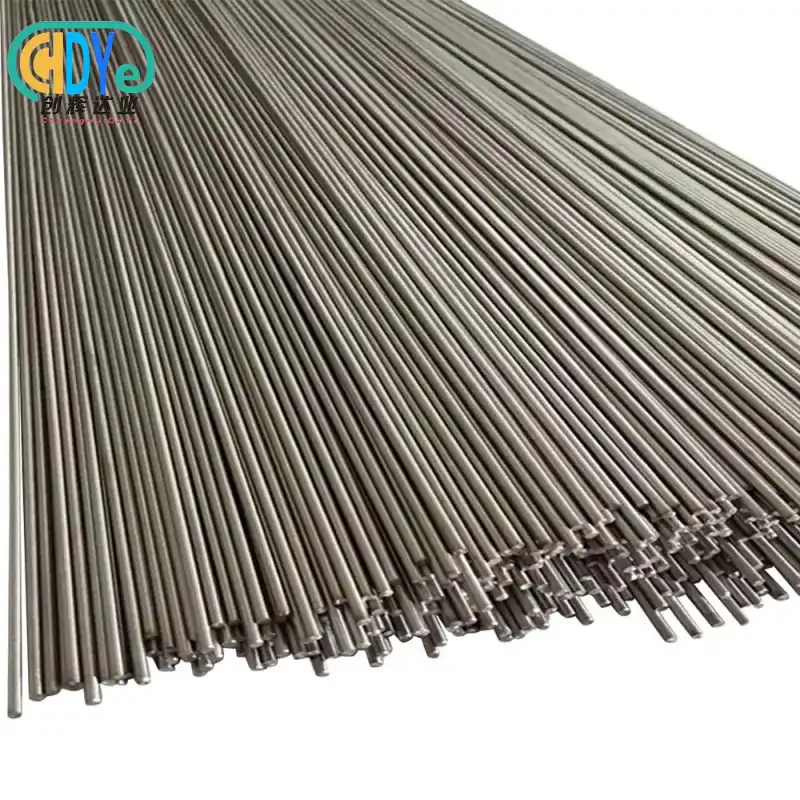
Understanding Straight Titanium Wire: Properties and Production
Modern manufacturing demands materials that can withstand extreme conditions while maintaining dimensional accuracy and surface quality. Titanium wire in its straightened form addresses these critical requirements through advanced metallurgical processing that transforms raw titanium into a precision-engineered product.
Advanced Manufacturing Processes
High-quality titanium wire is made using advanced vacuum heating technology that makes sure the material is pure and consistent. The Shaanxi Chuanghui Daye Metal Material Co., Ltd. in Baoji, China's "Titanium Capital," uses precision bending and multi-pass drawing tools to make wire that meets the highest standards. Starting with titanium sponge, the process includes controlled melting, extrusion, and mechanical bending steps that get rid of material stress and keep linear variation below 0.1 mm per meter. The controlled annealing process makes the microstructure of the wire uniform, which is important for making sure that the metallographic qualities stay fixed so that the wire always works well. This way of making things, along with real-time process tracking and automated inspection systems, makes sure that each batch is the same, which is what procurement pros need for important jobs.
Material Properties and Specifications
Titanium is one of the best industrial materials because of its unique qualities. This material's density of 4.54g/cm³ makes it lighter than steel (43% lighter) while still being stronger mechanically. The freezing point is 1942K, which means it can withstand high temperatures and still be used at 600°C without losing its mechanical structure. Chuanghui Daye makes titanium wire with widths from 0.5 mm to 7.0 mm and special lengths from 500 mm to 3000 mm to meet the needs of different applications. The substance has a low magnetic permeability, which means it can be used in computer and sensor settings where magnetic interference needs to be kept to a minimum.
Advantages of Straight Titanium Wire in Modern Manufacturing
Manufacturing engineers frequently choose straight titanium wire over alternative materials due to its better performance qualities and long-term cost advantages. When you put together mechanical properties and processing benefits, you get a strong value offer for tough uses.
Superior Mechanical Performance
Titanium wire is equivalent to steel in terms of mechanical strength, but it is much lighter. This material is twice as strong as aluminum and five times as strong as magnesium. This means that structural engineers can make lighter buildings without sacrificing their ability to hold weight. The stress-relieved finish keeps the metal from twisting or bending while it is being welded or machined, which cuts down on production errors and the cost of doing more work. The material is great for high-tension and structural uses where failure is not an option because it can hold a lot of weight. Vacuum melting creates a microstructure that is regular. This makes sure that the performance is consistent along the entire length of each wire, removing weak spots that could let the system down.
Corrosion Resistance and Environmental Durability
Titanium is very resistant to corrosion, which makes it useful in chemical processes and marine uses. The material works consistently in strong acids, alkalis, and seawater, all of which would quickly wear down stainless steel options. This resistance to corrosion makes parts last a lot longer, which cuts down on upkeep and repair costs. The strong TiO2 passive layer protects against chlorides and other harsh chemicals that are typical in industrial settings. This resistance means that manufacturing systems that work in harsh circumstances will have less downtime, lower repair costs, and better working efficiency.
Applications of Straight Titanium Wire Across Industries
Precision titanium wire is very useful in many different types of production because it can be used in many different ways. Different industries use different qualities to solve their own technical problems and make products work better.
Aerospace and Defense Applications
Aerospace manufacturers utilize straight titanium wire as feedstock for producing crucial bolts, rivets, and structural parts on Swiss-style sliding headstock lathes. The better straightness stops the bar-feeder from shaking at spinning speeds above 5,000 RPM, which is necessary for making flight-critical parts with micron-level accuracy. The lightweight nature of the material directly leads to better fuel economy in airplane design. By switching to titanium parts for other materials, you can lower the weight of your aircraft, which leads to lower running costs and better performance, giving you an edge in the aerospace market.
Medical Device Manufacturing
Biocompatible titanium wire is used by companies that make medical devices to make orthopedic implants, surgical instruments, and oral tools. The material is strong enough for bone penetration uses and doesn't cause immune rejection in humans, so it meets ASTM F136 and F67 standards. Precision titanium wire is used to make Kirschner wires (K-wires), spine fixation rods, and bone pins. These tools are stable and keep their shape even when the body puts stress on them. The non-toxic and biocompatible qualities make sure that patients are safe, and the mechanical strength gives doctors the tools they need to do successful treatments.
Industrial and Electronics Sectors
Titanium wire is good for precision instrument uses because it doesn't let magnetic fields pass through it and can handle high temperatures. The material is perfect for making parts that need to stay the same size even when heated and cooled, and not pick up electromagnetic interference. Manufacturers of chemical handling equipment use titanium wire to produce corrosion-resistant components exposed to aggressive chemicals. The material's ability to maintain structural integrity in acidic and basic environments makes it indispensable for pressure vessel construction and heat exchanger applications where failure could result in catastrophic consequences.
How to Choose and Procure Straight Titanium Wire for Your Business
To buy titanium wire successfully, you need to know the scientific specs, what the dealer can do, and how quality control works. Professionals in manufacturing have to look at a lot of things to make sure that the materials they choose meet the needs of the product and the company's goals.
Technical Specification Considerations
When buying titanium wire, choosing the grade is the most important thing to think about. Grades 1 and 2 are great for regular industrial uses because they don't rust and are easy to shape. Grade 5 (Ti-6Al-4V), on the other hand, has the extra strength needed for aircraft and high-stress situations. For better biocompatibility, medical uses usually need Grade 23 (Ti-6Al-4V ELI). The standards for diameter tolerance must match the methods used later in the manufacturing process. For precise tasks, centerless grinding may be needed to achieve h7 or h8 tolerances. For general tasks, h9 tolerances may be fine. Surface finish needs can range from "as drawn" to "mirror-polished," depending on how the surface looks and how well it resists contamination.
Supplier Evaluation and Quality Assurance
While ISO 9001:2015 approval is a good start for quality control, other certifications, like AS9100 for aircraft or ISO 13485 for medical devices, are often needed for titanium uses. As part of their services, suppliers should be able to provide full traceability documents, from the source of the raw materials to the final review. For uniform quality, manufacturing source control is very important. Suppliers who can make everything themselves, from titanium sponge to finished wire, have better quality control than those who use a lot of different suppliers. Automated inspection tools and real-time process tracking show that advanced quality control is needed for important uses.
Cost Optimization Strategies
Knowing the difference between trade and custom making can help you get the best deals on goods. When you need a lot of straight titanium wire, manufacturers that offer standard lengths and diameters will usually offer better prices. On the other hand, manufacturers that offer unique specs may need longer lead times and higher unit costs. Both prices and the cost of keeping goods in stock are affected by minimum order amounts. To find a good balance between the costs of buying and the investment in inventory, you need to know how things are used and how long lead times are needed. Long-term supply deals may help you save money on prices while making sure you have the materials you need for important production plans.
Future Trends and Innovations in Titanium Wire Manufacturing
The ways and tools used to make titanium wire are always changing as technology improves. Procurement experts can predict changes in the supply chain and find new ways to improve performance by understanding new trends.
Advanced Manufacturing Technologies
Using additive manufacturing methods, titanium wire can be used for more than just standard cutting tasks. Wire arc additive manufacturing (WAAM) uses straight titanium wire as a material to make complicated shapes that can't be made any other way or would be too expensive to make. Plasma nitriding and laser surface modification are new ways to treat surfaces that improve the qualities of materials for certain uses. In addition to making the base material more biocompatible, these processes can make it less likely to wear down or increase its wear resistance.
Sustainability and Environmental Considerations
Environmental duty is becoming more and more important in manufacturing businesses when choosing materials. Titanium's ability to be recycled and long useful life make it a good choice for sustainability goals while also having less of an effect on the environment than options with shorter lives. Supply chain optimization tries to cut down on energy use and pollution from movement during the whole production process. As environmental laws get stricter around the world, tactics for sourcing goods locally and making things that use less energy become competitive benefits.
Conclusion
Straight titanium wire plays a crucial role in modern manufacturing due to its special mix of mechanical qualities, dimensional accuracy, and flexibility in application. This material is used by manufacturing businesses all over the world to solve difficult engineering problems while lowering weight, making materials more resistant to rust, and making sure they are biocompatible. As production methods keep getting better and more uses are found for titanium wire, it becomes an even more important material for competitive industrial operations that want to improve performance and reliability.
FAQ
Q: What makes straight titanium wire different from regular coiled wire?
A: Straight titanium wire goes through mechanical bending and stress release steps that get rid of the coil memory and helix issues that come with spooled production. This process makes sure that the linear deviation is less than 0.1 mm per meter. This keeps automatic production systems from getting stuck and machining operations from having problems with spring-back.
Q: Which industries benefit most from using straight titanium wire?
A: The businesses that benefit the most from straight titanium wire are aerospace, medical device production, chemical processing, and electronics. These areas need strong materials that don't rust, are biocompatible, and are accurate in size even when they're used in harsh circumstances.
Q: How do I determine the correct grade of titanium wire for my application?
A: Choosing a grade is based on certain achievement standards. For general use, Grades 1 and 2 are very resistant to rust. Grade 5 (Ti-6Al-4V) is stronger and is used in aircraft, and Grade 23 (Ti-6Al-4V ELI) is biocompatible and is used in medicine. Talking to expert suppliers can help you match the qualities of a material to the needs of an application.
Q: What quality certifications should I look for in titanium wire suppliers?
A: ISO 9001:2015 is a basic quality management system certification. Certifications specific to a field, like AS9100 for aerospace or ISO 13485 for medical devices, show that the company has unique skills. Compliance with ASTM B863, ASTM F136, and AWS A5.16 standards makes sure that the material meets the performance standards set by the business.
Partner with Chuanghui Daye for Premium Straight Titanium Wire Solutions
Shaanxi Chuanghui Daye sells precisely designed straight titanium wire that is made in Baoji's advanced factories using cutting-edge vacuum melting and multi-pass drawing methods. Our production methods are ISO 9001:2015 approved, so the quality is always the same from the titanium sponge to the finished wire. This gives you full traceability and accurate measurements for your important uses. We are a reliable provider of straight titanium wire with more than 30 years of experience in the field. To meet your exact needs, we can cut the wire to any length, smooth it to a mirror finish, and provide technical support. Get in touch with us at info@chdymetal.com to talk about your needs and see for yourself why production workers all over the world trust us with their most difficult projects.
References
1. Boyer, R., Welsch, G., & Collings, E.W. "Materials Properties Handbook: Titanium Alloys." ASM International, Materials Park, Ohio.
2. Donachie, Matthew J. "Titanium: A Technical Guide, 2nd Edition." ASM International Technical Publications.
3. Peters, M., Kumpfert, J., Ward, C.H., & Leyens, C. "Titanium Alloys for Aerospace Applications." Advanced Engineering Materials, Vol. 5, No. 6.
4. Rack, H.J. & Qazi, J.I. "Titanium alloys for biomedical applications." Materials Science and Engineering: C, Biomimetic and Supramolecular Systems.
5. Lutjering, G. & Williams, J.C. "Titanium Engineering Materials and Processes." Springer-Verlag Berlin Heidelberg.
6. American Society for Testing and Materials. "ASTM B863-14 Standard Specification for Titanium and Titanium Alloy Wire." ASTM International Standards.
Learn about our latest products and discounts through SMS or email