- English
- French
- German
- Portuguese
- Spanish
- Russian
- Japanese
- Korean
- Arabic
- Greek
- German
- Turkish
- Italian
- Danish
- Romanian
- Indonesian
- Czech
- Afrikaans
- Swedish
- Polish
- Basque
- Catalan
- Esperanto
- Hindi
- Lao
- Albanian
- Amharic
- Armenian
- Azerbaijani
- Belarusian
- Bengali
- Bosnian
- Bulgarian
- Cebuano
- Chichewa
- Corsican
- Croatian
- Dutch
- Estonian
- Filipino
- Finnish
- Frisian
- Galician
- Georgian
- Gujarati
- Haitian
- Hausa
- Hawaiian
- Hebrew
- Hmong
- Hungarian
- Icelandic
- Igbo
- Javanese
- Kannada
- Kazakh
- Khmer
- Kurdish
- Kyrgyz
- Latin
- Latvian
- Lithuanian
- Luxembou..
- Macedonian
- Malagasy
- Malay
- Malayalam
- Maltese
- Maori
- Marathi
- Mongolian
- Burmese
- Nepali
- Norwegian
- Pashto
- Persian
- Punjabi
- Serbian
- Sesotho
- Sinhala
- Slovak
- Slovenian
- Somali
- Samoan
- Scots Gaelic
- Shona
- Sindhi
- Sundanese
- Swahili
- Tajik
- Tamil
- Telugu
- Thai
- Ukrainian
- Urdu
- Uzbek
- Vietnamese
- Welsh
- Xhosa
- Yiddish
- Yoruba
- Zulu
6al 4v titanium round bar Specifications and Buying Guide
Before choosing the right 6Al 4V titanium round bar for your business, you must know what it is and how to obtain it. Titanium is 90%, aluminium is 6%, and vanadium is 4%. You can pull this Grade 5 titanium metal apart at 895 MPa, and it will still be 828 MPa strong. However, it is 40% lighter than steel. It's important to know about technical standards like ASTM B348, AMS 4928, quality certificates, size limits, and source proof steps to source reliably. This helps buying workers, flight engineers, and people who make medical devices make good decisions.
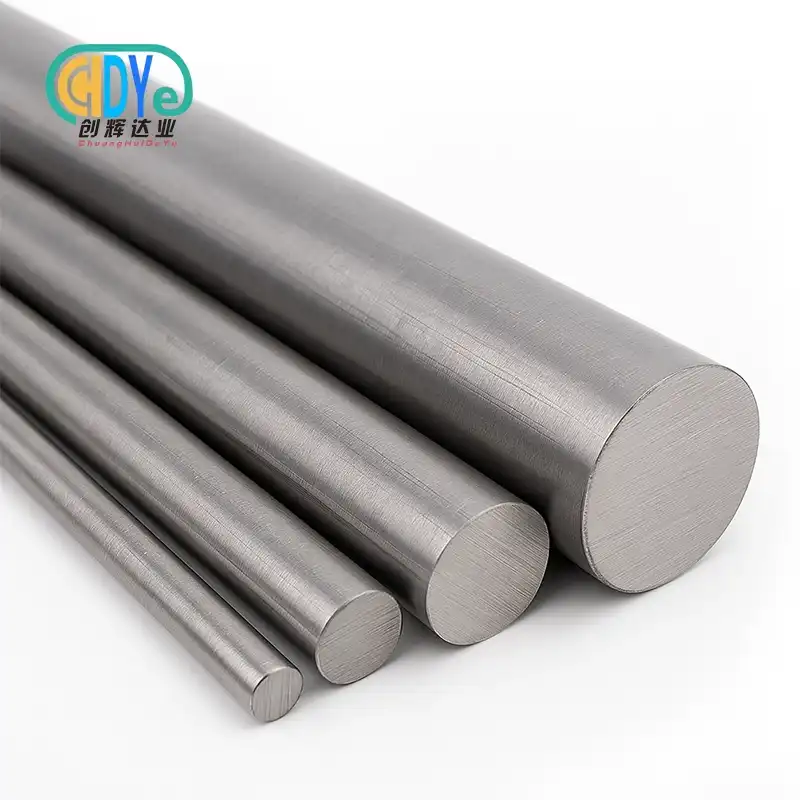
Understanding 6al 4v Titanium Round Bar: Properties and Specifications
Find out what 6Al-4V titanium round bar is made of and how it works. Engineers use a strong titanium metal called Ti-6Al-4V a lot in their work. Almost half of all the titanium used in the world comes from this alloy. Its fame comes from careful management of its chemicals. Vanadium stabilises the beta phase, allowing it to be heated and shaped in different ways. Aluminium stabilises the alpha phase, keeping it strong at room temperature. The material always meets the strict needs of the aerospace, pharmaceutical, and petroleum industries because of this balance.
Chemical Composition and Standards Compliance
Standards from around the world, like ASTM B348, ASME SB348, and AMS 4928, are very close to what our Grade 5 titanium material is made to. The mix always contains between 5.5% and 6.75% aluminium and between 3.5% and 4.5% vanadium. In the interstitials, amounts of iron below 0.40%, oxygen below 0.20%, and hydrogen below 0.015% are all closely monitored to keep them from getting weak and to ensure they work well. When our Baoji plant makes a lot of something, we use spectroscopic analysis and inert gas fusion tests to make sure the specs are correct.
Mechanical Performance Characteristics
At high temperatures, Ti-6Al-4V round bars can pull apart at least 895 MPa (130 ksi) and give way at 828 MPa (120 ksi). The range of extension is usually 10% to 14%, which is beneficial for getting things made. It's easy to work with and doesn't wear out quickly because it has a Rockwell hardness of C 30-34. The metal is very useful because it can hold its shape at temperatures as high as 400°C (750°F). This makes it perfect for uses that need steadiness at high temps. The elasticity number is about 114 GPa. This property gives bolts and structural parts the bendability they need without making them less strong.
Physical Attributes and Thermal Behaviour
At 4.43 g/cm³, this titanium metal is about 60% as dense as steel. It makes things a lot lighter without weakening them. The amount of heat it moves is only 6.7 W/m·K, which is less than many metals. This material changes the way heat is removed during cutting. The thermal growth rate stays at 8.6 µm/m·°C, so the sizes don't change when the temperature does. When these physical traits come together, they create a material that is great when weight is an issue and also protects against damage from the environment by making an inactive oxide layer that instantly fixes itself when it gets scratched or damaged.
Engineers can guess how a material will behave during production and over its useful life if they know these basic properties. When 6Al-4V titanium round bars that have been properly cleared are used, they always work. This lowers project risk and supports long-term stability in important uses.
Comparing 6al 4v Titanium Round Bar with Alternatives: Making the Right Choice
After looking at different 6Al-4V titanium round bar options, you can make the best choice. When people are buying something, they often have to look at several different materials to find the one that works best and costs the least. Titanium alloys are similar in some ways, but small changes in their make-up can have big impacts on how they can be used, how easy they are to machine, and how much they cost over their whole time.
Grade 5 versus Grade 2 Titanium
Grade 2 titanium is very good at not rusting and being made, but it is not as strong as Grade 5 titanium. Its shear strength is only about 340 MPa, while Grade 5's is 895 MPa. It's important to know this difference in strength because the size of a part is affected by how much weight it can hold. When making aircraft parts, Grade 5 is always used for structural bolts and landing gear parts. This is because it is stronger, which lets cross-sections be smaller, which makes the structure lighter. On the other hand, medical device makers sometimes pick Grade 2 for implant uses where a lower modulus fits the bone's flexibility better. Surgery tools that need to be hard are still mostly made from Grade 5.
Titanium versus Stainless Steel Alternatives
6Al-4V titanium round bars are stronger than austenitic stainless steels like 316L. This is clear from the first look. Titanium is not only stronger than steel, but it also weighs a lot less. Moving portable tools this way saves fuel and makes them easier to carry. Titanium doesn't rust as easily as stainless steel does when it's exposed to salt. Titanium doesn't change at all for decades, but stainless steel does after just a few months of being in saltwater. Titanium costs three to five times more per kilogram, so the difference must be explained by a careful lifecycle study. Titanium costs more at first, but many businesses that have to pay for maintenance costs or excessive weight find that it is worth the extra money in the long run.
ELI Grade Considerations for Critical Applications
Extra-Low Interstitial (ELI) types of Ti-6Al-4V keep the hydrogen and oxygen levels below 0.012% and 0.13%, respectively. It's harder to break and less likely to become weak from hydrogen because of this. You need this standard for cryogenics and some medical items. The high cost is worth it because it keeps cracks from spreading. Standard Grade 5 is fine for most industrial uses, but teams that are buying things for biological or aeroplane projects should check to see if ELI requirements provide enough safety gaps. This helps with material choice because it makes efficiency trade-offs clear. The best option will depend on the use and include things like loads, weather exposure, government rules, and price constraints.
Procurement Guide: How to Buy 6Al 4V Titanium Round Bar Efficiently?
If you want to find good titanium round bars, you need to carefully look at different sellers and know how the market works. To avoid project delays and quality issues, smart buying uses the certification of materials, the way prices are set, and the reliability of the supply chain.
Identifying Qualified Suppliers and Manufacturers
Getting in touch with qualified manufacturers and suppliers located in well-known production areas often yields better pricing and quality control transparency. Internationally known as the "Titanium Capital", the Baoji area of China is home to most of the specialised knowledge and high-tech working tools. Find companies that are certified to ISO 9001:2015 and ask for proof that they follow ASTM B348 or AMS 4928. This can be done through third-party testing labs. From the first vacuum arc remelt (VAR) melting step to the last cutting step, Chuanghui Daye saves full records. They give mill test reports (MTRs) for each batch of product that show the chemical make-up, mechanical qualities, and heat treatment records.
Understanding Pricing Structures and Cost Drivers
The price of Grade 5 titanium on the market changes based on how much energy costs, how much raw materials are available, and how the world's desire changes. How much you order has a big effect on the unit prices. When you buy more than 500 kilos, you can usually save 8% to 15%. Custom width needs may come with extra costs of 10% to 20%, especially for sizes that aren't common and need special tools. Lead times also affect prices, and plans to make things faster usually cost more. Suppliers who are truthful and open give detailed quotes that include the costs of products, handling, and tests. Because of this, it is possible to make correct spending forecasts. To get the best prices and delivery times, we tell our clients to talk to us right away about when they need things done and how long the project will take.
Quality Verification and Testing Requirements
Tough buyers do more than just basic reviews to make sure of the quality of their goods. Ultrasonic testing that follows the rules of AMS 2631 Class A finds holes or bits below the surface that make the framework less strong. The study of the microstructure reveals that the alpha and beta stages are spread out properly and that there are no continuous alpha networks that would make the wear life shorter. For medical or military uses that are very important, asking that testing be done at the production site makes it safer. As part of our quality control process, we use standardised tools to check the sizes, the roughness of the surface, and the stiffness of bars of different lengths to make sure everything is the same. These proof steps cost a little extra, but they keep mistakes that cost a lot from happening during production or service.
When you buy strategically, you also think about shipping and customer service after the sale. To help make samples, suppliers that offer flexible small-batch production can be helpful. Reliable global shipping partnerships make sure that all orders, even those from other countries, arrive on time.
Best Practices for Using and Handling 6al 4v Titanium Round Bars
To get the most out of titanium parts' performance and longevity, you must first handle and prepare them properly. Titanium is not the same as steel or aluminium. It has unique properties that need to be kept, polished, and made in certain ways.
Storage and Transportation Recommendations
Titanium doesn't rust by itself, but iron particles on the surface or bad storage can make this benefit less useful. To keep round bars away from carbon steel goods that are dirty or wet, we recommend keeping them in a clean, dry area. If you want to store things inside a building, wooden racks or plastic covers will do. The surface doesn't get scratched during shipping because of the safe packing. This isn't physically important but could mean that more work needs to be done to finish it. Since titanium doesn't mind being wet as much as some other metals, it's not as important to keep the humidity low. But staying away from things that have salt in them will keep the surface from getting stained.
Machining Guidelines and Tool Selection
To cut and shape Ti-6Al-4V, you need to follow different rules than to cut and shape steel. If you cut at slower speeds, about 40% to 60% of the steel rate, you can avoid work hardening and tool wear. Metal or polycrystalline diamond (PCD) cutting tools stay sharp longer than high-speed steel tools. Titanium doesn't let heat move easily, so a lot of coolant is needed to keep the heat from building up at the cutting edge. When you use climb milling instead of normal milling, work hardening is less likely to happen. These changes stop common issues like galling, tools breaking down too soon, and taking the wrong measures.
Heat Treatment and Fabrication Techniques
Solution treatment and ageing (STA) methods make things stronger than they were when they were annealed. This means they can do their job better. When heated to 900°C to 950°C and then cooled and hardened at 500°C to 600°C, the tensile strength can go up by 15% to 20%. When you weld, you need inert gas protection, like argon or helium, so oxygen and nitrogen don't get into the join zone and weaken it. Welds made with tungsten inert gas (TIG) are strong enough to be used in pressure tanks. It's not necessary to heat up first most of the time, but keeping the temperature steady between passes is important for keeping the quality of the weld in thick parts.
These methods have been used in the real world and have been shown to work. The tools last longer, and the surface finish is better when aircraft manufacturers use the recommended settings. Companies that make medical equipment can make sure that the materials they use are always safe by using controlled finishing methods that keep the passive oxide layer in place. Chemical companies say that parts can last for decades in toxic environments if the right welding and heat treatment steps are taken. If you follow these best practices, you can keep the cost of production low while turning raw materials into solid parts that meet high performance standards.
Conclusion
You need to find a mix between technical needs, source standards, and processing know-how in order to get high-performance 6Al-4V titanium round bars. The material is good for use in aeroplanes, medicine, and industry because it is strong for its weight and doesn't rust. Important parts of buying well are making sure that ASTM B348 and AMS 4928 are followed, looking at providers' quality systems, and understanding how order volume and the need for customisation affect prices. You can get the most out of your materials and keep production costs low by handling and cutting them in the right way. The world's need for strong but light materials is growing. The only way to be sure of getting high-quality titanium goods that meet project goals and performance standards is to work with approved makers.
FAQ
Q: What factors influence the tensile strength of Ti-6Al-4V round bars?
A: Its tensile strength changes based on how it was heated, the microstructure, and the amount of air in the area between the cells. Material that has been annealed is at least 895 MPa strong. Solution-treated and aged (STA) methods can make it 15-20% stronger. The oxygen level should be between 0.18 and 0.20% for the best strength. ELI grades, on the other hand, give up some strength to be tougher by keeping oxygen below 0.13%.
Q: How does corrosion resistance compare to stainless steel?
A: When it comes to salt, 6Al-4V titanium round bars work a lot better than 316L stainless steel. The titanium oxide layer that isn't doing anything comes back right away. It doesn't get split in salt water, wet chlorine, or acidic places that eat away at stainless steel. This benefit means that maintenance expenses are removed in places like chemical processing and the Navy, where stainless steel needs to be changed often.
Q: What certifications should I verify when selecting a supplier?
A: Check for quality with ISO 9001:2015 certification and make sure products meet ASTM B348 or AMS 4928 standards. Ask approved labs to give you test results for the mill that list the chemicals that were used and how well it works mechanically. If the test is going to be used for something important, make sure that it follows AMS 2631 and that the nanoscale study follows ETTC guidelines.
Partner with Chuanghui Daye for Reliable Titanium Round Bar Supply
To help you buy titanium alloys, Shaanxi Chuanghui Daye Metal Material Co., Ltd. has been in business for more than 30 years and makes them. This company still has the ISO 9001:2015 approval and makes Grade 5 6Al-4V titanium round bars that follow the rules set by ASTM B348 and AMS 4928. Our plant is in Baoji, which is the most important place in China for making titanium. Our accurate machining and high-tech VAR melting facilities can handle both large-scale output and small-scale trial orders that can be changed quickly. Our expert staff can help you pick the right material for your needs, whether you want standard annealed bars or bars that have been heat-treated to your exact specifications. When you buy directly from the plant, you don't have to pay the markups that distributors add on top of the prices. You also keep the quality control that your important apps need. Email our team at info@chdymetal.com to tell us what you need and get prices that are based on full mill test results.
References
1. Boyer, R., Welsch, G., & Collings, E.W. (1994). Materials Properties Handbook: Titanium Alloys. ASM International, Materials Park, Ohio.
2. Donachie, Matthew J. (2000). Titanium: A Technical Guide, 2nd Edition. ASM International, Materials Park, Ohio.
3. Lutjering, G., & Williams, J.C. (2007). Titanium, 2nd Edition. Springer-Verlag, Berlin Heidelberg.
4. ASTM International. (2021). ASTM B348-21: Standard Specification for Titanium and Titanium Alloy Bars and Billets. West Conshohocken, Pennsylvania.
5. SAE International. (2019). AMS 4928R: Titanium Alloy Bars, Wire, Forgings, Rings, and Drawn Shapes 6Al-4V Annealed. Warrendale, Pennsylvania.
6. Peters, M., Kumpfert, J., Ward, C.H., & Leyens, C. (2003). Titanium Alloys for Aerospace Applications. Advanced Engineering Materials, Volume 5, Issue 6, Pages 419-427.
Learn about our latest products and discounts through SMS or email