- English
- French
- German
- Portuguese
- Spanish
- Russian
- Japanese
- Korean
- Arabic
- Greek
- German
- Turkish
- Italian
- Danish
- Romanian
- Indonesian
- Czech
- Afrikaans
- Swedish
- Polish
- Basque
- Catalan
- Esperanto
- Hindi
- Lao
- Albanian
- Amharic
- Armenian
- Azerbaijani
- Belarusian
- Bengali
- Bosnian
- Bulgarian
- Cebuano
- Chichewa
- Corsican
- Croatian
- Dutch
- Estonian
- Filipino
- Finnish
- Frisian
- Galician
- Georgian
- Gujarati
- Haitian
- Hausa
- Hawaiian
- Hebrew
- Hmong
- Hungarian
- Icelandic
- Igbo
- Javanese
- Kannada
- Kazakh
- Khmer
- Kurdish
- Kyrgyz
- Latin
- Latvian
- Lithuanian
- Luxembou..
- Macedonian
- Malagasy
- Malay
- Malayalam
- Maltese
- Maori
- Marathi
- Mongolian
- Burmese
- Nepali
- Norwegian
- Pashto
- Persian
- Punjabi
- Serbian
- Sesotho
- Sinhala
- Slovak
- Slovenian
- Somali
- Samoan
- Scots Gaelic
- Shona
- Sindhi
- Sundanese
- Swahili
- Tajik
- Tamil
- Telugu
- Thai
- Ukrainian
- Urdu
- Uzbek
- Vietnamese
- Welsh
- Xhosa
- Yiddish
- Yoruba
- Zulu
ASTM B 348 Titanium Rods: A Versatile Material for Modern Industries
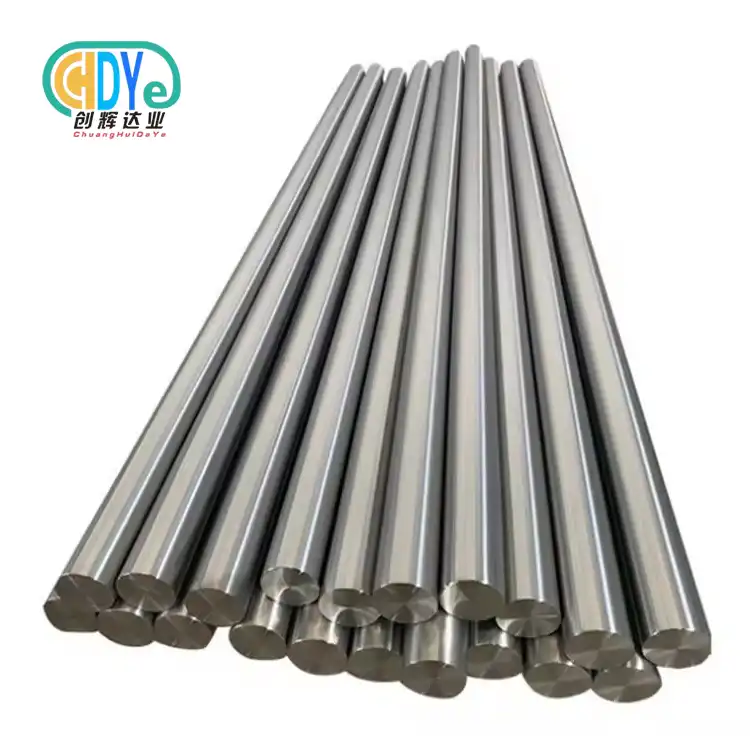
ASTM B 348 titanium bars are an important part of modern industry because they have great strength-to-weight ratios and are more resistant to corrosion than any other material. These high-quality pieces are used as building blocks in high-performance settings like chemical processing, medical device manufacturing, and aircraft. The ASTM B 348 industrial titanium rod standard makes sure that the quality and dependability that procurement workers around the world need are always met. As industries move toward more durable and efficient solutions, these titanium rods offer the flexibility and performance traits that help makers get around the limits of traditional materials while still achieving better working results.
Understanding ASTM B 348 Titanium Rods: Specifications and Properties
The ASTM B 348 guideline lists all the rules that bars, rods, and billets made of titanium and titanium alloys must follow when they are used in industrial settings. This standard covers several grades, each of which is designed to meet specific performance needs in a range of working conditions.
Key Grade Classifications and Their Characteristics
Grade 2 titanium is commercially pure and has great resistance to rust and flexibility, which makes it perfect for use in chemical processing equipment and on the water. The peak strength of the material is around 275 MPa, and it is very easy to shape, which makes complex industrial processes easier.
The most common titanium metal is Grade 5 (Ti-6Al-4V), which has compressive strengths of more than 895 MPa. This alpha-beta metal has aluminum and vanadium added to it to make it stronger while still being resistant to rust. The material works really well in high-stress situations where reducing weight is still important.
Small amounts of palladium are added to Grade 7 to make it more resistant to rust in reducing acid settings. This is especially useful in chemical processing where sulfuric acid or hydrochloric acid is present.
Mechanical Properties and Performance Standards
These rods' mechanical qualities are put through a lot of tests to make sure they meet the requirements of the standard. Standardized methods are used for tensile tests to confirm the yield strength, final tensile strength, and elongation percentages. Impact resistance testing proves that a material is tough under changing loads.
The fine-grain structure that was made through controlled thermomechanical processes can be seen through microstructural research. This fining of the grains immediately leads to better fatigue resistance and better mechanical qualities across the whole cross-section.
Heat Treatment and Processing Considerations
Annealing methods are very important for improving the mechanical qualities and reducing the stresses that build up inside the ASTM B 348 industrial titanium rod during production. Controlled heating and cooling processes make sure that the microstructure develops evenly and the dimensions stay stable during later machining operations.
Applications and Industry Use Cases of ASTM B 348 Titanium Rods
ASTM B 348 industrial titanium rod is very useful because it can be used in many different industries where performance, dependability, and durability are very important.
Aerospace and Defense Applications
These titanium bars are used by aerospace companies to make important parts like landing gear systems, engine mounts, and structural fixings. The high strength-to-weight ratio lets aircraft designers lower the overall weight of the vehicle while still making sure the structure stays strong under high operating stresses.
The material's ability to prevent bullets is used in defense to make armor and other protective gear. When it comes to defense tools, the non-magnetic properties are useful because they reduce magnetic signatures.
Chemical Processing and Petrochemical Industries
Titanium bars are used a lot in chemical processing plants for equipment that is exposed to harsh chemicals and high temperatures. Because the material doesn't crack under chloride stress, it is very useful in chlor-alkali plants and plants that remove salt from saltwater.
Products made from these bars, like heat exchanger parts, last a very long time in places where regular stainless steel would break down quickly. When you look at the longer service life and lower upkeep needs, it's easy to see how cost-effective it is.
Marine and Offshore Engineering
Titanium doesn't rust in seawater, so it can be used in marine applications without the need for safe coatings or cathodic protection systems. These rods are used to make reliable propeller shafts, pump parts, and underwater equipment that can work in harsh saltwater conditions.
Titanium is used in important systems on offshore oil and gas sites that could fail and cause environmental disasters or big financial losses. Long-term dependability is ensured by the material's ability to fight fatigue under repetitive pressure from wave action.
Medical Device Manufacturing
Titanium is used to make medical devices because it is biocompatible and doesn't rust in biological settings. The material is non-toxic and has great mechanical performance, which makes it useful for surgical tools, hip implant parts, dental equipment, and ASTM B 348 industrial titanium rod applications.
Comparing ASTM B 348 Titanium Rods with Alternative Materials
Professionals in procurement have to carefully choose materials based on the needs of the purpose, the cost, and the expected performance.
Titanium versus Stainless Steel Performance
Even though stainless steel is cheaper to buy at first, titanium rods work better in many situations anyway. Titanium has a strength-to-weight ratio that is about 40% higher than that of stainless steel. This means that substantial weight reductions are possible in rotating machinery and aircraft uses.
Another important difference is corrosion resistance. Even the best types of stainless steel can pit or crack when they are exposed to salt, but titanium keeps working perfectly in these conditions.
Grade Selection Considerations
Grade 2 titanium is good at resisting rust and can be shaped easily. It is not too expensive, so it can be used in chemical processing equipment and buildings. Because the material is flexible, it makes cold cutting and bonding easier.
Grade 5 is the strongest, but it needs to be handled more carefully when it is being made. The higher levels of strength make up for the higher cost in situations where weight reduction or high stress resistance are very important.
Lifecycle Cost Analysis
Although titanium rods cost more to buy at first than rods made of other materials, lifetime cost analysis often suggests that titanium is the better choice. Overall cost savings are seen in many situations where upkeep needs are lower, service life is longer, and protection coating systems are not needed.
Procurement Guide: How to Source ASTM B 348 Titanium Rods Efficiently
To buy ASTM B 348 industrial titanium rod successfully, you need to know how the market works, what your suppliers can do, and the quality control procedures that make sure the material is real and works well.
Market Factors and Pricing Considerations
Titanium prices change on the market depending on the cost of energy, the supply of raw materials, and changes in world demand. When procurement workers understand these market forces, they can better plan when to make purchases and negotiate better price structures.
Because of economies of scale in production and handling, ordering in bulk usually saves you a lot of money. Suppliers often offer bulk savings for orders that are bigger than a certain number of tons.
Supplier Evaluation Criteria
Quality approval is the most important thing to look for in a seller. When suppliers get ISO 9001:2015 certification, it means they have strong quality control processes in place for the whole business. For military uses, extra certifications like AS9100 or ISO 13485 may be needed. For medical uses, it may be necessary without these certificates.
Specific standards for dimensions and surface finish must be met by the manufacturing skills. You can be more sure of regular quality if your suppliers have high-tech processing tools like vacuum arc remelting furnaces, precise rolling mills, and full testing facilities.
Quality Documentation and Traceability
Mill test papers are important proof of the chemical makeup, mechanical qualities, and size compliance. For full tracking along the supply chain, these papers must have heat numbers on them.
Ultrasonic testing reports make sure that the inside is sound and that there are no flaws that could affect how well the service works. Suppliers should give full check records that show they are following the rules.
Best Practices and Future Trends in ASTM B 348 Titanium Rod Usage
Following best practices when handling, storing, and preparing ASTM B 348 industrial titanium rod is important for getting the most out of its performance and service life.
Handling and Storage Protocols
When you handle things the right way, you avoid contamination and mechanical damage that could change the qualities of the material. To keep surfaces from rusting or getting messed up by other things, storage places must stay clean and dry.
Temperature control during storage stops thermal cycles that could change the qualities of metals. Controlled conditions keep the quality of the surface finish and make sure that the dimensions stay the same.
Machining and Processing Best Practices
To keep work from hardening and make sure measurements are correct, machining factors need to be carefully optimized. For grinding to go well, you need sharp cutting tools, the right speeds and feeds, and a cooling system that works.
To get the mechanical qualities you want without lowering the corrosion resistance, heat treatment methods must follow set rules. Monitoring temperatures and controlling the atmosphere make sure that results are the same from one production batch to the next.
Emerging Trends and Future Applications
With the help of additive manufacturing technologies, titanium materials can be used in more ways. Complex shapes that were not possible with traditional manufacturing methods can now be made with 3D printing.
Recycling methods for titanium materials are being developed because of efforts to be more environmentally friendly. Closed-loop recycling methods keep up quality standards for materials while reducing their impact on the earth.
Titanium products are becoming more popular in markets that use renewable energy. Titanium is strong and doesn't rust, which makes it useful for energy storage, geothermal systems, and parts of wind turbines.
Conclusion
ASTM B 348 industrial titanium rod keeps showing its worth in a wide range of industrial settings where performance, dependability, and durability are still very important. The material is perfect for demanding conditions in aircraft, chemical processing, naval engineering, and medical device production because it has a high strength-to-weight ratio, is very resistant to corrosion, and can be processed in a variety of ways. These titanium rods are the building blocks for new ideas and better operating performance as businesses move toward more eco-friendly and efficient solutions. As processing methods keep getting better and the number of uses for ASTM B 348 titanium rods keeps growing, they will stay important materials for today's manufacturing problems.
FAQ
Q: What distinguishes Grade 2 from Grade 5 ASTM B 348 titanium rods?
A: Grade 2 represents commercially pure titanium, offering excellent corrosion resistance and superior ductility, making it ideal for chemical processing and architectural applications. Grade 5 (Ti-6Al-4V) is an alpha-beta alloy providing significantly higher strength properties (approximately three times that of Grade 2) but with reduced ductility, suitable for high-stress structural applications.
Q: How does corrosion resistance compare between titanium and stainless steel?
A: Titanium demonstrates superior corrosion resistance in chloride-containing environments, saltwater, and oxidizing acids, where stainless steel may experience pitting or crevice corrosion. The passive oxide layer on titanium self-heals rapidly, providing long-term protection without degradation.
Q: What certifications should buyers verify when selecting suppliers?
A: Essential certifications include ISO 9001:2015 for quality management systems, with additional industry-specific certifications such as AS9100 for aerospace applications. Mill test certificates according to EN 10204 3.1 must accompany shipments, documenting chemical composition, mechanical properties, and traceability information.
Q: Can ASTM B 348 titanium rods be welded effectively?
A: Grade 2 titanium exhibits excellent weldability under inert gas shielding (TIG/MIG) with minimal special procedures required. Grade 5 requires more specialized welding techniques and post-weld heat treatment to prevent cracking in the heat-affected zone.
Q: What surface finish options are available for delivery?
A: Common surface conditions include peeled (rough surface for further processing), turned (smooth, dimensionally accurate), and polished/centerless ground (high precision with h7-h9 tolerances). Selection depends on whether additional machining operations will be performed.
Partner with Chuanghui Daye for Premium ASTM B 348 Industrial Titanium Rod Solutions
Shaanxi Chuanghui Daye stands as your trusted ASTM B 348 industrial titanium rod supplier, leveraging over 30 years of expertise in rare metal manufacturing from China's renowned "Titanium Capital." Our ISO 9001:2015 certified facility delivers premium-grade titanium rods in multiple configurations, including round, square, and hexagonal profiles with diameters ranging from 4mm to 350mm. Advanced manufacturing capabilities featuring vacuum arc remelting furnaces and precision CNC equipment ensure consistent quality and dimensional accuracy for your critical applications. Contact our technical team at info@chdymetal.com to discuss your specific requirements and receive competitive quotations backed by comprehensive quality documentation and reliable global delivery.
References
1. American Society for Testing and Materials. "Standard Specification for Titanium and Titanium Alloy Bars and Billets." ASTM International, 2021.
2. Boyer, R.R. "An Overview on the Use of Titanium in the Aerospace Industry." Materials Science and Engineering: A, Vol. 213, 1996.
3. Donachie, Matthew J. "Titanium: A Technical Guide, Second Edition." ASM International, 2000.
4. Lutjering, Gerd and James C. Williams. "Titanium: Engineering Materials and Processes." Springer-Verlag Berlin Heidelberg, 2007.
5. Schutz, R.W. and Thomas, D.E. "Corrosion of Titanium and Titanium Alloys." Metals Handbook, Volume 13: Corrosion, ASM International, 1987.
6. Veiga, C., Davim, J.P., and Loureiro, A.J.R. "Properties and Applications of Titanium Alloys: A Brief Review." Reviews on Advanced Materials Science, Vol. 32, 2012.
Learn about our latest products and discounts through SMS or email