- English
- French
- German
- Portuguese
- Spanish
- Russian
- Japanese
- Korean
- Arabic
- Greek
- German
- Turkish
- Italian
- Danish
- Romanian
- Indonesian
- Czech
- Afrikaans
- Swedish
- Polish
- Basque
- Catalan
- Esperanto
- Hindi
- Lao
- Albanian
- Amharic
- Armenian
- Azerbaijani
- Belarusian
- Bengali
- Bosnian
- Bulgarian
- Cebuano
- Chichewa
- Corsican
- Croatian
- Dutch
- Estonian
- Filipino
- Finnish
- Frisian
- Galician
- Georgian
- Gujarati
- Haitian
- Hausa
- Hawaiian
- Hebrew
- Hmong
- Hungarian
- Icelandic
- Igbo
- Javanese
- Kannada
- Kazakh
- Khmer
- Kurdish
- Kyrgyz
- Latin
- Latvian
- Lithuanian
- Luxembou..
- Macedonian
- Malagasy
- Malay
- Malayalam
- Maltese
- Maori
- Marathi
- Mongolian
- Burmese
- Nepali
- Norwegian
- Pashto
- Persian
- Punjabi
- Serbian
- Sesotho
- Sinhala
- Slovak
- Slovenian
- Somali
- Samoan
- Scots Gaelic
- Shona
- Sindhi
- Sundanese
- Swahili
- Tajik
- Tamil
- Telugu
- Thai
- Ukrainian
- Urdu
- Uzbek
- Vietnamese
- Welsh
- Xhosa
- Yiddish
- Yoruba
- Zulu
Can Straight Titanium Wire Be Used in High-Temperature Applications?
It is possible to use straight titanium wire when the temperature is high. Titanium wire is very resistant to changes in temperature. It can keep its shape up to 600°C and has a melting point of 1942K, which is about 1669°C. Because it is resistant to high temperatures, rust, and other problems with structure, it is the best choice for places where performance must not be compromised at high temperatures, like in chemical processing, industrial manufacturing, and airplanes.
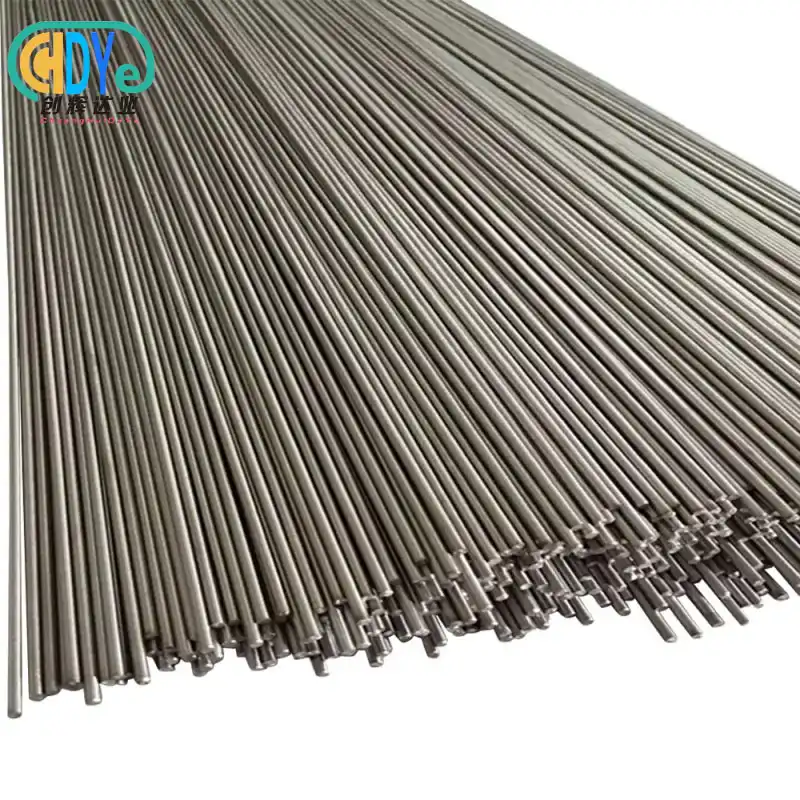
Understanding straight titanium wire and its high-temperature properties
Straight titanium wire is a precision-engineered metal item that goes through special steps to remove coil memory and improve the accuracy of the measurements. Unlike regular spooled wire, this material stays exactly straight because it has been treated to reduce stress and has been bent in a controlled way. The amazing properties of the wire come from titanium's unique hexagonal structure. It doesn't easily expand or change color when heated up.
Physical and Chemical Properties
Titanium wire can handle high temperatures well, so it is a good choice for use in those situations. Titanium is heavier than most other metals, weighing 4.54g/cm³. This makes it tougher. TiO₂, which is an inactive oxide layer, forms on its own, making a shield against oxidation that can't be broken even when heated very high. As long as it's used, this safe layer will keep working well because it heals itself when it gets broken.
Titanium's thermal conductivity doesn't change much across a wide temperature range, and its thermal expansion coefficient (8.6 × 10⁻⁶/°C) makes it easy to guess how its size will change when it gets hot and cold. This makes engineers feel good about building systems because they know that temperature forces won't hurt the structure.
Comparison with Alternative Materials
Titanium wire works better than stainless steel wire when it comes to high temperatures. Above 500°C, stainless steel starts to corrode and scale in a big way. Titanium, on the other hand, keeps its protective oxide layer in place well past 600°C. Nickel metals can handle high temperatures, but they cost a lot more and have higher-density fines. Titanium wire is the best for tough, high-temperature jobs because it doesn't rust, doesn't get too hot, and works well in high temperatures.
Performance and Advantages of Straight Titanium Wire in High-Temperature Environments
When you learn how titanium wire responds to very high temperatures, you can understand why it is so important in tough work environments. The material's abilities go far beyond just being able to handle heat. They also need to be physically stable, not oxidize easily, and be reliable over time when heated over and over again.
Thermal Performance Characteristics
When heated to 600°C, straight titanium wire works about 80% better than choices made of aluminum and steel. No matter how many times the material is heated and cooled, its modulus of elasticity stays pretty much the same. Because of this, it won't break from wear as other metals can. It is very important for this to be stable when exact readings need to be kept, even when the temperature changes.
The surface of the wire doesn't get oxidation scaling, so you don't have to worry about pollution or size changes that come from oxide formation. In vacuums or clean places where particle production needs to be kept to a minimum, this trait is very important.
Mechanical Advantages in Extreme Conditions
Titanium wire is not only resistant to heat, but it also has other useful properties that make systems more effective. It's good for sensitive electronics because it doesn't let much magnetic flux pass through it. It also doesn't wear down easily, so it lasts a long time even after being loaded and unloaded many times. The material can stand up to both tensile and compressive loads without breaking. This means it can be used in complicated mechanical systems that have to work in harsh weather conditions.
Available Specifications and Grades
Titanium wire sold in stores comes in lengths and widths ranging from 500mm to 3000mm and 0.5mm to 7.0mm. This can be used for a lot of different tasks. When used in chemicals, Titanium Grade 1 is the most corrosion-resistant. For normal industrial use, Titanium Grade 2 has a good mix of traits. Grade 5 (Ti-6Al-4V) is the best when it comes to airplanes and high-stress cases that need both good thermal performance and good mechanical properties.
Manufacturing and Processing Techniques for High-Temperature Straight Titanium Wire
To make titanium wire that can stand up to very high temperatures, you need to use complicated production methods that keep the material safe and make sure the numbers are correct. After many years of progress in metals, these methods were created to make things that meet all the exact needs for important high-temperature uses.
Advanced Production Methods
Vacuum melting is the first step in making something. It gets rid of any flaws that could make the product not work well at high temperatures. The material is the right thickness after being drawn through precise dies several times. This also works to make it stronger by stiffening it. Controlled annealing processes lower the pressure inside the wire while keeping its mechanical properties fixed. This keeps the wire's size from changing while it's being heated and cooled.
Coil memory is gone when you use the right tools to fix it, and using straight titanium wire, the linear difference is less than 0.1 mm per meter. This level of accuracy is very important for automatic assembly lines and industrial systems, since differences in materials could stop work or cause quality issues.
Quality Control and Certification Standards
Ti wire used in industry has to follow strict international rules, like ASTM B863 for general industrial uses and AWS A5.16 for welding. The chemical make-up, mechanical properties, and size changes are limited by these rules. This makes sure that all production runs work the same way.
If a company has ISO 9001:2015 approval, you can be even more sure that they handle quality and keep an eye on the production process the whole time. Material traceability paperwork is sent with every package. This lets end users look at the materials' composition and handling history for important tasks that need full proof.
Fabrication Best Practices
To keep the clarity of the titanium wire while working with it at high temperatures, you need to follow certain steps. When you weld, you need to protect the work area from toxic gases, and when you bend, you need to think about how the material will spring back. You can keep the metal from work-hardening if you use the right tools and cut at the right speed. If you don't, it might not work as well in later temperature tests.
Evaluating Market Options: Choosing the Right Straight Titanium Wire for High-Temperature Applications
You need to carefully look at the grade's qualities, the size standards, and the supplier's skills to find the right titanium wire for high temperatures. When hiring workers know about these things, they can make decisions that are more efficient and save money.
Grade Selection Considerations
The best titanium for chemical processes is grade 1, which doesn't rust and can be used at temperatures up to 550°C. Grade 2 is good for general industrial uses because it is stronger and works well at high temperatures up to 600°C. Grade 5 (Ti-6Al-4V) is stronger mechanically and can handle temperatures up to 400°C when it's loaded. It works really well in airplanes and other high-stress structures.
Each grade has its own benefits that depend on the work situations and performance goals. The grade for a job depends on how well it works with chemicals, how stressed it is, and how many times it is heated and cooled.
Configuration and Design Considerations
Straight titanium wire offers advantages over braided configurations in applications requiring precise dimensional control and predictable thermal expansion. The uniform cross-section provides consistent heat transfer characteristics, while the stress-relieved condition eliminates unpredictable movement during thermal cycling. These characteristics prove essential in precision instruments and measurement devices where thermal stability directly affects accuracy.
Supplier Evaluation and Sourcing Strategies
A lot of tests and statistical process control are used by trustworthy sources to show that their quality stays the same. You can save a lot of money by buying in bulk, especially if you need a lot of something or are smart about how you use your goods. Shipping costs and delivery times are cut down when a seller is close to a project site. This makes the supply chain more responsive to urgent project needs.
Real-World Case Studies and Application Scenarios
We can learn a lot about how things work and how to use them by observing how straight titanium wire has been used successfully in very hot environments. If you pick the right materials and build them properly, these examples show what you can do to get useful results.
Aerospace Applications
Titanium wire is used by airplane manufacturers to make temperature monitors for exhaust gases that work reliably at temperatures above 500°C. Because it doesn't rust, stays stable at high temperatures, and works with electromagnetic fields, the numbers will always be correct as long as the plane is being used. They are lighter than steel options, which helps save fuel while still meeting the safety standards needed for flying.
Titanium wire is used in heat control systems in spacecraft, where other materials would break down in the high temperatures and vacuum. The method will work well for long trips because the wire can keep its mechanical properties even when it goes through hot and cold cycles.
Chemical Processing Industries
In petroleum companies, titanium wire is used to keep an eye on the temperature inside reactor tanks, which are very dangerous places to work because of the high temperatures and corrosive gases that are inside. This material doesn't crack from salt stress rust, so it lasts a long time and doesn't need as many repairs or system shutdowns.
Titanium is good at moving heat and blocking rust, so it can be used in heat exchangers. Harsh chemicals that would quickly break down steel choices can't hurt it.
Best Practices and Lessons Learned
Implementations that go well show how important it is to move and set up things in the right way. For the system to work at its best, it's important to keep it clean during installation, make sure there is enough room between supports to allow for heat expansion, and check it regularly. When you cut wire to a certain length and treat the surface, for example, you can make patterns that work better and waste less material.
Conclusion
When it comes to high temperatures, straight titanium wire is great because it is thermally stable, mechanically strong, and doesn't rust. Because it can handle temperatures up to 600°C and works better than steel and nickel options, titanium wire is good for tough industrial settings. It comes in different sizes and specs, so it can be used in a variety of ways. Quality and efficiency are always the same because of the way things are made today. Titanium wire has been used successfully in airplanes, chemical processing, and other fields where dependability must not be affected at high temperatures.
FAQ
Q: What is the maximum operating temperature for straight titanium wire?
A: You can use straight titanium wire at temperatures up to 600°C, and it will still work fine. When used at high temperatures, the material's melting point of 1942K (1669°C) provides a lot of safety gaps. It also makes the structure stable well beyond the normal working ranges for industrial materials.
Q: How does titanium wire compare to stainless steel in high-temperature environments?
A: Titanium wire works much better than stainless steel when it needs to be heated. When titanium is heated above 600°C, its protective oxide layer stays on. But when stainless steel is heated above 500°C, it starts to rust and scale. Titanium is also 43% lighter than steel and doesn't rust as easily.
Q: What certifications should I look for when purchasing titanium wire for high-temperature use?
A: For use in business, look for materials that are in line with ASTM B863 guidelines. Look for products that meet AWS A5.16 standards if you want to weld them. The ISO 9001:2015 approval of the producer makes sure that quality control is kept up during the production process. Papers that certify materials make sure that they can be tracked and that their make-up can be checked.
Q: Can titanium wire be welded in high-temperature applications?
A: Titanium wire can be joined together in a way that makes it work at high temperatures if you do it the right way. The weld area stays clean with inert gas protection, and the material's properties are kept with little heat input. If the right steps are taken, the joined parts will keep the warmth of the material they are made of.
Contact Chuanghui Daye for Premium High-Temperature Titanium Wire Solutions
Shaanxi Chuanghui Daye is very good at making precision, straight titanium wire that is exact and made to work in tough, high-temperature conditions. Our cutting-edge plants in Baoji, China's "Titanium Capital," use controlled heating and vacuum melting to make sure that the metals we make are more stable and good at withstanding heat. As an ISO 9001:2015-certified company that makes straight titanium wire, we can help you choose the best material for your needs by giving you all the information you need to track it and giving you expert advice. Email our engineering team at info@chdymetal.com for personalized prices and expert help on high-temperature titanium wire solutions that make systems work better and be more reliable.
References
1. ASM Everything. There is an entry in Volume 2 of the 2018 ASM Handbook called "Properties and Selection: Nonferrous Alloys and Special-Purpose Materials."
2. It was written by Gerd Lutjering and James C. Williams and came out in 2017 by Springer-Verlag Berlin Heidelberg as "Titanium: Engineering Materials and Processes."
3. There is a group called the American Society for Testing and Materials. The 2017 ASTM International put out the "ASTM B863-17 Standard Specification for Titanium and Titanium Alloy Wire."
4. I am Rodney R. Boyer Jr. The 2019 issue of Materials Science and Engineering: A is called "An Overview on the Use of Titanium in the Aerospace Industry."
5. Harold J. Rack and John I. Qazi. The 2018 issue of Materials Science and Engineering: C is called "Titanium Alloys for Biomedical Applications."
6. Donachie, Matthew J. "Titanium: A Technical Guide." 2016 ASM International Materials Park, Ohio.
Learn about our latest products and discounts through SMS or email