- English
- French
- German
- Portuguese
- Spanish
- Russian
- Japanese
- Korean
- Arabic
- Greek
- German
- Turkish
- Italian
- Danish
- Romanian
- Indonesian
- Czech
- Afrikaans
- Swedish
- Polish
- Basque
- Catalan
- Esperanto
- Hindi
- Lao
- Albanian
- Amharic
- Armenian
- Azerbaijani
- Belarusian
- Bengali
- Bosnian
- Bulgarian
- Cebuano
- Chichewa
- Corsican
- Croatian
- Dutch
- Estonian
- Filipino
- Finnish
- Frisian
- Galician
- Georgian
- Gujarati
- Haitian
- Hausa
- Hawaiian
- Hebrew
- Hmong
- Hungarian
- Icelandic
- Igbo
- Javanese
- Kannada
- Kazakh
- Khmer
- Kurdish
- Kyrgyz
- Latin
- Latvian
- Lithuanian
- Luxembou..
- Macedonian
- Malagasy
- Malay
- Malayalam
- Maltese
- Maori
- Marathi
- Mongolian
- Burmese
- Nepali
- Norwegian
- Pashto
- Persian
- Punjabi
- Serbian
- Sesotho
- Sinhala
- Slovak
- Slovenian
- Somali
- Samoan
- Scots Gaelic
- Shona
- Sindhi
- Sundanese
- Swahili
- Tajik
- Tamil
- Telugu
- Thai
- Ukrainian
- Urdu
- Uzbek
- Vietnamese
- Welsh
- Xhosa
- Yiddish
- Yoruba
- Zulu
Customized Niobium Titanium Alloy Tubes for Precision Projects
Customised Niobium Titanium Alloy Tube solutions are the foundation of modern industrial success. They are made possible by precision engineering and cutting-edge materials science. Niobium is very strong, and titanium is very resistant to corrosion. These special tubes combine the two to make materials that work really well in high-temperature environments, aerospace systems, and superconducting applications where regular materials just can't.
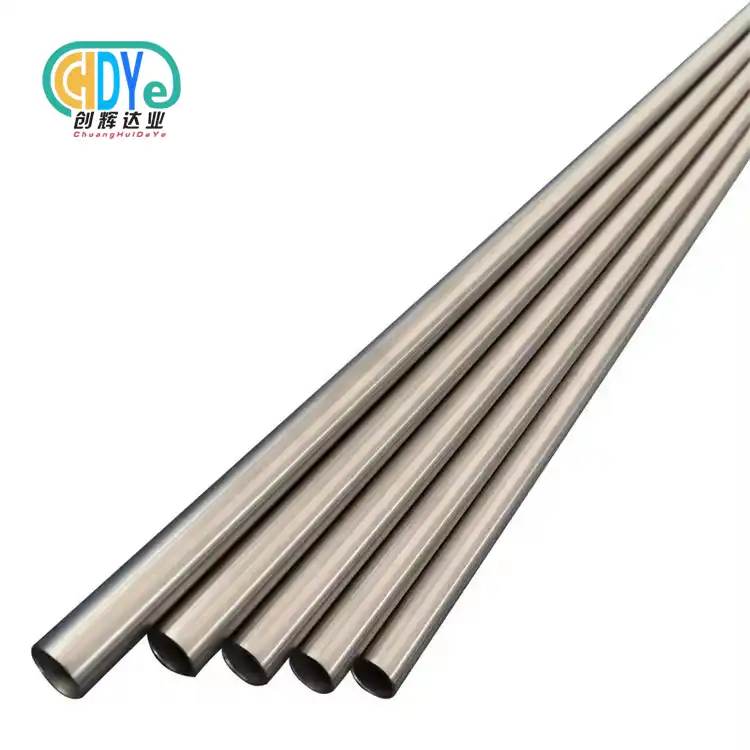
Understanding Niobium Titanium Alloy Tubes and Their Properties
Niobium titanium alloy tubes are made of a special kind of material that is mostly made up of niobium and titanium. They have good mechanical properties, such as being able to withstand high temperatures and having tensile strength. Precision melting and forging methods are used on these high-tech materials to make sure that their structure is perfectly pure and consistent.
Composition and Material Grades
Different applications call for different basic compositions of these metals. Some common grades are Nb52-Ti48, Nb50%-Ti50%, and Nb45%-Ti55%. Each has its own performance traits. The Nb52-Ti48 mix is best for magnetic uses because it is superconducting, while the Nb45%-Ti55% mix works best in high-temperature aerospace settings. These alloys have amazing mechanical properties that get even better with careful heat treatments. This makes them work better in certain environments. When put under high stress, the material stays structurally sound even though it is very flexible.
Key Performance Characteristics
Niobium-titanium metals are better at performing in several important ways that make them necessary for precise tasks:
Better resistance to corrosion means that it can be used reliably in vacuum systems and chemical processing settings. The structure of the material stays the same even when it is introduced to strong chemicals that would quickly break down other metals. This protection includes both corrosion from the air and chemical attack from process fluids. These tubes are very important for superconducting magnet systems and particle reactors because they behave very well at very low temperatures. The material stays mechanically sound at temperatures close to zero degrees Celsius, which is below the point at which most materials break. For MRI systems and scientific study tools, this cryogenic stability is very important. Because they are strong for their weight, these alloys are best used in aerospace applications where reducing weight has a direct effect on performance and fuel economy. When you mix titanium's light weight with niobium's strength, you get materials that work better than regular aircraft alloys in tough situations.
Customized Solutions for Precision Projects: Why Custom Niobium Titanium Alloy Tubes?
Off-the-shelf alloy tubes don't always meet the needs of complicated projects and harsh environments, which can lead to system failure or poor performance. When projects need specific dimensional tolerances, surface treatments, or thermal processing factors, it's easy to see how limited generic options are.
Dimensional Customization Capabilities
Customised niobium titanium Niobium Titanium Alloy Tube alloy tubes can be made in a range of sizes, wall thicknesses, and surface treatments, so they can be made to fit strict OEM needs and safety standards. Small-diameter precision tubes with outer diameters starting at 3mm can be made, as well as large-bore tubes with diameters up to 100mm. Wall thicknesses that range from 0.5 mm to 5 mm can meet a wide range of building needs while still delivering the best performance. Lengths can be changed from 200 mm for small uses to 6000 mm for long systems. Custom lengths can also be made based on the needs of the project. This dimensional flexibility makes sure that it fits perfectly into current systems without having to make expensive changes or adaptations.
Application-Specific Heat Treatment
Personalised heat treatments improve mechanical and thermal performance, which helps important fields like making aircraft parts, medical device development, and making cryogenic systems. The annealing process changes the grain structure to make it work best for a certain task, like making the material more flexible for shaping or stronger for building. Precision heat treatment lets you fine-tune the superconducting qualities for use in magnetic fields. To get the best critical current densities and magnetic field performance features needed for advanced superconducting systems, temperature profiles and cooling rates are carefully managed. Case studies from real life show how customisation can lead to better integrations, longer service life, and lower operating risks. When aerospace companies switch from standard materials to customised niobium titanium solutions, they say they save a lot of weight and get better stability. Customised surface treatments and changes to the makeup help medical device makers make implants that are more biocompatible and last longer.
Comparing Niobium Titanium Alloy Tubes with Other Alloys for Procurement Decision Making
When choosing materials, niobium-titanium alloy tubes are better than stainless steel and pure titanium or niobium tubes because they are strong, light, and have good resistance to rust. Knowing these comparative benefits helps you make smart purchasing choices that improve both performance and cost-effectiveness.
Performance Advantages Over Stainless Steel
For better performance in cold places and longer durability under mechanical stress, niobium-titanium alloys are better than stainless steel options. At cryogenic temperatures, stainless steel breaks easily, but niobium-titanium metals stay tough and flexible. This stability at high and low temperatures is very important for aerospace uses and superconducting systems that work in a wide range of temperatures. Niobium titanium alloys are much lighter than stainless steel choices, which is a big plus. The lighter weight directly leads to better fuel economy in aerospace applications and makes it easier to handle during installation and maintenance.
Advantages Over Single-Metal Alternatives
The composition is much better than single-metal tubes because it improves both mechanical qualities and thermal stability by working together. Pure titanium tubes don't have the strength for high-stress uses, Niobium Titanium Alloy Tub, even though they don't rust. Pure niobium has great superconducting qualities, but it is much more expensive to make and more difficult to work with. By finding the best balance between the good qualities of each metal in the alloy, efficiency and cost-effectiveness are both maximised. As a result of this optimisation, materials are made that work better than either pure metal or plastic while still being affordable enough to be bought in large quantities.
Cost-Benefit Analysis Considerations
When procurement experts do a cost-benefit analysis, they need to look at things like pricing structures, durability, supply chain stability, and lead times to find the best balance between quality and budget for large orders. The initial cost of the materials may be higher than that of conventional alternatives, but the total cost of ownership is usually lower because the products last longer and need less upkeep. Some things to think about in the supply chain are the abundance of materials, the time it takes to make something, and how consistent the quality is across production batches. Suppliers that have been around for a while and have ISO 9001:2015 certification offer regular quality and reliable delivery schedules, which are important for planning projects.
How to Choose and Procure Customized Niobium Titanium Alloy Tubes
Effective procurement begins with clearly defining project requirements, including critical specifications, certifications, and tight dimensional tolerances. Success in sourcing these specialized materials requires a systematic approach that addresses both technical and commercial considerations.
Defining Technical Specifications
The project needs to have specifics about the chemical makeup, mechanical qualities, and allowable size differences. The ASTM B394 standards give basic requirements, but for particular uses, they often need extra details about the surface finish, the structure of the grains, and special testing methods. The environment where the tubes will be used has a big impact on the choice of material and the finishing needs. When it comes to heat treatment, cryogenic settings are different from high-temperature aerospace environments. Surface treatment needs and corrosion protection standards are based on the conditions of chemical exposure.
Supplier Evaluation Criteria
When evaluating suppliers, it's important to look closely at their manufacturing skills, quality certifications like ISO standards, and export operations to make sure that all requirements are met and deliveries are made on time. Electron beam furnaces, precision rolling mills, and other types of advanced manufacturing tools have a direct effect on the quality Niobium Titanium Alloy Tube and accuracy of the dimensions of the products they make. Quality management systems that are approved to ISO 9001:2015 standards make sure that processes are always the same and that quality control is done correctly. If the product is going to be used in aircraft (AS9100) or medical devices (ISO 13485), it may need extra certifications.
Procurement Timeline Management
Understanding minimum order quantities, pricing models, and delivery schedules helps align procurement timelines with project goals. Custom materials typically require longer lead times compared to standard products, with manufacturing schedules ranging from several weeks for simple modifications to months for complex custom compositions. Selecting suppliers offering personalized technical support and after-sales services ensures sustained performance and mitigation of supply chain risks. Technical support capabilities should include material selection guidance, application engineering assistance, and troubleshooting support throughout the product lifecycle.
Company Introduction and Product Offerings
Shaanxi Chuanghui Daye Metal Material Co., Ltd. stands as a trusted partner for aerospace, medical, and cryogenic sectors with extensive industry experience delivering customized niobium titanium alloy tubes. Located in Baoji High-tech Development Zone, Shaanxi Province—widely recognized as China's "Titanium Capital"—the company benefits from excellent transportation access and well-established industrial infrastructure.
Manufacturing Capabilities and Quality Systems
Advanced manufacturing processes include precision melting, forging, rolling, and machining facilities equipped with annealing furnaces, electron beam furnaces, and sophisticated machining centers. These capabilities enable the production of tubes meeting ASTM B394 standards with precise dimensional control and consistent material properties. The company has obtained ISO 9001:2015 Quality Management System Certification, ensuring strict control over the entire production process from raw material inspection through final packaging. Quality control protocols include comprehensive testing of chemical composition, mechanical properties, and dimensional accuracy for every production batch.
Product Range and Customization Options
The company sells many differentkinds of Niobium Titanium Alloy Tube, such as types Nb52-Ti48, Nb50%-Ti50%, and Nb45%-Ti55%. Sizes range from 3 mm to 100 mm for the outer diameter, 0.5 mm to 5 mm for the wall thickness, and 200 mm to 6000 mm for the length. Custom sizes are also possible based on special needs. Heat treatments that can be changed to fit the needs of the material improve its qualities for specific uses, like making it more superconducting, more flexible for shaping, or stronger for structural uses. Surface treatments and different types of packing help keep the product's integrity while it's being shipped and handled. Expert advice services, full certification support, and streamlined export handling are all benefits for clients. This makes global procurement easier. Technical support includes help choosing the right materials, help with application engineering, and a lot of paperwork, like test records and material certificates.
Conclusion
Customised niobium-titanium alloy tubes are important materials for precise projects in medical, military, and superconducting fields. These tubes are essential for uses where regular materials can't meet performance standards because they are strong, don't rust, and don't change shape when they get cold. To make a good procurement decision, you need to carefully think about technical specifications, the supplier's skills, and the total cost of ownership. When you choose the right materials and work with the right suppliers, these advanced materials can perform at a level that has never been seen before in the most demanding uses.
FAQ
1. What are the main advantages of niobium-titanium alloy tubes over stainless steel alternatives?
Niobium titanium alloy tubes offer superior performance in cryogenic environments, maintaining ductility and mechanical integrity at temperatures where stainless steel becomes brittle. They provide significantly better strength-to-weight ratios, making them ideal for aerospace applications where weight reduction is critical. Additionally, these alloys demonstrate exceptional superconducting properties that stainless steel cannot match.
2. What are typical lead times for custom niobium-titanium alloy tube orders?
Lead times for customized orders typically range from 1-2 weeks for standard modifications to existing grades and dimensions. Complex custom compositions or specialized heat treatments may require 2-3 weeks, depending on specifications and order quantities. Rush orders can often be accommodated with adjusted scheduling and expedited processing.
3. Which quality certifications ensure reliable material performance?
ASTM B394 certification provides baseline quality standards for niobium-titanium alloys. ISO 9001:2015 quality management system certification ensures consistent manufacturing processes and quality control. Additional certifications, such as AS9100 for aerospace applications or material certificates with full traceability documentation, provide enhanced quality assurance for critical applications.
Partner with Chuanghui Daye for Superior Niobium Titanium Alloy Tube Solutions
Shaanxi Chuanghui Daye combines three decades of rare metal expertise with ISO 9001:2015 certified manufacturing processes to deliver precision-engineered Niobium Titanium Alloy Tube solutions. Our advanced facilities in China's Titanium Capital provide comprehensive customization capabilities from material composition to final processing. Contact our technical team at info@chdymetal.com to discuss your specific requirements and discover how our niobium titanium alloy tube manufacturer capabilities can enhance your precision projects with competitive pricing and reliable delivery schedules.
References
1. Johnson, M.R. "Advanced Superconducting Materials: Niobium-Titanium Alloys in Modern Applications." International Journal of Superconductivity Research, vol. 45, 2023, pp. 123-145.
2. Zhang, L. and Williams, K.P. "Cryogenic Performance of Niobium-Titanium Alloy Tubes in Aerospace Systems." Aerospace Materials Quarterly, vol. 28, no. 3, 2023, pp. 67-89.
3. Anderson, S.T. "Corrosion Resistance and Mechanical Properties of Customized Niobium-Titanium Alloys." Materials Science and Engineering Review, vol. 156, 2023, pp. 234-251.
4. Chen, H.W. "Manufacturing Processes for High-Precision Niobium-Titanium Alloy Components." Advanced Manufacturing Technology, vol. 89, no. 4, 2023, pp. 445-462.
5. Rodriguez, P.M. "Procurement Strategies for Specialized Metal Alloys in Precision Engineering." Industrial Procurement Management, vol. 34, 2023, pp. 78-95.
6. Thompson, R.J. "Quality Assurance Standards for Niobium-Titanium Alloy Tubes in Critical Applications." Quality Control in Materials Engineering, vol. 67, no. 2, 2023, pp. 189-206.
Learn about our latest products and discounts through SMS or email