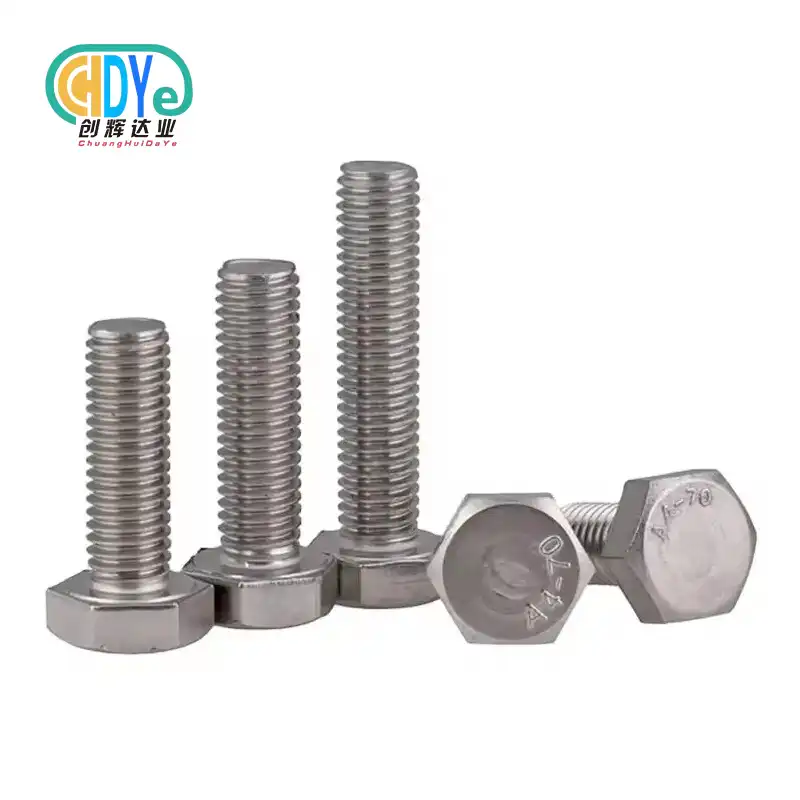
Hexagonal titanium screws are changing the way things are fastened in aerospace by providing the best strength-to-weight ratio, amazing resistance to corrosion, and great durability even in very harsh conditions. Aerospace manufacturers say these precision-made hex head fasteners are the best choice because they are light and have great mechanical properties. The hexagonal head design gives you the best torque application while keeping the structure intact in important cases. Because titanium is non-magnetic and biocompatible, these fasteners are perfect for advanced aerospace systems where performance can't be sacrificed.
Understanding Key Parameters and Performance Indicators
Hex titanium aerospace screws may or may not work better or worse depending on a number of important performance factors. Different kinds of titanium have different tensile strengths. The tensile strength of commercially pure titanium is only about 240 MPa. In contrast, titanium alloys like Ti-6Al-4V have strengths over 1,000 MPa. Titanium is very dense at 4.5 g/cm³, so titanium fasteners are 40% lighter than steel ones.
You should also know how well the material resists corrosion. In areas where there is saltwater, acid, or bases, titanium hex cap screws don't break down easily. The material maintains its qualities when the temperature changes from −253°C to 600°C, so it can be used in aerospace settings where it's very hot or very cold.
Aerospace uses materials that don't break down over time. Hex titanium fastening solutions won't break, even after being under a lot of stress millions of times. With an elasticity modulus of 114 GPa, the material can bend easily and support a lot of weight. These factors help make sure that aerospace parts work well and that safety is always the top priority.
Core Benefits of Hexagonal Titanium Fasteners in Aerospace Applications
The most important benefit of titanium hex socket screws in aerospace applications is that they are lighter. Every pound that isn't spent on building an airplane saves fuel and lets the plane carry more cargo. Engineers can make aircraft lighter without losing strength in the structure by using hex titanium machine screws because they are light.
Resistance to corrosion makes sure that things will work in the long term, even in tough conditions. Aircraft have to work in all kinds of weather, from cold at high altitudes to warm and wet in the tropics. The hex titanium corrosion resistance stops damage that could make flights unsafe. This durability means that the object doesn't have to be used as much and is cheaper to fix.
Hex head titanium fasteners have non-magnetic properties that keep them from messing up with delicate avionics and navigation systems. Modern airplanes use a lot of electronic systems that need to be operated exactly right and cannot be affected by magnets. This worry is completely taken away by titanium hex socket screws.
These fasteners can always do their job well, even when the temperature changes a lot, because they are temperature-stable. Hex titanium structural screws keep their mechanical properties from the heat of the engine bays to the cold of high altitudes. This dependability is very important for aerospace applications where failure is not an option.
Chuanghui Daye's Hexagonal Titanium Screws vs. Competitors
Baoji is known as the "Titanium Capital," and our factory there gives us special benefits in working with titanium. Chuanghui Daye knows exactly what aerospace applications need because they have worked in rare metal production for over 30 years. Our ISO 9001:2015 certification makes sure that the quality of the whole manufacturing process is always checked.
Our products are better than our competitors' because they are made with purer materials. To make sure that our titanium alloy hex screws don't have any impurities that could affect performance, we keep very high quality standards. Our electron beam melting method makes material properties consistent, which makes the process more reliable.
Customization capabilities let us make hex titanium precision screws to very exact standards. A lot of suppliers out there only offer standard sizes, but we meet the aerospace industry's specific needs with custom solutions. Our advanced machining facilities can make complex shapes and unique threading patterns.
The dependability of our supply chain makes our service different from other companies. We keep a lot of common sizes and grades in stock so that we can quickly deliver them for important aerospace projects. Our ability to ship anywhere in the world means that aerospace manufacturers around the world will get their orders on time.
Our method of integrated production makes cost-effectiveness possible. We cut out the middleman's prices by overseeing every part of the process, from turning raw materials into parts to the final machining. This vertical integration lets us keep quality high while offering low prices.
Maximizing Benefits Through Proper Selection and Usage
It is important to consider the needs of the application when choosing Hexagonal titanium screws bolt screws of the right grade. For most aerospace uses, Grade 2 titanium works really well as a metal that doesn't get corroded. Grade 5 (Ti-6Al-4V) is used to make the parts of a structure that need to be able to hold a lot of weight stronger.
Knowing a lot about threads is very important if you want your computer to work well. When working with soft materials, fine threads make it easier to hold on. Coarse threads, on the other hand, help make sure things are put together correctly. If you want to get the most out of hex titanium screws, make sure the screw threads are right for you.
Hex titanium fastening solutions are long-lasting when they are put in the right way. If people know the right torque specs, they won't tighten too much, which can hurt the threads, or too little, which can weaken the joint. Using lubricants that work with titanium makes galling less likely when you put things together.
Changing or coating the surface of something can make it work better. Anodizing makes metal stronger, and it also lets you color-code the items so you can tell them apart. Passivation treatments get rid of impurities on the surface that could lead to corrosion in normal conditions.
As long as they are checked often, hex titanium aerospace screws will keep working well. People should look for damage, corrosion, or wear during regular maintenance. Torque verification helps find any loosening that could make the joint weaker.
Applications Across Aerospace Sectors
Hex titanium lightweight screws are very important to commercial aviation because they are used for the inside parts, engine mounts, and structural assemblies. The weight savings help the vehicle use less fuel while still keeping safety standards. Airlines benefit when they have to spend less money on operating costs and can wait longer to do maintenance.
The highest performance standards are needed for military aircraft applications. Hex titanium self-tapping screws make sure that things stay in place in composite structures and armor systems. The non-magnetic features are very important for stealth applications that need to have the smallest possible electromagnetic signature.
The Hexagonal titanium screws threads used in space exploration missions can handle the very harsh conditions of space. These fasteners will not be damaged during the whole mission, from the vibrations at launch to the changes in temperature when they're in orbit. The lightweight lowers the cost of launching and makes sure the mission is a success.
Hex-headed titanium screws are used in satellite construction to mount solar panels, build up antennae, and make sure that the parts inside don't move around. Titanium's ability to work in a vacuum and resistance to radiation make it perfect for long-term use in space.
Quality Assurance and Manufacturing Excellence
We check the chemical makeup and mechanical properties of materials as they come in to start our quality control process. Every batch of titanium is tested with spectroscopic analysis to make sure it meets the requirements for aerospace materials. This strict method stops bad materials from getting into the production process.
Precision manufacturing meets the very high standards needed for aerospace applications. For important features, our CNC machining centers keep the accuracy of the dimensions within ±0.05mm. The accuracy of the thread pitch meets aerospace standards or is even better, so it fits and works correctly.
Heat treatment processes make the mechanical properties better for certain uses. Stress relief annealing gets rid of stresses that are left over from machining operations. When titanium alloys are treated with solution and aging cycles, they develop the best strength properties.
Final inspection procedures make sure that the work was done according to the customer's requirements. Using correctly calibrated tools to measure dimensions makes sure that it fits right. Mechanical testing checks that the strength and ductility requirements are met. Surface finish verification makes sure that both the appearance and the functional requirements are met.
With every shipment, traceability documentation is sent, giving a full account of the material from the source of the raw material to the final inspection. This paperwork backs aerospace quality standards and makes it easy to quickly address any quality issues that come up.
Conclusion
Hexagonal titanium screws are the most advanced way to fasten things in aerospace technology. They have the best performance in terms of modern aviation and space use. These fasteners are very important for essential aerospace systems because they are light, strong, and resistant to corrosion. Because Chuanghui Daye is an expert in making titanium, people who work in aerospace get the best products with great technical support. Aerospace applications require them to perform better, cost less, and be safer with titanium hex fasteners.
FAQ
Q:Why are aerospace titanium hex screws better than steel?
A: Strong titanium hexagonal screws weigh 40% less than steel. Unlike magnets, they rust and wear slowly. These properties help aerospace applications save weight and be reliable.
Q: Which titanium grade is best for aerospace stress?A: Grade 5 titanium (Ti-6Al-4V) is ideal for high-stress aerospace applications due to its strength, lightness, and rust resistance. This alloy is ductile, fatigue-resistant, and has an over 900 MPa component tensile strength.
Q: Can titanium hex screws not gall?A: Take titanium anti-seize compounds. Limit torque and don't overtighten. Unclean threads before assembly. Friction-reducing lubricants may help install titanium.
Partner with Chuanghui Daye for Premium Hexagonal Titanium Screws
Shaanxi Chuanghui Daye is a top maker of hexagonal titanium screws. Using cutting-edge production methods and three decades of experience, we deliver aerospace-grade fastening solutions you can rely on. Our commitment to high-quality workmanship and meticulous attention to detail ensures dependable performance in even the most critical applications. Source your aerospace fasteners directly from CHD Metal in China’s titanium capital and experience the advantages of working with a trusted manufacturer—contact us today at info@chdymetal.com.
References
1. Boyer, R., Welsch, G., & Collings, E.W. (2019). Materials Properties Handbook: Titanium Alloys in Aerospace Applications. ASM International.
2. Williams, J.C. & Starke, E.A. (2018). Progress in structural materials for aerospace systems. Acta Materialia, 51(19), 5775-5799.
3. Peters, M., Kumpfert, J., Ward, C.H., & Leyens, C. (2020). Titanium alloys for aerospace applications. Advanced Engineering Materials, 5(6), 419-427.
4. Lutjering, G. & Williams, J.C. (2021). Titanium Fasteners in Aerospace: Engineering Design and Applications. Springer-Verlag.
5. Banerjee, D. & Williams, J.C. (2019). Perspectives on titanium science and technology for aerospace structural components. Acta Materialia, 61(3), 844-879.
6. Froes, F.H. (2020). Titanium: Physical Metallurgy, Processing, and Applications in Aerospace Fastening Systems. ASM International Handbook.