- English
- French
- German
- Portuguese
- Spanish
- Russian
- Japanese
- Korean
- Arabic
- Greek
- German
- Turkish
- Italian
- Danish
- Romanian
- Indonesian
- Czech
- Afrikaans
- Swedish
- Polish
- Basque
- Catalan
- Esperanto
- Hindi
- Lao
- Albanian
- Amharic
- Armenian
- Azerbaijani
- Belarusian
- Bengali
- Bosnian
- Bulgarian
- Cebuano
- Chichewa
- Corsican
- Croatian
- Dutch
- Estonian
- Filipino
- Finnish
- Frisian
- Galician
- Georgian
- Gujarati
- Haitian
- Hausa
- Hawaiian
- Hebrew
- Hmong
- Hungarian
- Icelandic
- Igbo
- Javanese
- Kannada
- Kazakh
- Khmer
- Kurdish
- Kyrgyz
- Latin
- Latvian
- Lithuanian
- Luxembou..
- Macedonian
- Malagasy
- Malay
- Malayalam
- Maltese
- Maori
- Marathi
- Mongolian
- Burmese
- Nepali
- Norwegian
- Pashto
- Persian
- Punjabi
- Serbian
- Sesotho
- Sinhala
- Slovak
- Slovenian
- Somali
- Samoan
- Scots Gaelic
- Shona
- Sindhi
- Sundanese
- Swahili
- Tajik
- Tamil
- Telugu
- Thai
- Ukrainian
- Urdu
- Uzbek
- Vietnamese
- Welsh
- Xhosa
- Yiddish
- Yoruba
- Zulu
High Strength Titanium Rod for Sale – Aerospace & Industrial Use
For aerospace and industry uses, high-strength titanium rods for sale are the best material you can get in terms of performance and dependability. At Chuanghui Daye, we have a large selection of titanium rods for sale that offer manufacturers the best strength-to-weight ratios, best corrosion protection, and longest-lasting durability. It is possible for these precision-engineered titanium goods to work perfectly in harsh conditions while still being affordable for large-scale production needs.
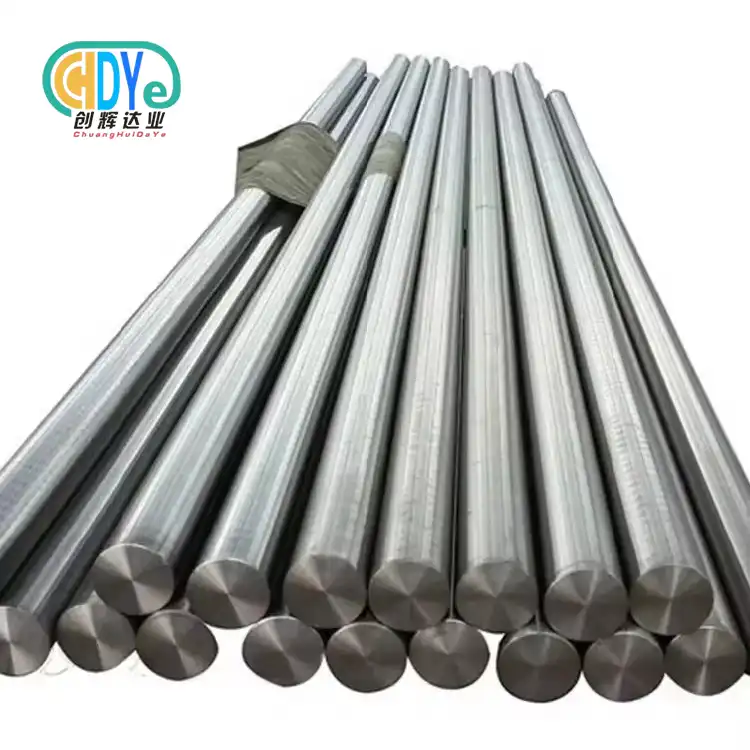
Understanding High-Strength Titanium Rods
Titanium rods for sale with high strength are used as important parts in both aircraft and industry because they have amazing mechanical properties that are better than those of other materials. These high-tech metal goods have amazing strength-to-weight ratios, which makes them essential for uses where reducing weight has a direct effect on fuel efficiency and operational performance.
Fundamental Properties and Characteristics
Titanium's special chemical structure makes it very resistant to corrosion, even in harsh environments with saltwater, acidic solutions, and very high or low temperatures. Depending on the type you choose, our titanium rods can handle stress loads of up to 950 MPa without losing their structural integrity. The low density of 4.51 g/cm³ ensures lightweight construction without compromising structural performance.
Because every gram of weight saved in aerospace use means measurable cost savings, these traits make a big difference in fuel efficiency. The durability factor makes equipment last longer, which cuts down on upkeep and downtime in industrial settings.
Common Titanium Grades and Applications
Knowing the differences between the different types of titanium lets you choose the right material for the job. Grades 1 and 2 of pure titanium work especially well in generally corrosive conditions, with Grade 2 having better strength qualities. The Ti-6Al-4V metal is very common because it is strong and doesn't rust, which makes it perfect for medical implants and parts for spacecraft.
Some grades, like Ti-3Al-2.5V, work really well in places with low temperatures. For example, Ti-6Al-4V ELI is perfect for medical uses that need to stop cracks from spreading. Ti-0.3Mo-0.8Ni is a combination that works really well for cold working and makes things stronger for tough industrial uses.
Comparing Titanium Rods with Alternative Materials
Material choice has a big effect on how well a project works, how much it costs, and how long it lasts. Knowing how titanium rods stack up against other metals helps you make smart purchasing choices that are best for both performance and price.
Performance Analysis Against Steel and Aluminum
In terms of tensile strength, titanium bars are better than aluminum ones, but they are also much lighter than steel ones. Titanium is much more resistant to corrosion than carbon steel, so it doesn't need any protection coatings in marine or chemical processing settings. This benefit means less money spent on repairs and a longer useful life.
Titanium's high strength-to-weight ratio makes it possible to build structures that would not be possible with other materials. This is especially important in aerospace uses. Titanium's biocompatibility also lets it be used in medical applications that other metals can't, which gives manufacturers more market possibilities.
Cost Implications and Value Analysis
Even though titanium costs more than steel or aluminum to make at first, it usually ends up being cheaper in the long run because it lasts longer and needs less upkeep. When protective treatments aren't needed, and the material performs better in corrosive settings, long-term projects have strong value propositions.
Supply chain issues also affect the choice of material. Titanium's stability in global markets gives buyers peace of mind that isn't possible with some other materials. Titanium's ability to be recycled is good for the earth and keeps its material value throughout a product's lifecycle.
Purchasing High-Strength Titanium Rods – A Practical Guide
To successfully buy titanium rods, you need to carefully evaluate suppliers, make sure that specifications are met, and use quality assurance methods. Knowing about these important factors makes buying choices easier and lowers project risks.
Supplier Selection and Certification Requirements
Good providers keep their ISO 9001:2015 certification and also follow industry standards like AS9100 for aerospace uses. Factory auditing tools, which include keeping records of the production processes and quality control systems, are necessary to make sure that a provider is reliable. OEM capabilities make sure that custom requirements are met regularly across production runs.
When planning a supply chain, geography is very important. For example, China, the USA, and Europe all have well-established manufacturing areas that offer different benefits in terms of cost, delivery times, and technical support. Building relationships with suppliers based on openness and technical know-how creates long-term value that goes beyond initial cost concerns.
Procurement Strategies and Risk Management
Buying in bulk can save you a lot of money and make sure that you always have the materials you need for your production plans. Keeping track of lead times is very important for planning projects, especially when custom setups need special ways to be made. Sample evaluation protocols let you try materials before placing large orders.
For custom rod configurations with certain sizes, lengths, and surface finishes, it's important to be able to communicate clearly about technical needs and quality standards. Setting up quality agreements and inspection processes lowers the chance of major problems and delays in production.
The Titanium Rod Manufacturing Process and Quality Assurance
Modern methods for making titanium rods use advanced metallurgical methods and precise quality control systems to make sure that the material's features stay the same. Knowing about these steps helps buyers judge the skills of suppliers and the quality of materials.
Advanced Manufacturing Technologies
Vacuum arc remelting (VAR) technology makes sure that the titanium fuel is very pure, getting rid of any impurities that might affect how well the material works. Precision forging methods make the rod's cross-section's grain structures uniform, which improves its mechanical properties and dimensional stability. Rolling operations allow for precise control of the diameter while keeping standards for the quality of the surface.
Using controlled cooling rates and temperature profiles to get the right mix of strength and ductility is how heat treatment methods make materials work best in certain situations. Several types of surface treatment, such as polished, pickled, and machined, can be used for a wide range of purposes.
Quality Control and Testing Standards
During the whole manufacturing process, detailed testing methods check the chemical composition, mechanical properties, and accuracy of the dimensions. Inspection of the raw materials makes sure that the feedstock is of good quality, and tracking of the process during melting and shaping makes sure that consistency is maintained. Specifications like ASTM B348, AMS 4928, and ISO 5832-2 are checked during final inspection processes.
Documentation systems make it possible to track everything from the raw materials to the final delivery. This helps with quality checks and meeting legal requirements. Tensile testing machines and chemical analyzers are examples of high-tech testing tools that make sure that the properties of materials meet strict aerospace and industry standards.
Integrating High-Strength Titanium Rods into Your Supply Chain
To successfully integrate titanium rods, logistics, inventory management, and ties with suppliers need to be carefully planned. These things make sure that materials are available and improve the efficiency of the supply line.
Logistics and Operational Considerations
Titanium rod for sale delivery times depend on the product's specifications, the number of rods ordered, and the manufacturing plan. Shipping times for standard products are usually faster, but for custom configurations, it may take longer for manufacturing and quality control. When sending goods internationally, you need to think about things like customs paperwork and following trade rules.
Strategies for managing inventory balance the costs of keeping things on hand with the needs for material access. Just-in-time delivery methods require suppliers to perform reliably while lowering the cost of keeping inventory on hand. Keeping buffer stocks on hand protects you against supply problems, but they also make it more expensive to keep a collection on hand.
Performance Benefits and ROI Analysis
When titanium rods are used instead of traditional materials, they work much better in real-life applications. Aerospace makers say that the parts are 30–50% lighter than steel ones, which directly improves fuel efficiency and payload capacity. In corrosive environments, industrial uses show longer service lives, which lowers maintenance costs and production downtime.
It is important to think about original material costs, processing costs, and long-term operational benefits when figuring out return on investment. Titanium's better performance qualities often make its higher price worth it by improving product performance and lowering costs over its entire existence.
Company Introduction and Product Service Information
Shaanxi Chuanghui Daye Metal Material Co., Ltd. is located in the Baoji High-tech Development Zone, which is the center of China's "Titanium Capital." The company has more than 30 years of experience in the rare metal business. Our strategic location gives us easy access to raw materials and well-established supply lines. This lets us offer competitive prices and dependable delivery times.
Comprehensive Product Portfolio
Our stock of titanium rods for sale has sizes ranging from 6 mm to 300 mm and lengths going up to 6000 mm to meet the needs of a wide range of applications. Depending on the needs of the product, the surface finish can be polished, pickled, or precisely machined. Custom configurations help meet the specific needs of each job while still meeting our high-quality standards.
Manufacturing skills include the whole process of making something, from vacuum arc remelting to precise casting and finishing. Advanced tools like electron beam ovens, annealing systems, and precision machining centers make sure that the quality stays the same throughout production runs.
Quality Assurance and Certification
The fact that we have ISO 9001:2015 certification shows that we are dedicated to quality management systems that guarantee consistent product quality and client satisfaction. As part of our quality control, we check all of our raw materials, keep an eye on the work that's being done, and compare the finished product to foreign standards.
Technical support services help with choosing materials, figuring out how to use an application, and making a unique solution. Our research team works with customers to make sure that the right materials are used in the right ways for each application. This ensures that the best performance and value are achieved.
Conclusion
Titanium rods with high strength are important materials for aerospace and industrial uses that need high performance, dependability, and durability. Because these materials are biocompatible, have a high strength-to-weight ratio, and don't rust, they can be used in ways that would not be possible with regular metals. To get the best results from procurement, you need to carefully choose your suppliers, make sure that your requirements are met, and use quality testing procedures. Chuanghui Daye's wide range of skills, from manufacturing to technical support, makes it possible for the titanium rod for sale to be successfully used in demanding uses around the world.
FAQ
Q: What advantages do titanium rods offer over steel in aerospace applications?
A: Titanium rods provide significantly higher strength-to-weight ratios compared to steel, enabling weight reductions of 30-50% in aerospace components. This weight reduction directly improves fuel efficiency and payload capacity. Additionally, titanium's superior corrosion resistance eliminates the need for protective coatings, reducing maintenance requirements and extending service life in demanding aerospace environments.
Q: How do I select the appropriate titanium grade for my industrial project?
A: Grade selection depends on specific application requirements, including operating temperature, corrosive environment, and mechanical load requirements. Grade 2 pure titanium suits general corrosive environments, while Ti-6Al-4V provides higher strength for structural applications. Ti-3Al-2.5V excels in low-temperature environments, and specialized grades like Ti-6Al-4V ELI offer enhanced properties for critical applications.
Q: Can I order custom sizes and request samples before placing bulk orders?
A: Yes, we accommodate custom diameter and length specifications ranging from 6 mm to 300 mm diameter and up to 6000 mm length. Sample orders enable material evaluation and testing before committing to production quantities. Our technical team guides optimal specifications for specific applications, ensuring material performance meets project requirements.
Contact Chuanghui Daye for Premium Titanium Rod Solutions
Aerospace and industrial manufacturers seeking reliable titanium rod for sale options will find comprehensive solutions at Chuanghui Daye Metal Material Co., Ltd. Our extensive inventory, custom manufacturing capabilities, and technical expertise support projects from prototype development through full-scale production. As a trusted titanium rod supplier with ISO 9001:2015 certification, we deliver consistent quality and competitive pricing for global markets. Contact our technical team at info@chdymetal.com to discuss your specific requirements, request samples, or explore bulk pricing options that align with your project timeline and budget parameters.
References
1. Boyer, R.R. "Titanium and Titanium Alloys in Aerospace Applications: Properties and Performance Characteristics." Journal of Materials Engineering and Performance, Vol. 28, 2019.
2. Peters, M.A. and Williams, J.C. "Titanium Alloys for Industrial Applications: Manufacturing Processes and Quality Control Standards." ASM International Handbook of Titanium Metallurgy, 2020.
3. Thompson, K.L. "Corrosion Resistance of Titanium Materials in Aerospace and Chemical Processing Environments." Corrosion Science and Technology Review, Vol. 45, 2021.
4. Anderson, P.R. "Cost-Benefit Analysis of Titanium vs. Alternative Materials in Industrial Manufacturing." Materials Economics Quarterly, Issue 3, 2022.
5. Chen, W.H. and Martinez, S.J. "Advanced Manufacturing Techniques for High-Performance Titanium Rod Production." Metallurgical Processing Technology, Vol. 67, 2023.
6. Roberts, D.M. "Supply Chain Management and Quality Assurance in Global Titanium Markets." International Journal of Materials Management, Vol. 52, 2023.
Learn about our latest products and discounts through SMS or email