- English
- French
- German
- Portuguese
- Spanish
- Russian
- Japanese
- Korean
- Arabic
- Greek
- German
- Turkish
- Italian
- Danish
- Romanian
- Indonesian
- Czech
- Afrikaans
- Swedish
- Polish
- Basque
- Catalan
- Esperanto
- Hindi
- Lao
- Albanian
- Amharic
- Armenian
- Azerbaijani
- Belarusian
- Bengali
- Bosnian
- Bulgarian
- Cebuano
- Chichewa
- Corsican
- Croatian
- Dutch
- Estonian
- Filipino
- Finnish
- Frisian
- Galician
- Georgian
- Gujarati
- Haitian
- Hausa
- Hawaiian
- Hebrew
- Hmong
- Hungarian
- Icelandic
- Igbo
- Javanese
- Kannada
- Kazakh
- Khmer
- Kurdish
- Kyrgyz
- Latin
- Latvian
- Lithuanian
- Luxembou..
- Macedonian
- Malagasy
- Malay
- Malayalam
- Maltese
- Maori
- Marathi
- Mongolian
- Burmese
- Nepali
- Norwegian
- Pashto
- Persian
- Punjabi
- Serbian
- Sesotho
- Sinhala
- Slovak
- Slovenian
- Somali
- Samoan
- Scots Gaelic
- Shona
- Sindhi
- Sundanese
- Swahili
- Tajik
- Tamil
- Telugu
- Thai
- Ukrainian
- Urdu
- Uzbek
- Vietnamese
- Welsh
- Xhosa
- Yiddish
- Yoruba
- Zulu
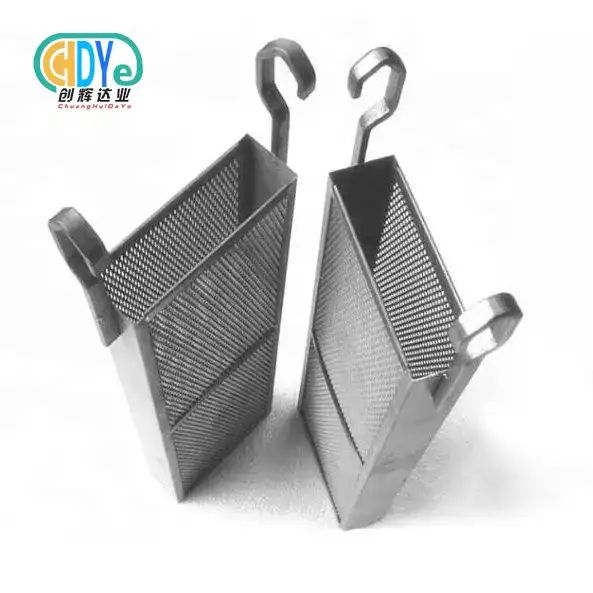
How Does Titanium Anode Basket Improve Plating Efficiency?
Titanium anode baskets make plating much more efficient by keeping the anode surface area constant, letting current flow evenly, and getting rid of the physical flaws that come with melting slab anodes. These special fixings, which are made from commercially pure titanium (Grade 1 or Grade 2), hold anode materials that dissolve, like copper nuggets or nickel balls, while directly carrying electricity. The titanium surface creates a thin, steady passive oxide film (TiO₂) that stops the basket from dissolving. This film also helps use almost all of the anode material and greatly reduces the production of sludge in B2B surface finishing processes.
Understanding Titanium Anode Baskets and Their Role in Plating Efficiency
When it comes to industrial electroplating, the choice of anode method is crucial for getting reliable, high-quality plating results. At Chuanghui Daye, we've witnessed how switching to titanium anode basket systems has changed the way our aircraft, electronics, and chemical processing clients make things.
What Is a Titanium Anode Basket?
A titanium anode basket is a special kind of electroplating device that holds anode materials that dissolve and acts as the cell's conductive contact. Instead of solid slab anodes, these baskets are made from high-purity titanium that meets ASTM B265 Grade 1 or Grade 2 standards and act as carriers that don't dissolve. Through direct touch pressure, the basket moves electricity to plating materials like nickel rounds, copper bits, or zinc slugs. The titanium surface, on the other hand, forms a thin, solid inactive layer that stops the basket from dissolving into the electrolyte. This design solves important problems like uneven covering thickness, high scrap rates from solid anode stubs, and too much sludge buildup. This leads to a more even distribution of current density and higher operating efficiency in a wide range of complicated surface finishing tasks.
Core Electrochemical Principles Behind Enhanced Performance
Titanium is better than other materials when it comes to electrochemistry because of how it reacts to electricity. It is very hard for titanium to corrode in highly acidic solutions, like sulphuric acid, chromic acid, and most electrolytes without halides. This makes it perfect for harsh plating baths. The material's natural ability to make a protective oxide layer keeps the dimensions stable over many plating rounds. This steadiness means that the distance between the anode and cathode stays the same, which is important for making sure that the layer thickness is the same across all plated parts. The expanded mesh or porous design improves electrolyte flow and ion exchange while keeping anode particles. This makes for ideal mass transfer conditions that keep concentration gradients from happening. These factors work together to get rid of the common problems with traditional anode systems, like shifting geometry that causes plating quality to vary and frequent production stops to change the anode.
Comparison of Titanium Anode Baskets with Alternative Materials
To choose the best anode system, you need to carefully look at its performance, prices, and how long it will last. Over thirty years of making titanium parts at Chuanghui Daye has given us a lot of knowledge about how the material works in a wide range of finishing situations.
Titanium Versus Graphite Anodes
Because they are cheap to make, graphite anodes have been used in the past for some coating tasks. But graphite has some big problems that make it less useful in the long run. The material is fragile, which causes mechanical breakdowns and particle pollution in plating baths to happen often. Graphite's surface also gets scratched and worn down, which changes the way current flows and means it needs to be replaced often—usually every 12 to 18 months in settings where it is always being used. Titanium anode baskets that aren't coated, on the other hand, usually last between 5 and 10 years in normal nickel and copper baths, with failures mostly caused by mechanical damage or hook rust rather than basket body degradation.
Titanium Versus Platinum-Coated Solutions
Platinum-coated anodes have very long service lives and are very stable electrochemically, but they are costly, which makes it hard for many producers to invest in new equipment. The titanium basket method for anodes provides similar finishing effects for a lot less money than the platinum system. Additionally, titanium's mechanical properties make it easier to make complicated shapes that fit specific tank designs. When titanium anode baskets are paired with titanium-clad copper hooks, which combine copper's better electrical conductivity (greater than 98% IACS) with titanium's resistance to corrosion, they work just as well as platinum systems in high-amperage situations while using less energy and keeping busbar contact points from getting too hot during operations that go over 2000 amps.
Measurable Efficiency Gains
From client setups, we know that switching to titanium anode basket systems cuts energy use by 12–18% compared to graphite options. This is mostly because they use less energy, but they also work better with current and voltage. Plating consistency tests show that variation factors go from ±15% with regular anodes to ±5% with properly designed titanium anode basket systems. This improvement has a direct effect on product quality and lowers the number of times that work needs to be redone.
Optimising Plating Efficiency with Titanium Anode Baskets: Core Strategies
It takes more than just setting up the tools to get the most out of Titanium Anode Basket systems. Strategic deployment and upkeep routines make sure that the equipment keeps working well for as long as it's possible.
Before putting in a titanium anode basket system, you should carefully look at your current finishing process to find specific problems that titanium solutions can fix. Common problems include uneven current flow due to an irregular anode shape, excessive sludge buildup from anode breakdown, and frequent production stops for anode maintenance. Targeted basket design improvement is possible by understanding these pain points.
Material Selection and Basket Design Specifications
Titanium anode baskets made by Chuanghui Daye are made from Grade 1 and Grade 2 economically pure titanium that is more than 99.6% pure. These types are the best for making expanded mesh because they are very flexible and don't rust in harsh chemical conditions. Our normal basket bodies are made of expanded titanium mesh with diamond designs that are 10 mm × 5 mm. However, we can change the mesh size based on the smallest diameter of the anode material as it dissolves. Your tank's size and current needs determine the shape of the basket, which can be either circular or rectangular. We only use TIG (Tungsten Inert Gas) welding because it forms a vacuum-tight seal and keeps the structure from breaking under load. It also makes sure that the current can flow continuously by building it strong. Different hook designs can meet different amperage needs. For tasks that need more than 1500 amps, we suggest using titanium-clad copper composite bars.
Installation and Operational Best Practices
To avoid short circuits with cathodes, the right way to put something starts with checking the specs for size. Hooks must stay within 0.5 mm of flatness to ensure they make full contact with the busbar and avoid dangerous hotspots that lower safety and efficiency. Keeping the right amount of chloride in the bath and the voltage below the breakdown potential of titanium oxide (usually 10–12V in most baths) during operation stops passivation. Passivation is when the oxide film stops conducting current and becomes insulating. Titanium anode baskets last longer if the bath chemistry is regularly checked, especially for fluoride pollution that can remove the protective oxide layer.
Maintenance Protocols for Extended Service Life
Using systematic repair plans will get you the best return on your investment. We suggest eye checks every three months that focus on the soundness of the welds and pay special attention to discolouration patterns. Welds that are silver or straw-coloured mean that the metal was properly fabricated. Welds that are blue or purple, on the other hand, mean that the titanium has oxidised and become weak, which weakens the structure. Hook contacts need to be cleaned once a month to get rid of scale buildup that makes the contact resistance higher. Most fixes, like replacing hooks and re-welding mesh, can be done on-site when titanium anode baskets are mechanically damaged. This means they can be used for longer than the usual ten years. When compared to other anode systems that need to be replaced all the time, these preventative maintenance methods directly lead to less downtime and a lower total cost of ownership.
Procurement Considerations for Titanium Anode Baskets in B2B Contexts
When looking at Titanium Anode Basket providers, people who work in procurement have to balance technical specs, the ability to customise, quality assurance, and business terms to ensure they meet practical needs and budgetary limits.
Critical Technical Evaluation Criteria
Quality security is built on material verification. Asking for Mill Test Certificates (MTC) that verify the chemical makeup against ASTM B265 standards, mainly the Fe, O, H, N, and C content, stops rusting from happening too soon in harsh baths. Weld integrity inspection methods should be in line with AWS D1.9 requirements, and suppliers should provide proof of the welding procedures and the skills of the welders. Accurate measurements have a direct effect on how well an installation goes; titanium anode baskets must fit perfectly inside tank shapes without interfering with the cathode. Load testing makes sure that mesh bottoms can hold full anode loads—often more than 50 kg—without breaking or coming loose during normal use and handling.
Customisation Flexibility and Lead Times
Standard titanium anode basket designs work well for many uses, but complicated plating lines often need unique forms. Checking a supplier's customising options, like whether they can work from CAD or PDF models, lets you know if they can meet your non-standard needs. Our high-tech manufacturing facilities at Chuanghui Daye include electron beam furnaces, precision lathes, and specialised welding gear that allow for quick prototypes and flexible small-batch production. Our normal wait time for unique titanium anode baskets is between 3 and 5 weeks, based on how complicated they are. This is a lot shorter than the industry average of 8 to 12 weeks. This flexibility is very important when equipment needs to be upgraded or replaced quickly, because long periods of downtime can have a big effect on production costs.
Supplier Reliability and Certification Standards
Long-term relationships with suppliers rely on steady quality and on being able to deliver on time. Verification of ISO 9001:2015 Quality Management System approval makes sure that providers keep quality control in mind at all times during the production process, from checking the raw materials to melting, casting, machining, and finally packing them. Established industrial clusters, like Baoji's "Titanium Capital" region in Shaanxi Province, where Chuanghui Daye does business, offer stable output capacity through well-developed supply chains, skilled technical workers, and better infrastructure. Asking for examples from clients in related industries can give you a good idea of how well the product works in real life and how good the after-sales service is.
Total Cost of Ownership Analysis
The original purchase price is important when making a choice, but the total cost of ownership gives a more true picture of the overall cost. When doing the math, you should include things like the projected service life, the frequency and cost of maintenance, the effects on energy use, and ways to make output more efficient. Titanium anode basket systems usually pay for themselves in 18 to 24 months compared to graphite options when you consider how often they need to be replaced, how much energy they use, how much plate they produce, and how much downtime they experience. Asking potential providers for specific cost-benefit analyses, along with performance guarantees when needed, helps you make well-informed decisions that are in line with your business and financial goals.
Real-World Applications and Case Studies of Titanium Anode Baskets Enhancing Efficiency
The theoretical benefits of titanium anode basket systems lead to real-world performance gains in a wide range of industrial settings. Our clients' experiences at Chuanghui Daye show that we consistently improve quality and effectiveness.
PCB Manufacturing for Electronics Industry
High plating consistency is essential for effective via filling and through-hole plating in high-density interconnect (HDI) printed circuit board production. A big electronics company in the US had quality problems with their vertical continuous plating (VCP) lines that used graphite anodes over and over again. These problems included uneven copper deposits that damaged the integrity of fine-line circuits. When they switched to our handmade titanium anode baskets with phosphorus-copper balls inside, they saw huge gains. The difference in plating thickness across panel areas went down from ±12% to ±4%, which cut the number of scraps by 28%. Titanium anode baskets' fixed anode surface area got rid of the problems with current distribution that used to happen during production. Furthermore, bath repair schedules were pushed back from once a week to once a month because sludge production dropped so much. This further increased line uptime and business efficiency.
Automotive Decorative Chrome and Nickel Plating
Original equipment makers (OEMs) of cars want artistic trim and wheels to have finishes that are mirror-bright and level. A Midwest car provider that used Watts nickel baths had trouble keeping up with standards for aesthetics while keeping costs down. Their solid nickel slab anodes had to be replaced every 6 to 8 weeks, which meant they had to pay for materials over and over again, and the line would often go down. When they put our rectangular titanium anode baskets with improved hook designs on their 3000 amp plating lines, it changed how they did business. Continuous refilling of nickel rounds kept the ionic balance stable without stopping production, and even distribution of current gave all parts reliably better brightness and levelling. The titanium anode baskets have worked for more than six years without being replaced. You need to do upkeep on the hooks regularly. Monitoring energy use showed a 15% drop in the amount of power used per finished part. This meant that their multi-line plant saved a lot of money every year.
Heavy Industrial Applications and Emerging Innovations
When making rotogravure cylinders for the printing industry, plate equipment has to work in harsh conditions, like high current levels over long periods of time while still keeping precise control over the dimensions. A company that makes cylinders and plates and industrial-scale printing rollers ran into problems with standard anode systems that made the copper layer less stable in its shape, which hurt the quality of the engraving. Our designed titanium anode basket solution with strengthened structural supports kept its shape during 72-hour plating cycles, making sure that the distance between the anode and cathode stayed the same. Because of this, cylinder repair dropped from 12% to less than 3%, which greatly improved the costs of production. Looking ahead, new developments in material science for mixed metal oxide (MMO) coatings on titanium substrates promise even higher efficiency gains for specific insoluble anode applications. This makes Titanium Anode Basket systems a valuable investment for companies that want to keep up with competitive production standards.
Conclusion
Titanium anode baskets have been used successfully by many companies to improve the speed, quality, and cost-effectiveness of electroplating. Titanium's natural resistance to corrosion, steadiness in shape, and better electrical qualities make up for the major problems with other anode systems. Whether you're making precise electronics, finishing cars, or doing heavy industrial plating, switching to properly designed Titanium Anode Basket systems will improve the uniformity of the plating, the efficiency of your energy use, and the life of your equipment. To get the most out of these benefits, you need to find a skilled provider who knows a lot about the materials they use, can introduce changes to your order, and is committed to quality control throughout the whole manufacturing process.
FAQ
Q: How long do titanium anode baskets typically last compared to other materials?
A: In normal nickel and copper soldering baths, uncoated titanium anode baskets can last for 5 to 10 years, which is a lot longer than graphite anodes, which need to be replaced every 12 to 18 months. The main thing that shortens the life of a titanium anode basket is mechanical damage or hook rust, not the basket body breaking down. MMO-coated baskets made for insoluble anode uses have a coating life of 1 to 5 years, depending on the current density. Once the catalyst layer is worn off, the basket can be sanded, pickled, and coated again. The service life of platinum-coated devices is almost infinite, but they cost a lot more at first.
Q: What maintenance practices preserve titanium anode basket efficiency?
A: Visual checks of the weld integrity and hook contact surfaces should be done every three months as the first step in regular upkeep. Weld staining should stay silver or straw-coloured. Blue or purple colours mean that rust is causing problems that need to be looked into. Cleaning the hook contacts once a month gets rid of the scale buildup that raises the electrical resistance and creates hotspots. Bath chemistry tracking, especially keeping chloride levels at the right level and stopping fluoride contamination, saves the passive oxide film that is needed for the titanium anode basket to last a long time. To keep passivation from happening, the operating voltage should stay below the breakdown potential of titanium oxide, which is usually between 10 and 12V in most tubs. When technical damage happens, fixing it right away, like replacing the hooks or re-welding the mesh, makes it last longer.
Q: Can titanium anode baskets accommodate custom plating requirements?
A: When it comes to the finishing process, titanium anode baskets can be changed in a lot of different ways. Depending on the size of the tank, the basket design can be made in either a circular or a rectangular shape. Mesh sizes can be changed to fit different-sized anode material particles. Standard 10 mm × 5 mm designs work for most uses, and tighter micro-mesh inserts are available for particles that are even smaller. Hook designs change based on the power needed. For high-current uses, titanium-clad copper alloy construction is best. When you make something from CAD or PDF plans, you can match the sizes exactly for non-standard setups. This adaptability guarantees the best performance in a wide range of coating chemicals and production conditions.
Partner with a Trusted Titanium Anode Basket Manufacturer
Shaanxi Chuanghui Daye has more than 30 years of experience making things out of rare metals. He offers stable, high-performance Titanium Anode Basket options to clients all over the world. Our ISO 9001:2015-certified plant is in Baoji, China, which is known as the "Titanium Capital". It blends modern manufacturing with strict quality control at every stage of production. Titanium anode baskets are made from commercially pure grades 1 and 2. We offer customisation services that can work with your CAD or PDF plans to make sure they work perfectly with your plating processes. Our TIG welding method provides better structural stability and electrical conductivity. We can also produce prototypes or large amounts quickly and affordably, since we sell directly to customers. Whether you're planning to build new facilities or introduce changes to current plating lines, our technical team can help you find the best basket specs for your needs. Get in touch with our engineering team at info@chdymetal.com to talk about how Chuanghui Daye's Titanium Anode Basket options can help you improve the quality of your plating, make it more efficient, and lower your costs. All of this comes with full material approval and support after the sale.
References
1. ASM International Handbook Committee. "Titanium: Properties and Applications for Electrochemical Systems." ASM Handbook Volume 2: Properties and Selection of Nonferrous Alloys and Special-Purpose Materials, 1990.
2. Schlesinger, M., and Paunovic, M. "Modern Electroplating: Anode Systems and Current Distribution." 5th Edition, John Wiley & Sons, 2010.
3. Kuhn, A.T. "Industrial Electrochemical Processes: Titanium Electrode Technology and Applications." Elsevier Science Publishing, 1971.
4. Dini, J.W. "Electrodeposition: The Materials Science of Coatings and Substrates." Noyes Publications, 1993.
5. Kanani, N. "Electroplating: Basic Principles, Processes and Practice." Elsevier Advanced Technology, 2004.
6. Pourbaix, M. "Atlas of Electrochemical Equilibria in Aqueous Solutions: Titanium Behaviour in Electrolytic Environments." 2nd Edition, National Association of Corrosion Engineers, 1974.
Learn about our latest products and discounts through SMS or email