- English
- French
- German
- Portuguese
- Spanish
- Russian
- Japanese
- Korean
- Arabic
- Greek
- German
- Turkish
- Italian
- Danish
- Romanian
- Indonesian
- Czech
- Afrikaans
- Swedish
- Polish
- Basque
- Catalan
- Esperanto
- Hindi
- Lao
- Albanian
- Amharic
- Armenian
- Azerbaijani
- Belarusian
- Bengali
- Bosnian
- Bulgarian
- Cebuano
- Chichewa
- Corsican
- Croatian
- Dutch
- Estonian
- Filipino
- Finnish
- Frisian
- Galician
- Georgian
- Gujarati
- Haitian
- Hausa
- Hawaiian
- Hebrew
- Hmong
- Hungarian
- Icelandic
- Igbo
- Javanese
- Kannada
- Kazakh
- Khmer
- Kurdish
- Kyrgyz
- Latin
- Latvian
- Lithuanian
- Luxembou..
- Macedonian
- Malagasy
- Malay
- Malayalam
- Maltese
- Maori
- Marathi
- Mongolian
- Burmese
- Nepali
- Norwegian
- Pashto
- Persian
- Punjabi
- Serbian
- Sesotho
- Sinhala
- Slovak
- Slovenian
- Somali
- Samoan
- Scots Gaelic
- Shona
- Sindhi
- Sundanese
- Swahili
- Tajik
- Tamil
- Telugu
- Thai
- Ukrainian
- Urdu
- Uzbek
- Vietnamese
- Welsh
- Xhosa
- Yiddish
- Yoruba
- Zulu
How to Select the Right 6al 4v titanium round bar Supplier?
To find the best provider for your 6Al-4V titanium round bar needs, you need to carefully consider their technical skills, quality standards, and service reliability. Don't just look at price; give more weight to providers who are ISO 9001:2015 certified, have full material traceability, have experience with vacuum arc remelting methods, and have met ASTM B348 and AMS 4928 standards in the past. Check to see if they can do special machining, fast development, and shipping around the world. A reliable partner should have clear pricing, thorough material test reports, and quick expert help that is tailored to your needs, whether you're in the aerospace, medical devices, or industrial manufacturing industries.
Introduction
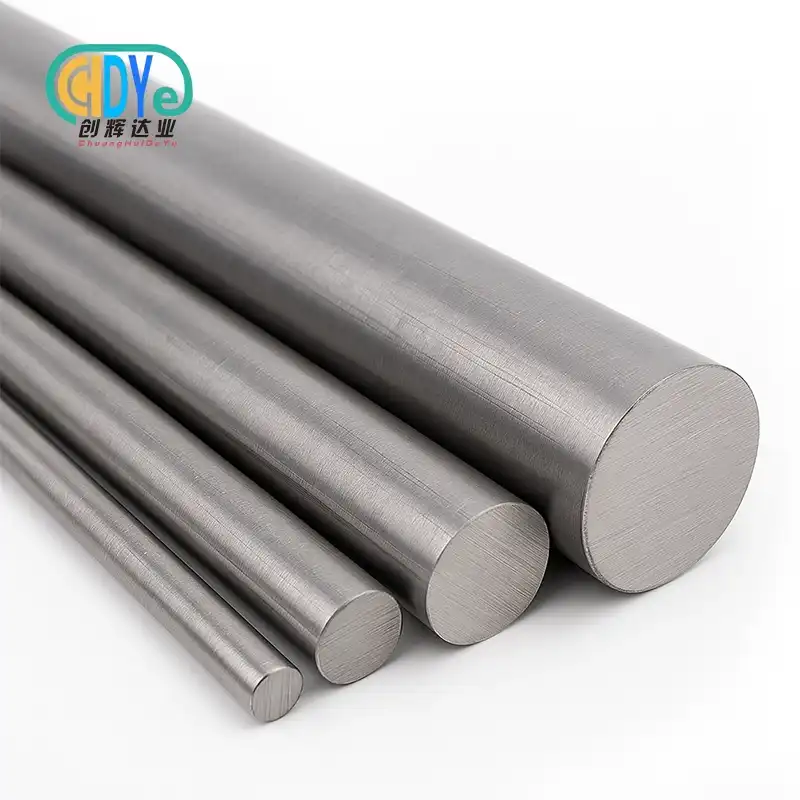
Grade 5 titanium metal, also known as 6Al 4V titanium round bar, is the workhorse of the titanium business. This substance is mostly titanium (about 90%), aluminium (about 6%), and vanadium (4%). It has a remarkable strength-to-weight ratio that is better than most metals, and it doesn't rust even in tough settings. This alloy makes parts that can't be harmed in many fields, from aerospace and defence to medical device making and chemical processing.
Finding the best source for titanium round bars is about more than just getting the best price. Your choice of supplier directly affects how well your products work, meet regulations, and produce reliably, and how well your business does. A partnership that doesn't work well together can lead to big problems like mistakes, delays in production, and expensive repairs that hurt profits and relationships with customers.
This guide gives procurement pros, engineers, and manufacturing decision-makers useful models for thoroughly evaluating possible suppliers. We look at the most important technical factors, point out the things that set good sellers apart from great ones, and give you steps you can take to build partnerships based on trust and common goals. Whether you're responsible for large military contracts or complex medical device projects, knowing these basics will help your company make smart decisions that will make your supply chain stronger.
Understanding Your Procurement Needs for 6al 4v Titanium Round Bar
Define Application-Specific Requirements
Your needs for materials should exactly match your needs for end use. When aerospace parts undergo repeated loading and unloading, they require titanium bars that are very strong and don't easily break. The people who make medical implants need materials that are very biocompatible and have very little intermediate content. When chemicals are present, rust resistance is a top priority for people who build industrial machinery. Making a list of these application factors, such as the expected stress levels, environmental conditions, and performance life, sets the stage for talks with suppliers. This makes things clear, stops confusion, and makes sure you obtain material that really fits your production goals.
Identify Critical Material Specifications
The mechanical qualities of a material depend a lot on its state and how it has been processed in the past. 6Al 4V titanium round bars that have been annealed usually have a yield strength of about 828 MPa and a tensile strength of about 895 MPa. Higher values can be achieved by solution-treating the bars and letting them age. Surface finish type affects how easy it is to machine and how well the end part fits together. Different finishes, like rolled, turned, or centreless ground, are used for different things. Tolerances in dimensions are crucial when bars are used in automatic production lines or don't need many extra steps. Clearly stating the diameter ranges, length needs, straightness tolerances, and accepted surface conditions clears up any confusion and stops expensive material rejects.
Verify Standards Compliance and Certification
Compliance with regulations is the minimum standard that suppliers must meet. ASTM B348 and ASME SB348 set general titanium bar standards, but aircraft uses must follow AMS 4928, AMS 4965, or AMS 4967. Medical gadget makers demand that ISO 5832-3 guidelines be followed. Suppliers must provide full material test results that include records of heat treatment, chemical makeup analysis, and mechanical property checks. Certification from a third party from a well-known lab adds authority and shows a commitment to openness. Make sure that your provider has up-to-date certifications and can provide proof that meets the requirements of the regulatory bodies in your business.
Plan Order Volume and Delivery Logistics
Coordinated material supply is important for the ease of production planning. Suppliers who offer inventory plans and planned deliveries that work with production cycles are good for companies that make a lot of things. Researchers and people who make prototypes need sources who can handle small orders and flexible minimum numbers. Expected lead times vary. Items with standard measurements may ship within weeks, but items with custom requirements need longer production windows. Talking about your preferred shipping regularity, volume patterns, and ability to expedite during the seller review process will keep you from being frustrated in the future. International transportation experts know how to deal with customs rules, the right way to package titanium materials, and the paperwork that is needed to make cross-border trades go smoothly.
Key Criteria to Evaluate 6al 4v Titanium Round Bar Suppliers
Product Quality and Material Traceability
Consistent material quality comes from strict rules during production and clear documentation. Reliable sources give material test results that connect each bar to its original melt batch. These reports show the chemical make-up, which is checked by spectroscopic analysis, and the mechanical properties, which are checked by tensile testing. During checks and quality reviews, this ability to track down information is very important. Suppliers who use vacuum arc remelt furnaces or electron beam melting tools show that they care about making sure their products are pure and have as few defects as possible. Ask for test results of sample materials during the evaluation process; the quality of the paperwork often shows how well the operation is run as a whole.
Manufacturing Capability and Technical Expertise
Advanced processing tools let providers send materials that exactly match what they asked for. Forging processes improve the structure of the grains and make the directional features work best. Controlled heat treatment methods, like annealing, solution treating, or ageing, have a direct effect on how well and how easily the metal can be machined. With precise machining tools, suppliers can cut bars to exact lengths and finish the surfaces to certain roughness levels. The ends of the bars can be squared off. Technical staff who know about metals can suggest the right material conditions for a given application and can solve processing problems, and are much more valuable than just providing materials.
This level of technical detail is shown by Shaanxi Chuanghui Daye Metal Material Co., Ltd., which has over 30 years of experience in the rare metal business. The company has modern annealing ovens, electron beam melting tools, and precision machining centres. It is based in Baoji, which is known around the world as China's Titanium Capital. This built-in feature gives you full control over the quality of the material from the first heating step to the final inspection.
Supply Chain Reliability and Delivery Performance
Predictable material supply prevents shortages from throwing off your production plans. When suppliers keep the right amount of raw materials and finished goods in stock, they can quickly meet urgent needs. A track record is very important. Ask current customers in related fields for examples and find out what percentage of deliveries they make on time. Knowing a supplier's limits on ability helps you figure out if they can grow with your needs or handle high demand during busy times. Being close to major shipping hubs and knowing how to deal with export rules make foreign business easier and cut down on travel times.
Pricing Transparency and Payment Flexibility
To set competitive prices, you need to know more than just the price per kilogram. Because factory-direct sellers don't add markups for distributors, they offer better value while keeping quality high. Base material costs, handling fees, testing fees, and packaging costs are all clearly listed in transparent price systems. This breakdown makes it possible to compare different providers in a useful way. Payment terms affect how you handle your cash flow. For example, sellers who offer net-30 or net-60 terms to regular customers make it easier to plan your finances than those who require upfront payments. Volume discount systems and long-term deal rates make it possible for ongoing projects to plan their budgets with confidence.
Comparing 6al 4v Titanium Round Bar with Alternatives—Making Informed Decisions
Mechanical Performance Across Titanium Grades
Even though Grade 5 titanium is the most common choice for high-strength uses, knowing about other options can help you choose the best material. Commercially pure titanium grade 2 is very resistant to rust and less expensive, but it has only about half the tensile strength of 6Al-4V, which means it can't hold structural loads. Grade 23 (Ti-6Al-4V ELI) has extra-low interstitials that make it more flexible and resistant to fatigue. It is chosen for use in important medical implants, even though it costs more. Grade 9 (Ti-3Al-2.5V) has a middling strength and great cold formability, making it useful for things like hydraulic tubes. The 6-4 metal strikes a good mix between strength, weight, resistance to corrosion, and cost-effectiveness for the widest range of uses.
Titanium Versus Traditional Metals
It's easier to understand value ideas when you compare titanium to stainless steel and aluminium. Grade 5 titanium is as strong as many high-strength steels but 40% lighter, which is very important in aircraft and racing where weight reduction directly improves performance. It is more resistant to corrosion than 300-series stainless steels, especially in salt conditions and high temperatures. Aluminium metals are a little lighter than titanium, but they can't match its hardness or temperature resistance. Even though titanium costs more per kilogram, it usually ends up being cheaper over its lifetime because it lasts longer, needs less upkeep, and doesn't need any protective coatings.
Round Bar Versus Billet Form Considerations
Round bars usually have a width of between 6 mm and 300 mm and are used as stock for machined parts, fixings, and structural elements. As the name suggests, billets are bigger shapes that are meant to be further processed by forging or heavy machining. For parts with normal width ranges, 6al 4v titanium round bar cuts down on waste and machining time. The uniform sizes and fine microstructure that come from rotary forging methods often make their mechanical qualities better than those of bar stock that is machined from billet centres. When the sizes fit your component limits, the cost per kilogram tends to favour round bars.
How Trusted Suppliers Support Your Procurement Journey?
Comprehensive Quality Assurance Systems
Suppliers who want to be the best have quality control systems that go beyond just getting certified. While ISO 9001:2015 certification shows that processes are being controlled in a planned way, the best providers go even further by regularly having third-party audits and reviews by customers. Multiple quality checks are set up, such as inspecting raw materials as they come in, checking progress at key stages of production, and trying the finished product before it is shipped. Documented steps for treating nonconforming materials and taking appropriate action show that the quality culture is mature. Shaanxi Chuanghui Daye keeps its ISO 9001:2015 certification up to date with strict controls that cover everything from inspecting the raw materials to packing them at the end. This makes sure that the quality of the materials is the same from batch to batch.
Customisation and Engineering Support
When users need custom solutions, the quantity of generic materials isn't enough. Suppliers that offer OEM services work together to meet specific needs, such as those that require custom sizes, special heat processes, or tight tolerances. There is real value in having engineering teams look over your plans, suggest design improvements that make the product easier to machine or use less material, and confirm that the product can be made before production starts. Case studies from similar programmes show that you can solve problems and know about your business. With this consultative method, sellers become partners who care about the success of your product.
After-Sales Technical Assistance
When cutting, welding, or checking a component, questions about the material's performance come up. Respondent sources give expert advice on things like the best way to cut, how much heat to use during welding, and how to treat the metal with heat to improve its properties. Your quality system needs full paperwork packages that include material approvals, test results, and handling suggestions. When problems happen, having expert staff that is easy to reach, looks into them fully, and suggests ways to fix them keeps projects moving forward and business relationships strong.
Practical Steps to Select and Engage Your Ideal 6al 4v Titanium Round Bar Supplier
Conduct Thorough Supplier Pre-Qualification
Start looking for suppliers by using industry listings, trade associations, and suggestions from other people in the same field. Make a list of qualifications that includes things like certification standards, minimum skill levels, and signs of financial security. Ask companies for profiles that include information about their production capability, tools, quality certifications, and customer examples. Contact references, especially to talk about how reliable the service is, how consistent the quality is, and how quickly they fix problems. During this pre-qualification step, you narrow down the list of potential sellers to those who can really meet your needs.
Develop Detailed Requests for Quotation
When RFQs work, they get replies that are similar, which makes review easier. Give accurate names for the material grades, the applicable standards, the required licences, the measurements with their respective ranges, the expected surface finish, and the ranges of quantities. Include required delivery dates, recommended packaging methods, and places where the goods will be sent. Ask for a price breakdown that shows the different costs of materials, handling, testing, and shipping. Ask providers to let you know if there are any clarifications needed on the specifications and to suggest other ways to do things that might be cheaper or better in terms of performance. RFQs that are well-structured show that you are a professional and get thoughtful replies from serious sellers.
Validate Quality Through Trial Orders
Qualifications on paper are less important than success in real life. Trial orders for non-essential uses let you see for yourself how good the materials are, how accurate the paperwork is, how well they are packaged, and when they will arrive. Run practice material through your production processes and make notes on how easy it is to machine, how consistent the dimensions are, and any problems that come up out of the blue. If the stakes are high enough, compare the real mechanical features to values that have been confirmed by a third party. When trial orders go well, they give you confidence before you commit to bigger orders or important production uses.
Establish Performance Monitoring Systems
Set up key performance markers that are important to you, such as the percentage of on-time deliveries, the percentage of material rejections, the accuracy of your paperwork, and how quickly you respond to questions. Set up regular business reviews with your seller to talk about performance trends, future changes to requirements, and ways to make things better. Balanced scorecards that track multiple aspects stop people from focusing too much on price and not enough on quality or service. Sharing feedback on performance in a clear way supports ongoing growth and builds stronger partnerships.
Negotiate Mutually Beneficial Agreements
The rules of a contract should protect both sides and encourage them to work together for a long time. Talk about how prices are set, such as stable prices for set amounts of time or prices that change based on the cost of raw materials. Define the standards for quality acceptance, the rights to check, and the steps to take when an object doesn't meet the requirements. Make it clear who owns the intellectual property if there are special requirements or secret methods involved. Include sensible "force majeure" clauses that take into account disruptions that can't be planned for when setting up communication methods. Well-written deals cut down on disagreements and make sure that everyone has a reason to succeed.
Conclusion
Choosing a source for your 6Al 4V titanium round bar is a strategic choice that will have long-lasting effects on your business. By following these guidelines—being clear on your exact needs, judging suppliers on a number of quality and capability factors, objectively comparing material options, and using structured selection processes—your company will be able to form partnerships that give it a competitive edge. When part performance and delivery reliability are what make your business successful, small price differences don't mean nearly as much as material quality, professional know-how, supply chain reliability, and quick service. When suppliers spend money on new manufacturing technology, keep strict quality standards, and work together with customers on technical issues, they provide long-term value through less work that needs to be redone, faster development processes, and a better image for the product.
FAQ
Q: What advantages does Grade 5 titanium offer over other structural materials?
A: Ti-6Al-4V has the same tensile strength as many alloy steels but weighs about 40% less. This makes it very useful in situations where weight is important. It doesn't rust as stainless steel does in chloride conditions and high temperatures, so you don't need to use a protection layer. The metal keeps its mechanical qualities up to 400°C, so it can be used in moderately high-temperature situations. Biocompatibility and low modulus of elasticity are good for medical implants because they lower the stress buffering effects.
Q: How does heat treatment affect titanium round bar properties?
A: When you anneal metal, it becomes the most flexible, with a yield strength of about 828 MPa. This makes it perfect for large-scale shaping or cutting processes. Solution treatment and age (STA) make things much stronger—the yield strength can go over 1100 MPa—but they are less flexible. Mill-annealed material is the usual supply state because it is strong and easy to work with. Setting the right conditions for heat treatment makes sure that the qualities of the material match the needs of the application.
Q: Can suppliers provide custom diameters and lengths?
A: Reliable providers can meet special requests as long as their tools can handle them. The most common diameters are 10 mm to 250 mm, but the larger sizes need longer lead times. Cutting along a length to exact measurements cuts down on waste and extra work. Talk about your volume needs as soon as possible. As the quantity goes up, custom sizes become more cost-effective because the costs of tooling and setup are spread out over more pieces.
Q: What minimum order quantities should buyers expect?
A: MOQ rules are very different depending on the type of material and how the seller runs their business. For standard diameter bars, the minimum order quantity (MOQ) could be as low as 50 to 100 kilograms. For special specs, the MOQ could be 500 kilograms or more in order to justify setting up production. Suppliers that focus on research can often work with smaller orders because they know that production can grow in the future. Talking about your expected volume growth during the first meetings helps you find sellers whose MOQ policies match the way you buy things.
Partner with Chuanghui Daye—Your Trusted Titanium Round Bar Supplier
When it comes to Grade 5 titanium round bars, Shaanxi Chuanghui Daye is the best. They have been working with rare metals for 30 years and have ISO 9001:2015-approved quality processes. We control every step of the production process, from vacuum arc remelting to precision cutting, in Baoji, which is known as the "Titanium Capital." This way, we can be sure that the materials are pure and the sizes are correct. Our engineering team offers expert advice for use in aircraft, medicine, and industry, backed up by full paperwork for material traceability. We offer low factory-direct prices, flexible terms, and reliable shipping around the world, no matter how many you need for a prototype or how many you need for production. Get in touch with our team at info@chdymetal.com to talk about your unique needs and get quotes for 6Al-4V titanium round bars made to fit them.
References
1. Lutjering, G. & Williams, J.C. (2007). Titanium: Engineering Materials and Processes. Springer-Verlag, Berlin.
2. Boyer, R., Welsch, G., & Collings, E.W. (1994). Materials Properties Handbook: Titanium Alloys. ASM International, Materials Park, Ohio.
3. Donachie, M.J. (2000). Titanium: A Technical Guide, 2nd Edition. ASM International, Materials Park, Ohio.
4. ASTM International. (2021). ASTM B348-13: Standard Specification for Titanium and Titanium Alloy Bars and Billets. West Conshohocken, Pennsylvania.
5. SAE International. (2019). AMS 4928: Titanium Alloy Bars, Wire, Forgings, Rings, and Drawn Shapes 6Al-4V Annealed. Warrendale, Pennsylvania.
6. Froes, F.H. (2015). Titanium: Physical Metallurgy, Processing, and Applications. ASM International, Materials Park, Ohio.
Learn about our latest products and discounts through SMS or email