- English
- French
- German
- Portuguese
- Spanish
- Russian
- Japanese
- Korean
- Arabic
- Greek
- German
- Turkish
- Italian
- Danish
- Romanian
- Indonesian
- Czech
- Afrikaans
- Swedish
- Polish
- Basque
- Catalan
- Esperanto
- Hindi
- Lao
- Albanian
- Amharic
- Armenian
- Azerbaijani
- Belarusian
- Bengali
- Bosnian
- Bulgarian
- Cebuano
- Chichewa
- Corsican
- Croatian
- Dutch
- Estonian
- Filipino
- Finnish
- Frisian
- Galician
- Georgian
- Gujarati
- Haitian
- Hausa
- Hawaiian
- Hebrew
- Hmong
- Hungarian
- Icelandic
- Igbo
- Javanese
- Kannada
- Kazakh
- Khmer
- Kurdish
- Kyrgyz
- Latin
- Latvian
- Lithuanian
- Luxembou..
- Macedonian
- Malagasy
- Malay
- Malayalam
- Maltese
- Maori
- Marathi
- Mongolian
- Burmese
- Nepali
- Norwegian
- Pashto
- Persian
- Punjabi
- Serbian
- Sesotho
- Sinhala
- Slovak
- Slovenian
- Somali
- Samoan
- Scots Gaelic
- Shona
- Sindhi
- Sundanese
- Swahili
- Tajik
- Tamil
- Telugu
- Thai
- Ukrainian
- Urdu
- Uzbek
- Vietnamese
- Welsh
- Xhosa
- Yiddish
- Yoruba
- Zulu
How to Select the Right Pure Titanium Wire for Your Industry?
Choosing the right pure titanium wire has a direct effect on how well a product works, how well it meets regulations, and how efficiently operations run in many B2B areas. This unalloyed material is made from commercially pure titanium that has over 99.6% titanium content. It is very resistant to rust, biocompatible, and has a strength-to-weight ratio that is better than most wire materials. Titanium wire is used in many fields, from aircraft and medical device making to chemical processing and electronics, to deal with tough conditions, reduce weight, and make things last for a long time. Your purchasing plan will meet both technical needs and your budget if you work with experienced suppliers who know about grade specifications, dimensional tolerances, and application-specific needs. This guide gives you useful information on how to compare different types of titanium wire, other materials, and trusted suppliers that can help you reach your manufacturing goals.
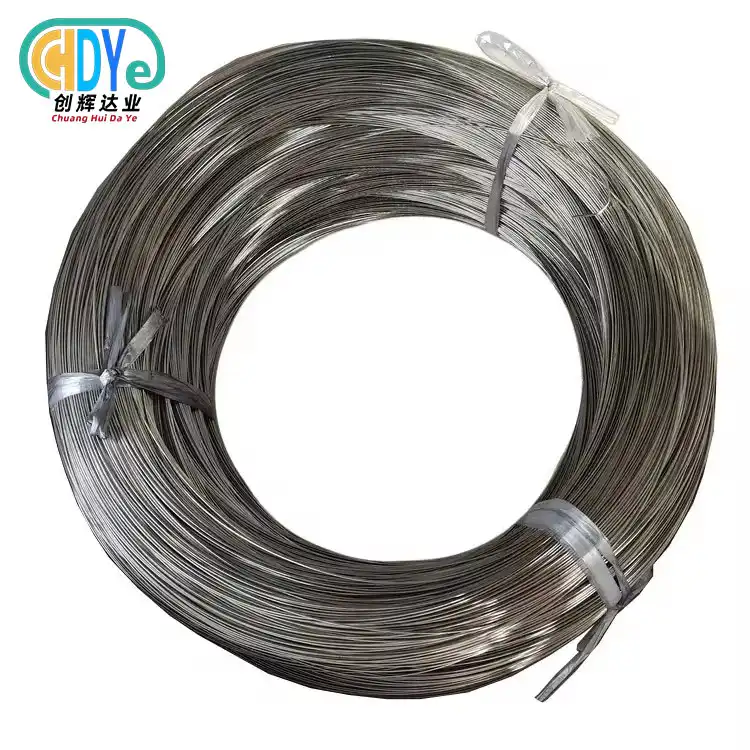
Understanding Pure Titanium Wire: Composition, Properties, and Grades
What Defines Commercially Pure Titanium Wire
Pure titanium wire that is sold in stores has an alpha-phase crystal structure and not many alloying elements. It is made up of more than 99% pure titanium. Based on ASTM B863 and AWS A5.16 standards, the material is put into groups. Hydrogen, oxygen, iron, carbon, and nitrogen are some of the controlled intermediate elements that are used to make the grades. These parts between the layers change the way the material works mechanically, but they don't change its basic ability to resist rust. Titanium alloys like Ti-6Al-4V are not as easy to shape and bend as pure titanium wire. If you need to bend, weave, or cold-work metal in complicated ways, this is the best tool for the job.
Common Grades and Their Industrial Applications
There are four main types of unalloyed titanium wire used in business, and each one is used for a different task:
Type 1 is the most bendable and easy to form. It has a tensile strength of about 240 MPa. This makes it perfect for cold heading, deep drawing, and other tasks that need to be very resistant to corrosion in low-stress areas. When flexibility is important, this grade works great for tools used in chemical processing and in the marine world. Grade 2 is the most common grade used in business. It's not very strong (340 MPa tensile strength), but it's very resistant to corrosion and easy to work with. Grade 2 is cheap and can do a lot of different jobs well, so it is often used in chemical plants, heat exchanges, and other business settings.
Grade 3 has more oxygen in it, which makes it stronger (450 MPa) but still easy to shape. It is used in pressure tanks and parts for spacecraft that need better mechanical properties but don't want to switch to full titanium alloys. If you need the strongest material that won't rust, Grade 4 is the best choice. Its strength of 550 MPa makes it ideal for high-performance chemical processing, structural parts in aeroplanes, and other places.
Key Physical and Chemical Properties
About 4.51 g/cm³ is how dense the material is. This means it is only 60% as heavy as steel but still strong. This is a good way to cut down on weight for portable and space equipment. While the form is being worked on at high temperatures, the freezing point of 1668°C keeps it fixed. When pure titanium wire comes in contact with air, it forms a layer of titanium dioxide (TiO₂) that is not active. This layer makes the wire very strong against stress corrosion cracking, pitting, and crevice corrosion in chloride, seawater, nitric acid, and organic acids. It is better for this process than stainless steel when chemicals are strong, and other materials break down quickly. As required by ASTM F67, the material is biocompatible and can be used within the body. It doesn't release any harmful ions and doesn't cause allergies, which are both important for surgical tools and devices that are implanted.
Core Criteria for Selecting Pure Titanium Wire for Your Industry
Evaluating Mechanical Performance Requirements
For the right wire grade to fit the right engineering needs, you need to know how much stress, wear, and warping the product will be under. Businesses that make medical equipment care about biocompatibility and modest power. Most of the time, they pick Grade 2 or medical-grade versions that follow FDA rules. For aircraft applications, the tensile strength, yield strength, and stretch properties must be proven. You must be able to fully track the materials and certify each heat lot. The most important thing to look for in materials used in pure titanium wire methods is how well they prevent rust. To make chemicals less likely to damage the material, lower strength grades are often accepted.
Dimensional Specifications and Form Factors
It's important to keep in mind that differences in wire thickness can make a product less accurate. This is especially true when automatic assembly, weaving, and making precision screws are involved. If the tolerance level is ISO h7, h8, or h9, then guide bushings, dies, and automatic feed systems will always fit together properly. Our pure titanium wire has widths ranging from 0.1 mm to 6.0 mm, and you can order it in either a coil or a straight cut shape to suit the way you want to use it. Coiling wire is the best way to draw, weave, and join continuously at high speeds. Straight-cut forms, on the other hand, are best for tasks where you need to be very precise with the sizes and shapes of the parts. You can pick a bright-annealed finish for looks or a pickled finish for the best weldability and cleanest surface when it matters.
Quality Certifications and Regulatory Compliance
Companies that are ISO 9001:2015 approved make sure of quality control by checking the raw materials, keeping an eye on the production process, and doing one last check. Aerospace clients need material test certificates (MTCs) that show the chemical make-up through spectrochemical analysis, the mechanical properties through tensile testing, and the batch traceability that links finished wire to specific melt lots. For medical purposes, it must meet ASTM F67 standards and have been tested for biocompatibility and processed according to sterile rules. Chemical company clients like rust test results that show how well the product works in certain media, like immersion testing in common process fluids. At Chuanghui Daye, we keep full records by using batch numbers and giving full MTC paperwork that has been checked by testing labs outside of Chuanghui.
Comparing Pure Titanium Wire with Other Wire Types: Making an Informed Decision
Performance Comparison with Alternative Materials
While stainless steel wire is cheaper at first, it cracks and pits easily in marine and chemical environments because of chloride-induced stress corrosion. Pure titanium wire, on the other hand, is better in these conditions. In aircraft use, the extra weight of stainless steel is noticeable. Titanium, on the other hand, is 40% lighter, which directly leads to higher payload capacities and better fuel economy. Nickel alloys are strong at high temperatures, but they are much more expensive than titanium, and their magnetic qualities mean they can't be used in some computer uses. Copper wire is better at conducting electricity than other materials, but it doesn't last long and isn't strong enough for structural uses. Pure titanium wire has unique performance characteristics that can't be found in other wire materials, such as not corroding, being biocompatible, and not being magnetic.
Cost Analysis and Value Proposition
Pure titanium wire costs more than stainless steel or copper for its raw materials, but lifecycle cost analysis often shows that it is a better value because it lasts longer, needs less maintenance, and doesn't need protective coatings. Chemical processing uses titanium parts that last more than 20 years, while treated steel parts need to be replaced every 2 to 5 years. When you buy in bulk, the price per kilogram goes down, and the material's qualities stay the same from one production run to the next. We keep common sizes in stock in both Grade 1 and Grade 2 configurations. This lets us deliver quickly—within one to three days for standard requirements—and lowers our clients' costs of keeping inventory on hand. Customising the size and finish of the surface may make lead times longer, but it will give the best performance for certain uses.
Streamlining Procurement: How to Buy Pure Titanium Wire for Business Needs
Vetting Supplier Capabilities and Credentials
Before deciding on a supplier, it's important to check their manufacturing capabilities, quality certifications, and technical support infrastructure. China's "Titanium Valley" is in Baoji, Shaanxi Province, where Changhui Daye is located. The company benefits from a lot of industry knowledge, integrated supply chains, and specialised processing equipment like electron beam furnaces, precise rolling mills, and advanced melting systems. Our ISO 9001:2015 certification shows that we have structured quality control at all steps, including checking the raw materials, melting, forging, drawing, and final checking. Technical support for pure titanium wire should include metallurgical advice, suggestions that are tailored to the application, and quick communication about issues like tolerances for dimensions, surface finish needs, and performance confirmation.
Procurement Logistics and Order Specifications
To do effective buying, you need to be able to clearly communicate grade standards, dimensional tolerances, number needs, and delivery dates. We ask that you send us thorough drawings or specifications that show the width, length, shape (coil or straight), preferred surface finish, and any relevant industry standards (ASTM, AWS, ISO). Minimum order numbers depend on the design. Standard sizes can be ordered in smaller quantities, but custom measurements may have production minimums. We provide free samples so that you can check the quality of the material and see how well it works before committing to large amounts. Depending on what needs to be done next, the packaging options include spools, coils with protective wrapping, or straight-cut bundles. Freight forwarding partnerships make international shipping operations easier by providing paperwork that helps with customs clearing and following rules in target markets.
Questions to Ask Your Supplier
To confirm a supplier's skills, you need to directly ask about a number of important factors. Check the source of the raw titanium and the methods used to make sure it is pure. These should include spectrochemical analysis techniques and interstitial element control procedures. Find out about the possible measurement tolerances, checking tools, and process controls that make sure that each production run is the same. Ask about wait times for both stock sizes and custom specs, as well as choices for faster production if you need something right away. Make the service terms, return rules, and steps for dealing with non-conforming material clearer. Set up expert support so that you can get help with applications, help choosing materials, and help with fixing problems during implementation.
Real-World Industry Use Cases and Best Practices
Medical Device Manufacturing: Biocompatibility and Precision
Manufacturers of surgical instruments use Grade 2 or medical-grade pure titanium wire for applications like forceps, retractors, and suture wire that need to be biocompatible, resistant to corrosion in sterilisation environments, and nonmagnetic so they can work with MRI equipment. Implantable device makers use titanium wire in heart implants, orthopaedic support devices, and other places where osseointegration, zero ion leaking, and long-term tissue compatibility are important. Following the rules set by ASTM F67, keeping track of the materials used, and making sure the mechanical properties are correct through lot-specific testing are all ways to get regulatory approval. Specifications for the surface finish stress how clean it must be, how free of flaws it must be, and how well it works with other processes like electropolishing or bioactive coatings.
Aerospace Engineering: Weight Reduction and Extreme Environments
Pure titanium wire is used by aircraft manufacturers in safety cables, locking wire to keep fasteners in place, and structural parts where reducing weight directly improves fuel efficiency and payload capacity. The material's strength-to-weight ratio lets thinner wire gauges meet strength standards while lowering the mass of the whole unit. Corrosion resistance is very important in sea aircraft settings where salty air breaks down other materials quickly. When buying things for flight, paperwork is very important. This includes material test certificates, being able to track heat lots, and making sure that the materials meet aerospace material specifications (AMS standards). Avionics and navigation systems can't be harmed by non-magnetic properties.
Chemical Processing: Corrosion Resistance in Aggressive Media
Chemical plants use pure titanium wire for parts of vessels, heat exchangers, and filter systems that are exposed to chlorine, chlorides, sulphuric acid, and organic acids, which quickly wears down stainless steel. The formation of the passive layer on its own protects against corrosion without any maintenance and doesn't wear down over time. Grade 1 or Grade 2 options are a good mix between resistance to rust and the need to be able to be shaped into complex shapes. Process environment analysis helps choose the grade, and testing in real-world media makes sure that performance expectations are met before the full implementation. Lifecycle cost analysis shows return on investment by getting rid of the need for replacements and cutting down on downtime.
Conclusion
To choose the right pure titanium wire, you need to make sure that the material grades, size standards, and supplier skills meet the scientific and operational needs of your business. By knowing the difference between economically pure grades, comparing mechanical and corrosion performance to application conditions, and building relationships with approved sources, you can make buying decisions that improve product quality and cut costs. The material's unique mix of resistance to corrosion, biocompatibility, and strength-to-weight performance solves important problems in the chemical, aerospace, medical, and electronics industries that regular materials can't.
FAQ
Q: What grade of titanium wire is best for medical implants?
A: For implantable devices and surgical instruments, it is most common to use Grade 2 pure titanium wire or medical-grade titanium that meets ASTM F67 standards. These grades offer the best biocompatibility, with proven non-toxicity, no allergenic response, and osseointegration qualities needed for FDA clearance. Material records need to show the amounts of interstitial elements, especially hydrogen content below 0.015% to keep the material from becoming weak, and mechanical qualities that are within certain ranges for implant use.
Q: How does titanium wire compare in cost to stainless steel alternatives?
A: Pure titanium wire usually costs three to five times more to make than stainless steel wire of the same size. Lifecycle analysis often changes this cost relationship by making things last longer, getting rid of protective coatings, and needing less upkeep. Chemical processing uses titanium parts that last longer than 15-20 years, while stainless steel parts need to be replaced every 2–5 years. This means that titanium has a lower total cost of ownership, even though it costs more at first.
Q: What lead times should I expect for custom titanium wire orders?
A: Once an order is confirmed, standard sizes that are kept in stock will be sent out within one to three days. Custom specifications like non-standard diameters, specific surface finishes, or special certifications usually take two to four weeks to make, but this depends on the number of orders and how complicated the specifications are. For urgent needs, faster processing may be possible. Lead times will be confirmed during quotation talks based on how busy production plans are at the moment.
Partner with a Trusted Pure Titanium Wire Manufacturer
Shaanxi Chuanghui Daye has been working with rare metals for more than 30 years and uses ISO 9001:2015 certified manufacturing methods to make high-purity pure titanium wire that meets the strict requirements of the electronics, aerospace, medical, and chemical industries. Our site in Baoji, China's Titanium Valley, gives you access to streamlined supply chains, specialised processing tools, and a wealth of metallurgical knowledge that can help you with your most difficult projects. We keep common grades and sizes in stock so that standard specs can be met quickly (within one to three days). For unique measurement, surface finish, and certification needs, we can do custom processing. Free samples let you test the material before committing to production. As a pure titanium wire provider dedicated to quality, dependability, and client success, please email our expert team at info@chdymetal.com to talk about your project requirements, get detailed quotes, or set up a sample evaluation.
References
1. American Society for Testing and Materials. (2021). ASTM B863: Standard Specification for Titanium and Titanium Alloy Wire. ASTM International.
2. American Welding Society. (2018). AWS A5.16/A5.16M: Specification for Titanium and Titanium-Alloy Welding Electrodes and Rods. AWS Technical Standards.
3. Boyer, R., Welsch, G., & Collings, E.W. (2019). Materials Properties Handbook: Titanium Alloys. ASM International Publishing.
4. Donachie, M.J. (2020). Titanium: A Technical Guide, 3rd Edition. ASM International Materials Technology Series.
5. Schutz, R.W. & Thomas, D.E. (2017). "Corrosion of Titanium and Titanium Alloys in Industrial Applications." Corrosion Engineering Handbook, Volume 2, pp. 683-738.
6. Veiga, C., Davim, J.P., & Loureiro, A.J.R. (2022). "Properties and Applications of Titanium Alloys: A Brief Review." Reviews on Advanced Materials Science, 32(1), pp. 14-34.
Learn about our latest products and discounts through SMS or email