- English
- French
- German
- Portuguese
- Spanish
- Russian
- Japanese
- Korean
- Arabic
- Greek
- German
- Turkish
- Italian
- Danish
- Romanian
- Indonesian
- Czech
- Afrikaans
- Swedish
- Polish
- Basque
- Catalan
- Esperanto
- Hindi
- Lao
- Albanian
- Amharic
- Armenian
- Azerbaijani
- Belarusian
- Bengali
- Bosnian
- Bulgarian
- Cebuano
- Chichewa
- Corsican
- Croatian
- Dutch
- Estonian
- Filipino
- Finnish
- Frisian
- Galician
- Georgian
- Gujarati
- Haitian
- Hausa
- Hawaiian
- Hebrew
- Hmong
- Hungarian
- Icelandic
- Igbo
- Javanese
- Kannada
- Kazakh
- Khmer
- Kurdish
- Kyrgyz
- Latin
- Latvian
- Lithuanian
- Luxembou..
- Macedonian
- Malagasy
- Malay
- Malayalam
- Maltese
- Maori
- Marathi
- Mongolian
- Burmese
- Nepali
- Norwegian
- Pashto
- Persian
- Punjabi
- Serbian
- Sesotho
- Sinhala
- Slovak
- Slovenian
- Somali
- Samoan
- Scots Gaelic
- Shona
- Sindhi
- Sundanese
- Swahili
- Tajik
- Tamil
- Telugu
- Thai
- Ukrainian
- Urdu
- Uzbek
- Vietnamese
- Welsh
- Xhosa
- Yiddish
- Yoruba
- Zulu
The Best Practices for Working with ASTM B 348 Titanium Rods
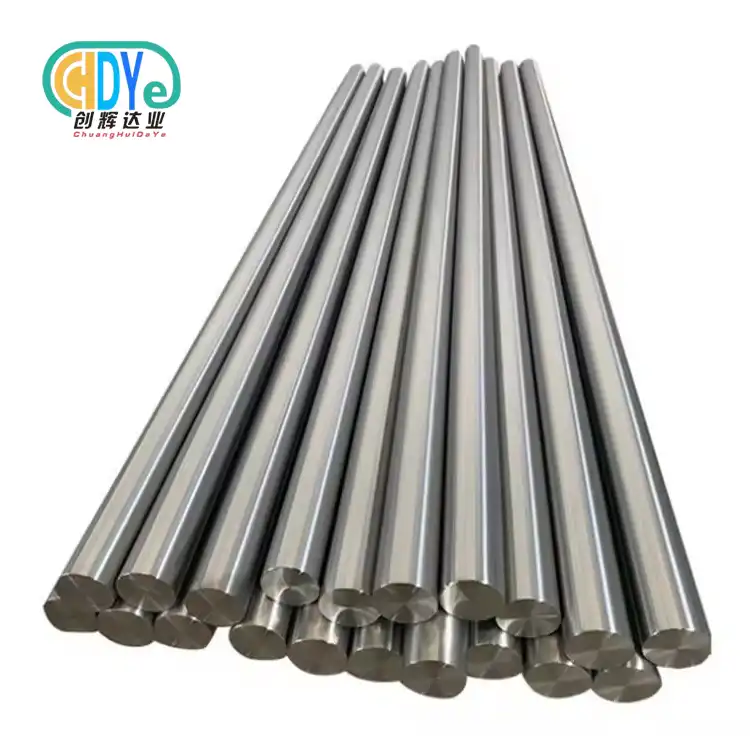
If you want to get the most out of ASTM B 348 industrial titanium rod, you should know how to handle it properly and know about the features and quality standards of the material. These unique titanium items are used to make medical devices, airplanes, and chemicals because they don't rust and are very strong for their weight. It's important to get good grades, follow the rules for dealing, and work with professionals who keep a close eye on quality while they do the work and send it.
Understanding ASTM B 348 Titanium Rod Specifications and Properties
Grade Classifications and Chemical Composition
Different types of titanium are discussed in ASTM B 348. Each type is made for a unique job in business. Ti-6Al-4V is clean enough for business use, and it doesn't rust. It's also very simple to make. It is very flexible, even though it doesn't have many alloying elements. Alum and vanadium are added to Grade 5 (Ti-6Al-4V), which makes it much harder. It's great for making things that will hold a lot of weight.
This is because different chemicals make something work better or worse in different scenarios. What something is made of affects how strong and flexible it is, and what it's made of affects how easy it is for it to rust in salt. Adding nitrogen to steel makes it stronger, but it may also make it easier to damage, so you need to make sure you get the right type for the job. When engineers know how these parts fit together, they can pick the best materials for tough roles.
Mechanical Properties and Performance Characteristics
Grade to grade, tongue and groove strength is very different. It can get as low as 345–480 MPa in Grade 2, and it can get as low as 895–930 MPa in Grade 5. Also, different yield rates are important because they change how safety factors are used and how parts are made. The rate of growth shows how simple it is to make the stuff. Types that are sold as pure are easier to work with than types that are made of combinations that are harder.
To run a business, you should also think about how stable the temperature is. The qualities of Grade 2 stay good from 0°C to 315°C. The qualities of Grade 5 stay good up to 400°C, after which they start to break down a lot. These thermal properties help choose the right materials for plane parts that need to work in hard conditions and chemical processing equipment that needs to be able to handle high temperatures.
Comparing ASTM B 348 Titanium Rods with Other Materials and Standards
Standard Specifications and Compatibility
ASTM B 348 is not the same as ASTM B 863 or ASTM F 136. There are different quality standards with different goals. B 863 talks about a different way to work with wire things, and F 136 is about medical implants that need extra-low intermediate material to work. These differences will help you get the right things for the jobs you want to do and avoid getting the wrong things.
For each business and use, the surface finish needs to be different. For most chemical processing jobs, a normal mill finish will work. For very precise cuts, though, you should use a precision-ground surface. The standards for straightness and measurement accuracy have a direct effect on the cost, quality, and amount of extra work that needs to be done, as well as the end part itself. These things need to be thought about a lot when the first material specs are being made.
Performance Comparison with Alternative Materials
Some types of steel, like 316L, are cheaper at first, but they aren't as strong for their weight and rust rapidly in harsh conditions. In chloride-containing solutions, where stainless steels fail due to pitting and crevice corrosion, ASTM B 348 industrial titanium rod performs admirably. It can be used for a long time in chemical and water processes because the oxide layer on it keeps growing back.
Because titanium isn't very dense, it has low spinning forces and works more efficiently. If your spinning machine needs to lose weight, this is very important. There are times when the skill to fight tiredness is better than everyday stuff. The parts will last longer and need less help in this case. The higher costs of the materials used at the beginning are more than made up for by the better performance that makes processes more stable and lowers costs over time.
Best Practices in Handling, Manufacturing, and Heat Treatment
Processing Techniques and Quality Control
Being careful with raw materials is the first thing that needs to be done to keep them from getting messed up. The end result might not be as good if they do that. Titanium reacts with air, nitrogen, and carbon when it is very hot. This is why it needs to be worked on in a controlled environment. Vacuum arc remelting gets rid of any dangerous bits that could cause wear failures and makes sure that all the chemicals are the same.
Here are the essential processing considerations for maintaining material integrity:
• When high temperatures are used, keeping an eye on the atmosphere stops alpha cases from forming. These cases make the material less flexible and less resistant to wear.
• If you pick the right tool and cutting settings, you can make sure you follow the right measurements and keep the work from getting too hard.
• During grinding, keep an eye on the temperature to make sure the grain forms correctly and to keep it from getting burned.
• When you clean something, you get rid of any dirt that might get in the way of the next step in the process or service.
These rules during the processes make it possible for parts and materials to always have the same quality and work well in many different fields.
Heat Treatment Procedures and Optimization
Stress reduction annealing is used to get rid of any forces that are left over from industrial processes applied to ASTM B 348 industrial titanium rod. The mechanical qualities that were wanted are kept with this method. As long as the temperature stays between ±15°C and 25°C, the results will remain stable. This way, the traits won't get worse, and no extra grains will grow. Surface rust is stopped during annealing by keeping the area protected, which also means that fewer finishing and material removal steps are needed afterward.
What the metal is made of and how well it can be stretched depend on how quickly it cools down after being annealed. For some kinds of alloys, the rate of change can change how the alpha and beta stages stick together. All lots of goods are treated the same way as long as the oven is fed properly and the temperature stays the same. Being aware of the specifics of the heat treatment process helps make sure that the quality is high and that the best conditions are found for each use.
Procurement Guidelines for ASTM B 348 Titanium Rods
Supplier Selection and Certification Requirements
You can tell if a service is good by how well they make things, how well they handle quality, and how well they follow standards. That the product is certified to ISO 9001:2015 means that it has strong quality control systems in place, and that it is accepted by NADCAP means that it can be used in important ways in the airplane business. There needs to be full chemical analysis, proof of mechanical qualities, and tracking information on mill test records that connect goods to specific production lots.
It's important to be able to count on transportation and production capacity in order to stick to work plans and keep track of supplies. If sellers have enough raw materials on hand and good supply lines, they can meet short-term needs without lowering the level of their work. The cost and time of shipping depend on where you live. This is especially true for large orders that need special plans to get to you.
Order Specifications and Customization Options
What makes a big difference in how much extra work needs to be done and how accurate the end part is is the width difference. For most jobs, standard specs might work, but for more accurate jobs, you need to be able to tweak the numbers more. These two tools can help you do this: centerless grinding or precision turning. Cutting gaps and standards for straightness must be taken into account when length is given because they change how much material is used and how quickly it is worked with.
According to ASTM B 348 industrial titanium rod comes in a range of lengths and widths (4mm to 350mm) and can be used for a wide range of manufacturing jobs. Making shapes like squares and hexagons to order cuts down on extra cuts and makes better use of material for some part shapes. The surface finish changes both how the part looks and how well it works. Two examples are surfaces with a normal mill finish and surfaces that fit perfectly.
Application Spotlight: Where ASTM B 348 Titanium Rods Excel
Chemical Processing and Marine Applications
People who work with chemicals need materials that don't rust and keep their shape while they're being worked on. Chlor-alkali plants have strong chlorine that breaks down other things very quickly. I really like how well the ASTM B 348 industrial titanium rod works there. It is possible for Grade 2 titanium parts to last a very long time when they are used in salt water.
Titanium is useful in wet places because it doesn't rust or break down when it comes in contact with electricity. In diving tools and rotor shafts, the shape and surface structure of these parts stay the same after a long time of use. The method is better for ships and ports in the water because it is lighter and stronger than it is heavy.
Aerospace and High-Performance Applications
There are a lot of heavy things in space that need to be very strong and stable at high temperatures. These parts are made from ASTM B 348 industrial titanium rod. Grade 5 titanium is used to make motor parts because it can handle high temperatures and can also help you lose weight. It is better for landing gear parts not to wear down or rust when they are being used in rough conditions.
For things like valve springs, exhaust systems, and connecting rods, it is being used more and more in fast cars. Because it is strong and can be bent, the material can be used to make parts that work better and weigh less, which helps the engine run better. They're strong, not heavy, and last a long time, even when things get rough. They are great for racing because of this.
Conclusion
You need to know a lot about the metal's qualities, how to work with it, and when to use ASTM B 348 industrial titanium rod correctly. You can be sure that parts will work well and last a long time if you choose the right grade, work with trusted suppliers, and treat them in the right way. It is strong for its weight, doesn't rust, and doesn't change shape at high temperatures, so it can be used in harsh industrial settings where other materials wouldn't work. Titanium things that are well-made last longer, need less upkeep, and speed up processes in many areas, so they are worth the money in the long run.
FAQ
Q: What distinguishes Grade 2 from Grade 5 ASTM B 348 titanium rods?
A: Ti-6Al4V is pure enough for business use, doesn't rust, and is simple to make. Grade 5 (Ti-6Al-4V), on the other hand, is much stronger because it has aluminum and vanadium mixed in. Grade 2 is better for making things because it is more flexible. Grade 5 is about three times stronger for building things.
Q: How do delivery timelines vary for different order quantities?
A: Standard diameter rods generally ship in two to three weeks for orders under 1000 kg. For bigger sales, it could take four to six weeks, depending on how much work needs to be done and how much stock is available. Usually, it takes two to four weeks longer to ship when you ask for non-standard sizes or styles on the surface.
Q: What quality certifications should accompany titanium rod shipments?
A: On mill test sheets, there must be full records of inspecting for chemical properties, mechanical properties, and sizes. ISO 9001:2015 approval is used to make sure that the quality management system is followed. Things are linked to specific production lots with paperwork used for material tracking.
Q: Can ASTM B 348 rods be customized for specific applications?
A: You can make it your own by picking from different sizes, finishes, and close specs. There are different kinds of work that can be done with cross-sections that are round, square, or triangular. Also, there are different ways to finish the surface, such as a regular mill finish or a precision finish.
Q: What factors influence pricing for titanium rod procurement?
A: How hard the job is, how big the order is, and how it needs to be shipped all play a big role in setting prices. Most of the time, the unit price is better when you buy in bulk. However, if you need specifics or hurry, the price may go up. While the market price of titanium sponge changes, so do the costs of all the parts that go into making something.
Partner with Chuanghui Daye for Premium ASTM B 348 Industrial Titanium Rod Solutions
For more than 30 years, Shaanxi Chuanghui Daye has worked with rare metals. Because of this, they know how to make sure that their ASTM B 348 industrial titanium rod goods are a cut above the rest. Our ISO 9001:2015-certified plant in China's "Titanium Capital" uses cutting-edge vacuum arc remelting technology and careful treatment to make sure that all grades, from Gr1 to Gr12, are the same quality and work the same way. We can change the sizes (4 mm to 350 mm) and the cuts and styles on the outside to fit your needs. If you need ASTM B 348 industrial titanium rods, email our helpful staff at info@chdymetal.com to talk about your needs and find out how our factory-direct prices and reliable delivery plans can save you the most money.
References
1. American Society for Testing and Materials. "Standard Specification for Titanium and Titanium Alloy Bars and Billets." ASTM B348-19, 2019.
2. Boyer, Rodney R., Gerhard Welsch, and E.W. Collings. "Materials Properties Handbook: Titanium Alloys." ASM International, 1994.
3. Lutjering, Gerd, and James C. Williams. "Titanium: Engineering Materials and Processes." Springer-Verlag Berlin Heidelberg, 2007.
4. Donachie, Matthew J. "Titanium: A Technical Guide, Second Edition." ASM International, 2000.
5. Peters, Manfred und Christoph Leyens. "Titanium and Titanium Alloys: Fundamentals and Applications." Wiley-VCH, 2003.
6. Schutz, Russell W., and H.B. Bomberger. "Corrosion of Titanium and Titanium Alloys." Metals Handbook, Ninth Edition, Volume 13, ASM International, 1987.
Learn about our latest products and discounts through SMS or email