- English
- French
- German
- Portuguese
- Spanish
- Russian
- Japanese
- Korean
- Arabic
- Greek
- German
- Turkish
- Italian
- Danish
- Romanian
- Indonesian
- Czech
- Afrikaans
- Swedish
- Polish
- Basque
- Catalan
- Esperanto
- Hindi
- Lao
- Albanian
- Amharic
- Armenian
- Azerbaijani
- Belarusian
- Bengali
- Bosnian
- Bulgarian
- Cebuano
- Chichewa
- Corsican
- Croatian
- Dutch
- Estonian
- Filipino
- Finnish
- Frisian
- Galician
- Georgian
- Gujarati
- Haitian
- Hausa
- Hawaiian
- Hebrew
- Hmong
- Hungarian
- Icelandic
- Igbo
- Javanese
- Kannada
- Kazakh
- Khmer
- Kurdish
- Kyrgyz
- Latin
- Latvian
- Lithuanian
- Luxembou..
- Macedonian
- Malagasy
- Malay
- Malayalam
- Maltese
- Maori
- Marathi
- Mongolian
- Burmese
- Nepali
- Norwegian
- Pashto
- Persian
- Punjabi
- Serbian
- Sesotho
- Sinhala
- Slovak
- Slovenian
- Somali
- Samoan
- Scots Gaelic
- Shona
- Sindhi
- Sundanese
- Swahili
- Tajik
- Tamil
- Telugu
- Thai
- Ukrainian
- Urdu
- Uzbek
- Vietnamese
- Welsh
- Xhosa
- Yiddish
- Yoruba
- Zulu
Titanium alloy tube standards and quality inspection guide
To find trustworthy titanium alloy tube solutions, you need to know a lot about the rules for material standards and quality control that guide output and performance. Titanium alloy tubes have the best strength-to-weight ratios and are also very resistant to corrosion. This makes them essential in the energy, chemical processing, aircraft, and medical device industries. At Shaanxi Chuanghui Daye Metal Material Co., Ltd., we use strict testing methods and follow international standards to make sure that every tube meets the high standards of global sourcing professionals who are looking for reliable, traceable, and high-performance materials.
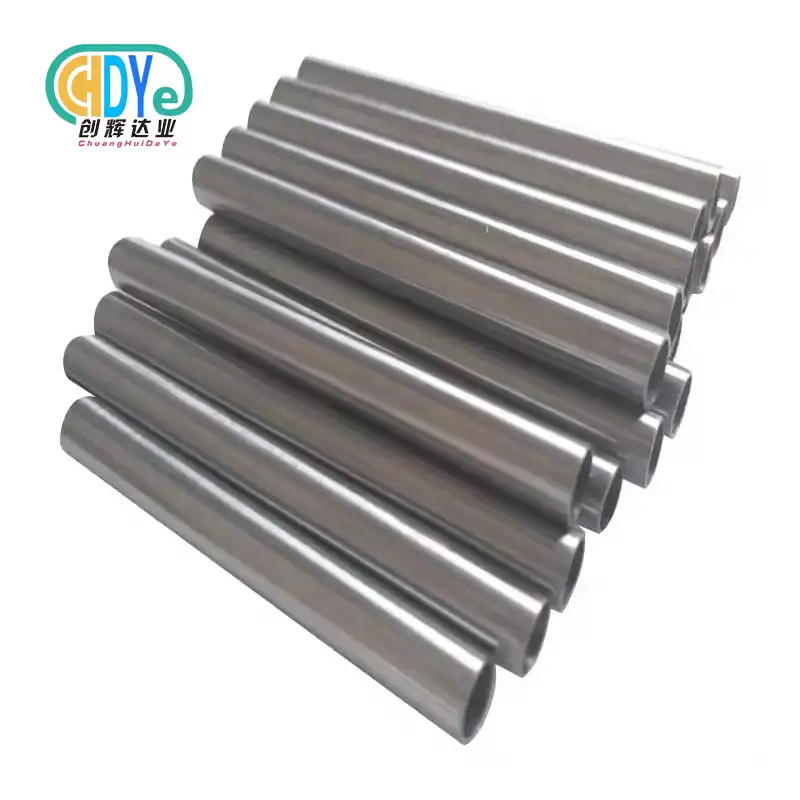
Understanding Titanium Alloy Tube Standards
International guidelines make sure that titanium alloy tube items are safe, of good quality, and always the same. In North America, most procurement rules are based on ASTM standards. ASTM B338 covers seamless and welded tubes for condensers and heat exchangers, ASTM B337 covers seamless tubes for general uses, and ASTM B861/B862 covers seamless and welded pipe that can be used in high-pressure and corrosive environments. In these frames, exact chemical compositions, mechanical qualities, tolerances for size, and surface finish standards are laid out.
ASTM B338: Heat Exchanger and Condenser Applications
ASTM B338 lays out the rules for tubes that are either smooth or welded and are used in heat transfer systems where thermal efficiency and resistance to rust are very important. The grades that are covered are Gr1, Gr2, Gr7, Gr9, and Gr12. Each has its own set of success characteristics. Grade 2 is fairly pure titanium that is moderately strong and can be used for general purposes. Grade 12 adds molybdenum and nickel to make it more resistant to reducing acids and crack corrosion in chemical plant settings.
ASTM B861 and B862: Seamless and Welded Pipe Standards
The ASTM B861 and B862 standards cover both seamless and welded pipes. ASTM B861 talks about seamless pipe that is used in structural and pressure-containing uses that need very tight limits on size and strength. When performance and cost-effectiveness are both important, ASTM B862 controls welded pipe, as long as the weld seam is properly inspected to make sure the structure stays together. Both standards require hydrostatic or gas tests to make sure the system can keep pressure and doesn't have any leaks.
Grade Selection Based on Operational Requirements
The operating factors affect the choice of material grade. For use at low temperatures, Gr1 and Gr2 are very easy to shape and join. By adding limited amounts of palladium, Gr7 makes it more resistant to rust in oxidizing acid conditions. Gr9 is a combination of titanium, aluminum, and vanadium that is stronger and can be used for hydraulic lines in spacecraft and exhaust systems in cars. Gr12 works great on chemical handling equipment that comes into contact with hot chloride solutions. Understanding these differences keeps you from having expensive material fails and makes sure you follow the rules.
Quality Inspection Procedures for Titanium Alloy Tubes
A thorough quality check makes sure that the product meets standards and the needs of the application, protecting the money spent on purchase. Visual inspection, measuring, non-destructive testing, figuring out mechanical properties, and chemical analysis are all parts of inspection processes. Each step gives important information that, when put together, proves that the titanium alloy tube is suitable.
Visual and Dimensional Inspection
Visual inspection finds surface flaws like cracks, pits, scratches, and coloring that might affect performance or point out problems with the way it was made. Precision micrometers and laser measurement tools are used in dimensional checking to make sure that the outer diameter, wall thickness, length, and straightness are all within certain limits. Tubes with an outside diameter (OD) of 10mm to 300mm, a wall thickness of 0.5mm to 10mm, and lengths of up to 18,000mm need to be measured very carefully to make sure they work with other parts and system assemblies.
Non-Destructive Testing Methods
Non-destructive testing finds flaws inside and below the surface of an object without damaging it. Ultrasonic testing uses high-frequency sound waves to find cracks, laminations, flaws, and holes in the walls of tubes. Surface-breaking and near-surface defects can be found accurately with eddy current testing. This is especially useful for long tubular goods where fast scanning increases productivity. Both ways meet the requirements of ASTM E213 and ASTM E426 and are very good at finding defects.
Mechanical and Chemical Testing Protocols
Tensile strength, yield strength, extension, and hardness are all tested mechanically and found to meet the criteria. Flattening and flaring tests check how flexible and well-welded the seams are, making sure that the tubes can handle the stresses of fitting and tube-sheet growth. Inductively coupled plasma optical emission spectroscopy is used for chemical research to confirm the interstitial material and elemental makeup. Too much oxygen, nitrogen, or hydrogen makes the material less flexible and more likely to break. This is why tight chemical control is so important. When you mix these testing methods, you get all the quality assurance paperwork you need for important applications.
Comparing Titanium Alloy Tube Grades and Their Quality Impact
Different titanium alloy tube grades have different mechanical qualities, cost profiles, and how they react to corrosion, all of which affect buying choices. Choosing the right grade strikes a mix between performance needs and price constraints, while also guaranteeing long-term dependability.
Grade 2 Versus Grade 12: Compositional and Performance Differences
Grade 2 titanium is fairly pure and has no more than 0.3% oxygen. It has a modest tensile strength of about 345 MPa and great corrosion protection in oxidizing conditions. Grade 12 has between 0.2% and 0.4% molybdenum and between 0.6% and 0.9% nickel. This makes it more resistant to rusting in acidic and chloride-containing environments. This structural improvement solves some problems in chemical processes where Grade 2 isn't enough, but it costs more in materials.
Grade 9: High-Strength Alpha-Beta Alloy
The Grade 9 (Ti-3Al-2.5V) alloy is in the middle of the commercially pure grades and the high-strength Grade 5 alloy. Adding aluminum and vanadium makes an alpha-beta matrix that has a tensile strength of about 620 MPa and is easy to shape and join. When aerospace makers need to reduce weight and keep strength levels reasonable, Grade 9 hydraulic tubing is the best choice. When metal is heated, it becomes very flexible, which is ideal for bending and curling.
Heat Treatment Impact on Performance
The mechanical qualities and composition are greatly changed by heat treatment. Annealing removes any remaining pressures from cold working, makes the material flexible again, and creates a regular grain structure that is needed for forming. Solution treating and aging alpha-beta metals like Grade 9 makes them stronger by controlling the precipitation processes. To make sure that all production lots work the same, the procurement specs must clearly state the conditions for heat treatment.
How to Select a Certified Titanium Alloy Tube Supplier
Choosing the right titanium alloy tube supplier has a big effect on the quality of the product, how reliably it is delivered, and the total cost of ownership. Certifications, output capacity, quality management systems, and expert support services are some of the things that set capable manufacturers apart from average suppliers.
ISO 9001:2015 Certification and Quality Management
Getting ISO 9001:2015 approval shows that you have a method for managing quality that includes keeping an eye on documents, making sure processes work, fixing problems, and always getting better. This approval is kept up by Shaanxi Chuanghui Daye Metal Material Co., Ltd., which makes sure that every step of the production process—from receiving the raw materials to packaging them at the end—follows written processes that are regularly audited. This methodical technique reduces variation and makes sure that the quality of the products is the same from one sale to the next.
Manufacturing Capability and Technical Infrastructure
How well providers can meet volume, size, and wait time needs is based on their production potential. Advanced factories with electron beam melting furnaces, precision extrusion presses, cold pilger mills, and CNC milling centers make it possible to precisely control the dimensions and finish of the products. We make tubes from OD10mm to OD300mm with wall thicknesses as thin as 0.5mm at our factory in Baoji, which is known as China's Titanium Capital. We use local knowledge and integrated supply chains to get these tubes to you.
Inspection Documentation and Traceability
Full records allow tracking from the hot lot of the raw materials to the final product. Material test results confirm the chemical make-up and mechanical features of a substance. Reports from non-destructive tests show how flaws were found. Dimensional measurement records show that the tolerances were met. Hydrostatic test papers show that the pressure is correct. This paper trail helps with quality checks, failed investigations, and following the rules. It is especially important for medical and aerospace uses that have to meet strict quality standards.
Best Practices in Titanium Alloy Tube Procurement and Quality Assurance
Strategic titanium alloy tube buying practices make sure that results are of the highest quality while keeping costs and delivery times under control. For procurement success to happen, there must be clear requirements, cooperative relationships with suppliers, and independent verification methods.
Defining Comprehensive Technical Specifications
Detailed specs get rid of doubt and set acceptable criteria that can be measured. Specifications should include more than just the standard name. They should also include tolerances for dimensions, requirements for surface finish, limits for straightness, heat treatment conditions, NDT acceptance criteria, and requirements for paperwork. By stating whether the product is seamless or bonded, annealed or cold-worked, and bright annealed or pickled, you can avoid confusion and make sure that the goods you receive meet your needs.
Collaborative Inspection and Quality Partnerships
For quality assurance to work well, procurement teams, quality experts, and factory partners need to work together. Meetings before production make checking procedures and acceptance criteria clear. Witness testing lets customer service reps watch important checks and make sure rules are being followed. Communication that happens regularly during work lets problems be fixed before they get worse. This relationship method turns suppliers into quality friends instead of vendors who are out to get you.
Third-Party Inspection Services
Third-party review by a third party adds another level of proof that is especially helpful for high-value or safety-critical orders. Accredited inspection agencies check the dimensions, watch over the technical tests, make sure all the paperwork is full, and give out independent inspection certificates. This independent validation gives buyers trust and helps with quality assurance processes in controlled fields where fairness is important.
Documentation Management and Audit Readiness
Keeping paperwork in order makes quality control and following the rules easier. Digital document management systems store certificates, inspection reports, calibration records, and tracking data for materials and make them easy to find when needed. This organized method helps with internal audits, customer satisfaction polls, and government reviews. It also lets you respond quickly to problems in the field that need to be looked into to find their root cause.
Conclusion
To successfully source titanium alloy tubes, you need to have a good mix of material science knowledge, standard reading skills, and the ability to evaluate suppliers. When you know how ASTM standards set chemical and technical requirements, you can make more accurate specifications. Comprehensive quality checking procedures make sure that standards are met and stop mistakes that cost a lot of money. When you choose the right grade for the job, you get the best results and lowest cost. Buying from ISO-certified companies with advanced production tools and strict quality control systems lowers the chance of buying something. Supply chain reliability is increased by following best practices for clear specifications, joint inspection, third-party verification, and managing documents. Now that procurement professionals know this, they can easily find titanium alloy tubular goods that will work for a long time in tough aircraft, chemical, medical, and industrial settings.
FAQ
Q: What distinguishes Grade 2 from Grade 5 tubes?
A: Grade 2 titanium is commercially pure. It is moderately strong and has good general corrosion resistance, making it good for use in chemical processing and coastal settings. Grade 5 (Ti-6Al-4V), which isn't talked about in detail here, is much stronger thanks to the alloying of aluminum and vanadium and is best for use in aircraft structures. Our main products are titanium alloy tubes in grades Gr1, Gr2, Gr7, Gr9, and Gr12, which meet the needs of a wide range of industries.
Q: How do ASTM standards influence purchasing decisions?
A: Standards set by ASTM are used all over the world to describe the make-up of materials, their mechanical qualities, allowable size differences, and testing requirements. Specifying ASTM B338, B337, B861, or B862 makes sure that sellers know exactly what is needed, makes bidding easier, and makes quality control easier. Following the rules lowers the risk of buying things and makes sure that they are accepted by regulators.
Q:Can tubes be supplied with custom dimensions and heat treatment?
A: Of course. We make tubes with ODs from 10mm to 300mm, wall thicknesses from 0.5mm to 10mm, and lengths of up to 18,000mm. To get the mechanical qualities you want, you can get a custom heat treatment that includes certain annealing processes. During the quote process, detailed conversations make sure that the specs match the needs of the product and the manufacturing capabilities.
Partner with a Trusted Titanium Alloy Tube Manufacturer
Shaanxi Chuanghui Daye offers precision-engineered titanium tubes that are made to strict ASTM standards. They are backed by ISO 9001:2015 approval and have over 30 years of experience working with rare metals. Our wide range of products, including Gr1, Gr2, Gr7, Gr9, and Gr12 types, meets a wide range of needs in the chemical processing, aircraft, power generation, and medical device industries. In Baoji's Titanium Capital, state-of-the-art production tools make it possible to make tubes that are both smooth and bonded with perfect dimensions and surfaces. Each tube goes through strict non-destructive testing, mechanical evaluation, and chemical analysis, all of which are backed up by full paperwork that shows where the tubes came from. Whether you need standard sizes or unique shapes, small prototypes or big production runs, our technical team can help you choose the best materials. You can talk to our global supplier team at info@chdymetal.com about your needs, ask for material approvals, or get cheap quotes. Partnering with a titanium alloy tube maker who cares about quality, dependability, and customer success can be very helpful.
References
1. American Society for Testing and Materials. (2021). ASTM B338-21: Standard Specification for Seamless and Welded Titanium and Titanium Alloy Tubes for Condensers and Heat Exchangers. West Conshohocken, PA: ASTM International.
2. American Society for Testing and Materials. (2020). ASTM B861-20: Standard Specification for Titanium and Titanium Alloy Seamless Pipe. West Conshohocken, PA: ASTM International.
3. Donachie, M.J. (2000). Titanium: A Technical Guide, 2nd Edition. Materials Park, OH: ASM International.
4. Schutz, R.W. and Watkins, H.B. (1998). Recent developments in titanium alloy application in the energy industry. Materials Science and Engineering: A, 243(1-2), 305-315.
5. Boyer, R., Welsch, G., and Collings, E.W. (1994). Materials Properties Handbook: Titanium Alloys. Materials Park, OH: ASM International.
6. International Organization for Standardization. (2015). ISO 9001:2015: Quality Management Systems – Requirements. Geneva, Switzerland: ISO.

Learn about our latest products and discounts through SMS or email