- English
- French
- German
- Portuguese
- Spanish
- Russian
- Japanese
- Korean
- Arabic
- Greek
- German
- Turkish
- Italian
- Danish
- Romanian
- Indonesian
- Czech
- Afrikaans
- Swedish
- Polish
- Basque
- Catalan
- Esperanto
- Hindi
- Lao
- Albanian
- Amharic
- Armenian
- Azerbaijani
- Belarusian
- Bengali
- Bosnian
- Bulgarian
- Cebuano
- Chichewa
- Corsican
- Croatian
- Dutch
- Estonian
- Filipino
- Finnish
- Frisian
- Galician
- Georgian
- Gujarati
- Haitian
- Hausa
- Hawaiian
- Hebrew
- Hmong
- Hungarian
- Icelandic
- Igbo
- Javanese
- Kannada
- Kazakh
- Khmer
- Kurdish
- Kyrgyz
- Latin
- Latvian
- Lithuanian
- Luxembou..
- Macedonian
- Malagasy
- Malay
- Malayalam
- Maltese
- Maori
- Marathi
- Mongolian
- Burmese
- Nepali
- Norwegian
- Pashto
- Persian
- Punjabi
- Serbian
- Sesotho
- Sinhala
- Slovak
- Slovenian
- Somali
- Samoan
- Scots Gaelic
- Shona
- Sindhi
- Sundanese
- Swahili
- Tajik
- Tamil
- Telugu
- Thai
- Ukrainian
- Urdu
- Uzbek
- Vietnamese
- Welsh
- Xhosa
- Yiddish
- Yoruba
- Zulu
Titanium Wire for Sale – Premium Grades Ready to Ship
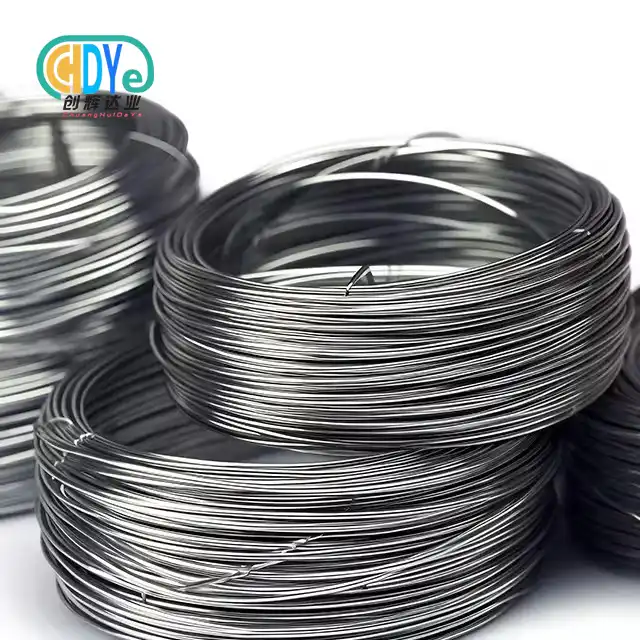
When sourcing high-performance materials for critical applications, titanium wire for sale represents one of the most versatile and reliable solutions available in today's advanced manufacturing landscape. Shaanxi Chuanghui Daye Metal Material Co., Ltd. is an expert at making high-quality titanium wires that are very strong, don't rust, and are precisely cut to fit needs in aircraft, medicine, chemicals, and industry. In Baoji, China's famous "Titanium Valley," our titanium wires are made using cutting-edge technologies for melting, drawing, and cooling to make sure they meet world quality and performance standards.
Understanding Titanium Wire – Properties and Applications
Titanium wire is an important advance in the study of materials because it has special qualities that make it essential in many high-performance fields. Titanium wire for sale is distinguished by its high strength-to-weight ratio, exceptional rust resistance, and exceptional biocompatibility. These properties make it the ideal material when standard metals fail to meet strict requirements.
Key Material Properties and Performance Characteristics
Titanium wire has many great qualities, but its strength-to-weight ratio is one of the best. Titanium wire has a density about 45% lower than steel but the same tensile strength, so it can be used to reduce weight without affecting the strength of the structure. This trait is especially useful in aircraft, where every gram counts, and in medical implants, where less weight makes patients more comfortable. Another thing that makes titanium wire unique is that it doesn't rust. The substance creates a solid, self-healing oxide layer that protects against salt, acids, alkalis, and chlorides better than anything else. Titanium wire is great for aquatic uses, chemical handling equipment, and places where stainless steel or aluminum would break down quickly because of this natural passivation.
Industrial Applications Across Multiple Sectors
Titanium wire is useful in many different business settings, each using different qualities of the material to solve its own problems. Titanium wire is used as a welding filler metal for airplane parts in the aerospace industry. This makes sure that the joints stay as strong and resistant to rust as the base materials. Because it works consistently in temperatures from -200°C to 600°C, the wire is needed for both cold fuel systems and high-temperature engine parts. Another important area where titanium wire's biocompatibility becomes very important is in the production of medical devices. For orthopedic implants, cardiovascular devices, and oral uses, surgeons depend on titanium wire because it works well with human flesh and doesn't cause any problems. The wire's modulus of flexibility is very close to that of human bone. This keeps stress shielding effects from happening, which can cause the implant to become free or fail. Titanium wire is used in the chemical and petrochemical industries to make heat exchangers, pressure tanks, and piping systems that are used in harsh chemical conditions. Because it doesn't crack under chloride stress and is also resistant to sulfuric acid, nitric acid, and chemical acids, the material is a good investment for long-term use.
How to Choose the Right Titanium Wire for Your Needs
To choose the right titanium wire for sale, you need to carefully look at its technical specs, how it will be used, and how well it will work. To make sure that materials work well and don't cost too much, procurement workers have to balance a lot of things, such as grade choice, dimensional limits, surface finish requirements, and certification standards.
Grade Selection and Technical Specifications
The first step in choosing the right titanium wire is to understand how the different types are different. Different types of commercially pure titanium (Gr1, Gr2, Gr3, and Gr4) have different amounts of strength and shapeability. Grade 1 is the most flexible, while Grade 4 is stronger for structural uses. Grade 2 titanium wire is the most common economically pure choice. It has a great mix of strength, ductility, and corrosion resistance, making it perfect for use in a wide range of industrial settings. Titanium alloy types with better mechanical qualities are used in tough situations. Grade 5 (Ti-6Al-4V) titanium wire has a great strength-to-weight ratio and doesn't wear down easily, which makes it perfect for medical implants and aircraft fixings. Grade 7 has palladium added to it to make it more resistant to rust in less acidic settings. Grade 9 (Ti-3Al-2.5V) is stronger and easier to shape when cold.
Dimensional and Quality Considerations
The diameter of the wire you choose varies depending on the needs of the product. Standard diameters range from 0.1mm to 6.0mm. Tight measurement tolerances are needed for precision uses. These are usually defined as h8 or h9 grade tolerances, which can be reached through centerless grinding or precision drawing. Surface finish needs range from a pickled state for general use to a bright-annealed state for tasks that need a high-quality surface and exact measurements. Quality approvals are very important when choosing materials, especially for businesses that are controlled. The broad rules for titanium wire are set by ASTM B863, and the rules for welding are set by AWS A5.16. For medical uses, products must meet ASTM F136 or F67 standards. These standards make sure that the products are biocompatible and have consistent mechanical properties, which is important for internal devices.
Titanium Wire Procurement Guide – Buying Tips and Supplier Considerations
To be successful in the titanium wire for sale market, you need to know about the skills of suppliers, quality systems, and buying strategies that make sure you have a steady supply of materials while lowering your total cost of ownership. Because titanium engineering is so complicated, suppliers must be carefully evaluated to make sure that quality and performance are always the same.
Supplier Evaluation and Quality Assurance
Before judging a possible supplier, you should look at how well they can make things and how well they handle quality. If a provider has ISO 9001:2015 approval, it means they are committed to maintaining quality throughout the whole production process. Advanced sellers keep extra certifications, like AS9100 for aircraft uses or ISO 13485 for making medical devices, which show they know how to provide quality products in those industries. As part of a manufacturing capability review, vacuum melting equipment, precision drawing machines, and heat treatment facilities should be looked at. Modern suppliers use vacuum arc remelting (VAR) or electron beam melting (EBM) to make sure that the chemicals are all the same and that there aren't many flaws that could affect the performance of the wire. The ability to do cold drawing with multiple reduction passes makes sure that the dimensions are correct and the surface quality is consistent.
Procurement Strategies and Market Dynamics
Procurement strategies that work well combine the need for materials right away with the need to ensure long-term supplies and cut costs as much as possible. Bulk buying deals often save a lot of money and make sure that the right goods are sent to the right people when the market is tight. Titanium, on the other hand, has a pretty long shelf life, which lets you handle your supplies strategically without worrying about material degradation. The costs of raw materials, how well production capacity is used, and trends of world demand all affect prices. Titanium sponge prices change based on supply and demand around the world, which has a direct effect on the prices of wire. Knowing about these trends helps procurement managers choose the best time to buy things and arrange good long-term deals.
Manufacturing and Processing of Titanium Wire – From Raw Material to Finished Product
Professional titanium wire is made using complex mechanical methods and careful process control to make sure it has the exceptional qualities needed for important uses. Knowing how this process works helps buyers figure out what the seller can do and what quality they can expect.
Raw Material Processing and Primary Manufacturing
High-purity titanium sponge is made by reducing titanium tetrachloride to solid titanium in the Kroll or Hunter process. This is the first step in making titanium wire. The sponge is remelted using a vacuum arc in special ovens that keep the ingot chemically uniform and clean from airborne contaminants. To change an ingot into something else, hot forging and rolling are used to break down the cast structure and give it the right mechanical properties. Multiple hot working passes reduce the size of the ingot to that of a billet while keeping the temperature stable to avoid contamination and make sure that the distortion is uniform. Intermediate annealing processes lower working pressures and make the microstructure best for the next step in the process.
Wire Drawing and Finishing Operations
Wire drawing is an important part of the industrial process because it sets the quality of the surface and the accuracy of the dimensions. Multiple drawing passes through dies made of tungsten carbide or diamond gradually lower the width while keeping the dimensions close to the required levels. Intermediate stress-relief annealing keeps the flexibility needed for further processing and stops work hardening.As part of surface cleaning, acid pickling is used to get rid of oxide scale and make the surface chemistry uniform. Advanced sellers use pickling with mixes of hydrofluoric and nitric acid that is done in more than one step. This is followed by reduction and passivation processes. Bright annealing in safe atmospheres can make better surface finishes for uses that need very little surface contamination. Quality control throughout manufacturing includes chemical analysis, mechanical tests, and checking the dimensions. Tensile tests, hardness measurements, and microstructural examinations are done on each output lot to make sure it meets the requirements. Statistical process control keeps an eye on important parameters and capability measures that make sure the quality of the result stays the same.
Titanium Wire Price Insights and Bulk Purchase Options
When buying, managers understand how titanium wire prices are set, and they can make choices that meet quality standards and stay within their budgets. Titanium wire for sale has complicated pricing because of the complex manufacturing methods and high raw material costs.
Price Structure Analysis and Market Factors
Titanium wire prices are based on a number of factors, such as the cost of raw materials, the cost of handling, the cost of quality assurance, and the supplier's profit margins. Prices for raw titanium sponge change all the time based on world supply and demand. It usually makes up 40 to 50 percent of the total cost of wire. Processing costs change a lot from one provider to the next, based on how well they make things and how complex their quality systems are. Choosing the right grade has a big effect on the price, with widely pure grades usually selling for less than specialty metals. Grade 2 titanium wire is usually used as a price standard. Grade 5 (Ti-6Al-4V), on the other hand, costs more because it needs to be processed in a more complicated way and has alloying added to it. Specialized grades, like Grade 7 or Grade 12, may have higher prices because there is less desire for them and less production.
Bulk Purchasing Advantages and Logistics Considerations
Buying things in bulk can save you a lot of money and make sure you always have enough for high-volume uses. Volume savings usually start at 1,000 kilograms, and there are more price breaks at 5,000 and 10,000 kilograms. Long-term supply deals can keep prices stable and make sure that supplies are distributed evenly when the market is tight. Logistics issues involve things like how to package things, how to ship them, and when to send them. Titanium wire for sale needs to be carefully packed so that it doesn't get dirty or damage its surface while in transit. For important uses, specialized providers offer secure packing with inert atmosphere purging. The ability to ship goods all over the world guarantees safe arrival to customers in North America and Europe, along with the right paperwork for customs clearance.
Conclusion
High-quality titanium wire for sale is an important material investment for fields that need top-notch performance, dependability, and durability. Due to its exceptional strength, resistance to corrosion, and biocompatibility, titanium wire is an essential material for use in chemical, medical, military, and industrial settings. To be good at procurement, you need to know about grade standards, what suppliers can do, and the quality processes that make sure materials always work well. Chuanghui Daye's dedication to high-quality production and excellent customer service makes them a great partner for long-term supply partnerships that help your business succeed and give you an edge in today's tough global markets.
FAQ
Q: What applications are most suitable for titanium wire?
A: Titanium wire is great for uses that need high strength-to-weight ratios, biocompatibility, or resistance to rust. Filler metal for TIG welding is used in aircraft and chemical processing equipment, medical tools like surgical staples and orthodontic devices, and additive manufacturing material for 3D printing. Because the material is so flexible, it can be used in marine areas, high-temperature settings, and any other case where regular materials don't work well enough.
Q: How do I determine the correct grade for my application?
A: Choosing the right grade relies on the performance needs and working situations. Commercially pure grades (Gr1–Gr4) are very good at resisting rust and being shaped, with Grade 2 being the most useful. When it comes to structural uses, Grade 5 (Ti-6Al-4V) is stronger, and Grade 7 is better at resisting rust in reducing conditions. For medical uses, Grade 1, 2, or 4 is usually enough, based on how strong it needs to be and how well it works with living things.
Q: What quality certifications should I expect from suppliers?
A: Material test certificates (MTCs) from reputable sources show the chemical makeup, mechanical qualities, and measurements of each production lot. Some qualifications that are specific to an industry are ASTM approval for general uses, AWS certification for welding supplies, and ASTM F136/F67 certification for medical uses. As a minimum, suppliers should have ISO 9001:2015 quality management certification. For advanced uses, suppliers should also have AS9100 for aircraft or ISO 13485 for medical devices.
Q: What are typical lead times for custom titanium wire orders?
A: Lead times depend on the specifications, the amount, and the supplier's availability. Standard grades and sizes usually ship between 2 and 4 weeks, but handling for special specs may take 6 to 8 weeks. Lead times may go up to 10 to 12 weeks for large orders or alloys that aren't commonly used. Most of the time, emergency needs can be met through faster handling, though there may be an extra charge.
Ready to Purchase Premium Titanium Wire? Contact Us Today!
Shaanxi Chuanghui Daye is ready to meet your needs for titanium wire for sale. We have a large stock of top grades and can send them quickly. Our factory in China's Titanium Valley is ISO 9001:2015 approved and makes high-quality titanium wire that meets international standards for use in aircraft, medicine, and industry. We offer reasonable factory-direct prices, variable order amounts, and top-notch technical help to make sure you get the right stuff for your needs. Get in touch with our knowledgeable staff at info@chdymetal.com to talk about your titanium wire needs and get a detailed price. Our experienced supplier representatives can help with all kinds of technical questions and can speed up delivery for projects that need to be done right away in North America and Europe.
References
1. American Society for Testing and Materials. "ASTM B863 Standard Specification for Titanium and Titanium Alloy Wire." ASTM International, 2021.
2. American Welding Society. "AWS A5.16 Specification for Titanium and Titanium Alloy Welding Electrodes and Rods." AWS Publications, 2020.
3. Boyer, Rodney R., Gerhard Welsch, and E.W. Collings. "Materials Properties Handbook: Titanium Alloys." ASM International, 1994.
4. Donachie, Matthew J. "Titanium: A Technical Guide, 2nd Edition." ASM International, 2000.
5. International Organization for Standardization. "ISO 5832-2 Implants for Surgery - Metallic Materials - Part 2: Unalloyed Titanium." ISO Publications, 2018.
6. Peters, Manfred, Christoph Leyens, Ulrich Schulz, and Wolfgang A. Kaysser. "Titanium and Titanium Alloys: Fundamentals and Applications." Wiley-VCH, 2003.
Learn about our latest products and discounts through SMS or email