- English
- French
- German
- Portuguese
- Spanish
- Russian
- Japanese
- Korean
- Arabic
- Greek
- German
- Turkish
- Italian
- Danish
- Romanian
- Indonesian
- Czech
- Afrikaans
- Swedish
- Polish
- Basque
- Catalan
- Esperanto
- Hindi
- Lao
- Albanian
- Amharic
- Armenian
- Azerbaijani
- Belarusian
- Bengali
- Bosnian
- Bulgarian
- Cebuano
- Chichewa
- Corsican
- Croatian
- Dutch
- Estonian
- Filipino
- Finnish
- Frisian
- Galician
- Georgian
- Gujarati
- Haitian
- Hausa
- Hawaiian
- Hebrew
- Hmong
- Hungarian
- Icelandic
- Igbo
- Javanese
- Kannada
- Kazakh
- Khmer
- Kurdish
- Kyrgyz
- Latin
- Latvian
- Lithuanian
- Luxembou..
- Macedonian
- Malagasy
- Malay
- Malayalam
- Maltese
- Maori
- Marathi
- Mongolian
- Burmese
- Nepali
- Norwegian
- Pashto
- Persian
- Punjabi
- Serbian
- Sesotho
- Sinhala
- Slovak
- Slovenian
- Somali
- Samoan
- Scots Gaelic
- Shona
- Sindhi
- Sundanese
- Swahili
- Tajik
- Tamil
- Telugu
- Thai
- Ukrainian
- Urdu
- Uzbek
- Vietnamese
- Welsh
- Xhosa
- Yiddish
- Yoruba
- Zulu
Trusted Titanium Sheets Manufacturer for OEM Orders
When looking for titanium sheets for important OEM manufacturing projects, it's important to find a partner that can provide consistent quality, accurate design, and reliable service. We at Shaanxi Chuanghui Daye Metal Material Co., Ltd. know that your parts need to be very resistant to rust, have the best strength-to-weight ratios, and be exactly the right size. Our 2mm titanium sheets in Grades 2 and 5 are used by research institutions, aerospace companies, medical device companies, and chemical equipment companies all over the United States because they are strong and work well in harsh circumstances. We are based in Baoji, China, a city known as the "Titanium Capital." With more than 30 years of experience making rare metals, we can offer you solid supply options that meet your technical needs and delivery dates.
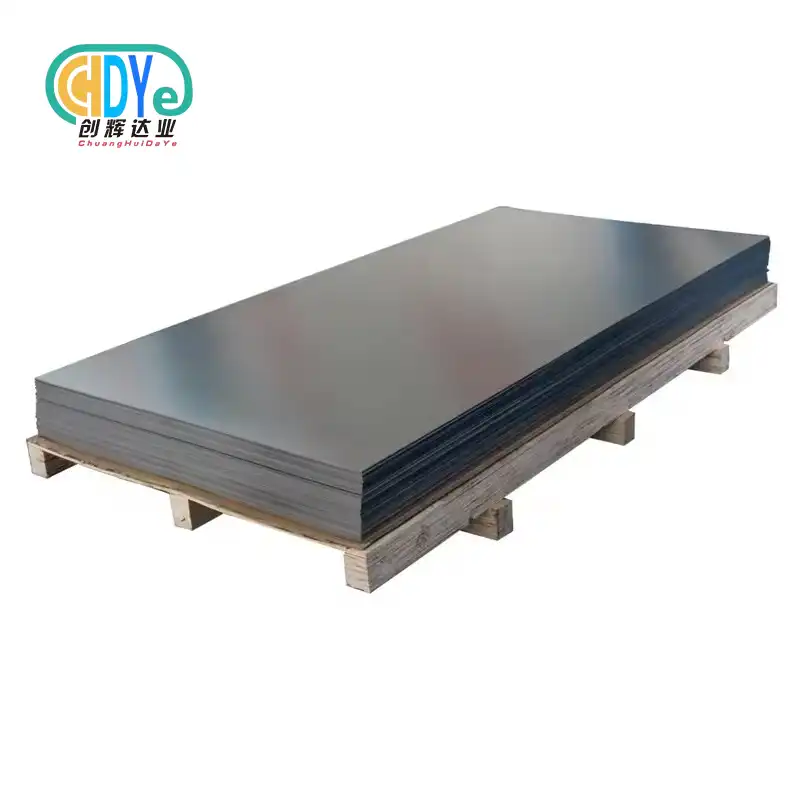
Understanding Titanium Sheets: Properties, Grades, and Applications
Titanium sheets are an important group of flat-rolled mill materials. They are usually between 0.5 mm and 4.75 mm thick and were made to solve the problem of weight, strength, and rust that regular metals can't. When these materials are exposed to air, they form a titanium oxide (TiO₂) film on their own. This protects them from chloride-induced stress corrosion cracking in coastal and offshore settings and keeps their structure strong at temperatures that would normally break aluminium alloys.
Material Properties That Matter
The way your making turns out is directly affected by the physical properties of our titanium sheets. With a density of 4.51 g/cm³, which is about 60% that of steel, these materials make assemblies lighter without lowering their dynamic performance. Our 2mm sheets have a freezing point of about 1668°C and a low thermal expansion rate, which makes them perfect for uses that will be exposed to heat or temperature changes. Anisotropic behaviour is caused by the hexagonal close-packed crystal structure during forming operations. We carefully control this behaviour through precise rolling parameters to reduce earring and ensure that the thickness is distributed evenly across lengths from 500 mm to 2000 mm.
Grade Selection for OEM Requirements
Grade 2 economically pure titanium has a yield strength of about 345 MPa and is effortless to shape when cold. This grade is excellent for parts in chemical processing equipment, heat exchangers, and ships where rust resistance is more important than ultimate tensile strength. We offer Grade 2 sheets in lengths ranging from 1000 mm to 3000 mm. These sheets meet ASTM B265 industrial standards and can be shaped to fit complex pressing processes. Grade 5 titanium alloy (Ti-6Al-4V) has yield strengths of more than 828 MPa, which is why it is the best choice for high-performance car parts, aerospace structural parts, and defence uses. This alloy can be heated to change its mechanical qualities. It also has better fatigue protection for situations with repeated loads. Our Grade 5 sheets meet the requirements of AMS 4911 for aircraft applications, giving important flying parts the paperwork and tracking they need.
Industry Applications
Our sheets are used by aerospace engineers for parts of the frames, engine nacelles, and hydraulic systems where reducing weight has a direct effect on fuel economy. Biocompatible qualities are important for medical devices like surgical tools, orthopaedic implants, and diagnostic equipment that needs to be sterilised many times. These materials are used in chemical processing plants for reactor vessels, pipe systems, and desalination plants that work in chloride-rich settings. The ability of the material to keep performance traits that standard metals can't keep up is good for all of them.
How to Select the Right Titanium Sheet Supplier for OEM Orders?
To find a good supplier, you have to look at a number of things that affect the quality of your work, the time it takes to get it, and the total cost of the purchase. The choice goes beyond unit pricing and includes things like certification accuracy, processing powers, and the dependability of the supply chain across global logistics networks.
Critical Procurement Parameters
When choosing a provider, you should make sure that they offer unique sizes that work with your stamping dies and manufacturing tools without wasting too much material. We still have the ability to shear sheets to within ±0.5mm of their exact size across lengths of up to 2000mm, which means that your plant won't have to do as many extra trimming operations. When you're in charge of just-in-time manufacturing or project-based procurement with firm milestone promises, your delivery plans need to match up with your production planning cycles.
Certification and Traceability Standards
ISO 9001:2015 approval is the standard for quality management systems. It makes sure that control is recorded from inspecting raw materials to packaging them. We set up batch tracking so that each sheet can be linked to a specific melt number, chemical composition analysis, and mechanical test records. Our quality paperwork includes mill test certificates (MTCs) that show full chemical analyses of the material's oxygen and nitrogen levels, which keep welded parts from becoming weak. For special processes, aerospace uses need extra certifications like AMS standards and NADCAP compliance. We keep working relationships with outside testing labs that check the tensile qualities, hardness values, and ultrasound inspection results based on what the customer wants. Because of this, your quality assurance teams can check that the materials are compliant before putting them together.
Comparative Material Analysis
Titanium sheets are pricier than stainless steel or aluminium sheets, but when you look at maintenance cycles, component lives, and breakdowns caused by corrosion, the total cost of ownership often works out better for titanium. Unlike stainless steel, which pits when chloride levels rise above 200 ppm, our titanium sheets don't get damaged by seawater or chemical process streams when they don't have coatings to protect them. For the same level of strength, the weight savings of about 40% compared to steel directly leads to better performance in aircraft and automotive uses.
Custom Cutting and Processing Services for Titanium Sheets
Professional processing services take raw sheet materials and turn them into precise pieces that fit your assembly processes without getting dirty or losing their shape. The methods used for cutting have a direct effect on the quality of the edge, the properties of the material, and the speed of the manufacturing process that follows.
Cutting Method Selection
When you cut something with a water jet, all heat-affected areas are removed, and the mechanical qualities stay the same within 1mm of the cut edge. This cold-cutting method can handle complicated shapes and small curves without adding heat stress that could lead to warping during later shaping steps. We use this method for complicated patterns that need to have dimensions that are accurate to within ±0.2mm. It is cheap and easy to use mechanical shearing to make straight cuts in sheets up to 3mm thick, leaving clean sides that are ready for welding. Our guillotine shears with titanium-specific tools keep edges from deforming and burrs from forming. Laser cutting is the fastest way to make forms with a modest amount of complexity, but operators must carefully control the amount of heat used so that titanium doesn't take gases at high temperatures.
Technical Expertise in Material Handling
To work with titanium sheets during processing, you need to know how the material works. Because it doesn't have as much flexibility as steel, it springs back when it's bent, so over-bend adjustment is needed based on the material grade and bend radius. Our processing team figures out these changes by using data from thousands of production projects, which makes sure that the first piece is accurate. Controlling contamination while cutting stops surface flaws that weaken resistance to rust. We keep our work areas clean, only use special cutting tools, and stay away from steel parts that could have iron bits embedded in them. We pay even more attention to cleanliness when it comes to packing. For example, we use protective interleaving to separate sheets and wooden boxes to keep moisture out during ocean freight.
Pricing, Bulk Purchase, and Supply Chain Solutions
The cost of materials for titanium sheets depends on many things, such as the price of global sponge titanium, the amount of grade-specific alloys added, how hard the processing is, and how many sheets are ordered. By understanding these factors, you can make more accurate budget plans and find ways to cut costs through smart purchasing.
Price Determinants
Because it costs less to combine and is easier to work with, Grade 2 commercially pure titanium is usually sold for less than Grade 5 alloy. When rolling and finishing, the thickness of the material affects both the yield and the performance of the structure. 2mm sheets are a good compromise between the output and the performance of the structure. When it comes to processing steps and costs, custom width and length measurements that don't match standard mill product sizes are cheaper than custom dimensions that need more cutting.
Volume Purchase Benefits
Ordering in bulk saves a lot of money per unit and makes sure that materials are always available for ongoing production projects. When you agree to quarterly or yearly amounts, we can find the best production schedule to cut down on setup costs, which you can then use to save money on your procurement budget. Volume deals also make sure that supplies are shared out during times when raw materials are hard to come by, which protects your production from changes in the market. Because our minimum order amounts are flexible, they can be used for both large-scale production plans and prototype development projects. Research institutions that are studying materials can get small amounts without having to pay too much, and automakers that are managing multi-year contracts get better pricing systems that make them more competitive.
Logistics and Delivery Reliability
We arrange foreign shipping through reputable freight forwarders who know how to handle metal goods that don't rust. According to the difficulty of the order, standard lead times are between 2 and 6 weeks. For urgent projects, faster handling is possible. International shipping rules say that our packaging must include moisture shields, edge protection, and the right labels to make customs clearance easier. Reliable delivery comes from keeping a collection of popular grades and sizes and having the production capacity to adapt to changes in yearly demand. We keep you informed about the state of your orders by sending you production updates and shipping documents that work perfectly with your ERP systems and inventory programs run by your vendors.
Why Choose Chuanghui Daye as Your Trusted Titanium Sheet Manufacturing Partner?
When choosing a provider, you need to look at more than just the product specs. You also need to look at the whole partnership structure that will help your long-term manufacturing success. The things that make our company stand out are our unified skills, comprehensive technical help, and unwavering dedication to customer happiness.
Manufacturing Excellence and Quality Systems
Our plant in Baoji takes advantage of the region's concentrated titanium industry ecosystem, which gives us access to high-quality raw materials and specific knowledge that isn't available anywhere else in the world. We use high-tech tools like vacuum arc remelting furnaces that make ingots with controlled interstitial content, hot and cold rolling mills that are set for precise thickness control, and annealing furnaces that make the grain structure best for mechanical properties. Our quality management is based on ISO 9001:2015 approval, and there are written processes for every step of the production process. When titanium sponge comes in, it is chemically analysed to make sure it has the right makeup before melting starts. We use ultrasonic scales to check the thickness of the material many times during rolling to keep limits. Metallurgical testing proves that heat treatment processes follow time-temperature patterns. This makes sure that the mechanical properties are the same across production lots.
Technical Support Throughout Your Project Lifecycle
Our engineering team can help you with everything from choosing the right materials to fixing problems during production and making sure the quality is the best it can be. We help you choose the right grade based on your technical needs, the area where it will rust, and the way you plan to make the parts. Dimensional specs are looked over to see if standard sizes could save money or if there are ways to make better use of materials. When problems with production happen, like welding issues, making flaws, or rust worries, our metallurgists work with your quality teams to find the root causes and take corrective actions. This relationship for fixing problems includes more than just providing materials. It also includes the technical know-how that makes sure your OEM projects work.
Global Reach with Local Responsiveness
To serve people all over the United States, you need to know about the technical standards and business practices that are unique to American manufacturing. We keep in touch with people in different time zones by emailing info@chdymetal.com and responding with quotes and technical answers to your specific questions within 24 hours. Our paperwork meets U.S. government standards, which makes the approval process for your purchases easier. Consistent service and problem-solving ahead of time lead to long-term ties with customers. We keep track of how often you order so that we can predict what you'll need, tell you when to reorder, and give you market information about how changes in prices affect your material costs. This consultative method changes the connection between the buyer and the seller from one of buying things to one of forming a strategic partnership.
Conclusion
In conclusion, to get titanium sheets for OEM production, you need a provider that can work with you as a partner and offer material knowledge, handling skills, quality systems, and reliable service. Our 2mm Grade 2 and Grade 5 sheets are perfect for aircraft, medical, chemical processing, and industrial uses because they are resistant to corrosion, have a high strength-to-weight ratio, and are cut to exact measurements. We are located in China's titanium production centre and have been in business for over 30 years. We offer expert help and a reliable supply chain that lowers your procurement risk while raising the quality of your parts. Our flexible ordering, thorough testing paperwork, and quick customer service will help your project succeed from the first question to long-term supply deals, no matter if you're making prototype parts or running high-volume production programmes.
FAQ
Q: What tolerances can you achieve for custom-cut titanium sheets?
A: For laser and water jet cutting, our precision cutting services can meet dimensional tolerances as low as ±0.1mm, which is perfect for meeting the accuracy needs of OEM users in aircraft and medical device manufacturing. For straight cuts, mechanical shearing keeps a range of ±0.5 mm, making it good for less difficult tasks. We look at your size requirements during the quote process and then suggest the most cost-effective way to cut that meets your needs.
Q: Do your titanium sheets meet aerospace certification requirements?
A: We offer aerospace-grade materials that meet the requirements of AMS 4902 (commercially pure) and AMS 4911 (Ti-6Al-4V alloy). These materials come with full mill test reports that show their chemical make-up and mechanical features. Our quality method allows us to track back to the original melt lots, and if the customer needs NADCAP compliance, we can arrange for third-party tests to confirm. Shipments to aircraft makers come with all the paperwork needed for AS9100 quality systems.
Q: What are typical lead times for bulk OEM orders?
A: Lead times range from two to six weeks, based on the size of the order, the type of material, any special measurements, and the processing needs. Standard-sized sheets from a regularly stocked store are shipped within two weeks. Custom specs that need special processing may take up to six weeks. We offer fast production choices for projects that need to be done quickly, and we keep in touch with you throughout production to make sure we meet your delivery goals and work with your project schedules.
Partner With a Reliable Titanium Sheet Supplier Committed to Your Manufacturing Success
Shaanxi Chuanghui Daye uses quality systems that are ISO 9001:2015 approved and decades of experience making things out of rare metals to give you titanium sheets that go above and beyond what your OEM needs. Our 2mm Grade 2 and Grade 5 products are strong, don't rust, and are the exact size you need for your important uses. We offer flexible order sizes, full technical support, and reliable shipping schedules to makers across the United States who work in aerospace, medicine, chemicals, and industry. Contact our team at info@chdymetal.com to talk about your unique needs, get material certifications, or get detailed quotes for jobs you have coming up. We're ready to become your trusted titanium sheet manufacturer partner, whether you need a small amount for a prototype or a long-term supply deal.
References
1. ASM International. (2015). Titanium: A Technical Guide, 2nd Edition. Materials Park, OH: ASM International.
2. Donachie, Matthew J. (2000). Titanium: A Technical Guide for Manufacturers and Users. Materials Park, OH: ASM International.
3. Peters, M., Kumpfert, J., Ward, C.H., & Leyens, C. (2003). "Titanium Alloys for Aerospace Applications." Advanced Engineering Materials, 5(6), 419-427.
4. Boyer, R., Welsch, G., & Collings, E.W. (1994). Materials Properties Handbook: Titanium Alloys. Materials Park, OH: ASM International.
5. Schutz, R.W. & Watkins, H.B. (1998). "Recent Developments in Titanium Alloy Application in the Energy Industry." Materials Science and Engineering: A, 243(1-2), 305-315.
6. Lutjering, G. & Williams, J.C. (2007). Titanium: Engineering Materials and Processes, 2nd Edition. Berlin: Springer-Verlag.
Learn about our latest products and discounts through SMS or email