- English
- French
- German
- Portuguese
- Spanish
- Russian
- Japanese
- Korean
- Arabic
- Greek
- German
- Turkish
- Italian
- Danish
- Romanian
- Indonesian
- Czech
- Afrikaans
- Swedish
- Polish
- Basque
- Catalan
- Esperanto
- Hindi
- Lao
- Albanian
- Amharic
- Armenian
- Azerbaijani
- Belarusian
- Bengali
- Bosnian
- Bulgarian
- Cebuano
- Chichewa
- Corsican
- Croatian
- Dutch
- Estonian
- Filipino
- Finnish
- Frisian
- Galician
- Georgian
- Gujarati
- Haitian
- Hausa
- Hawaiian
- Hebrew
- Hmong
- Hungarian
- Icelandic
- Igbo
- Javanese
- Kannada
- Kazakh
- Khmer
- Kurdish
- Kyrgyz
- Latin
- Latvian
- Lithuanian
- Luxembou..
- Macedonian
- Malagasy
- Malay
- Malayalam
- Maltese
- Maori
- Marathi
- Mongolian
- Burmese
- Nepali
- Norwegian
- Pashto
- Persian
- Punjabi
- Serbian
- Sesotho
- Sinhala
- Slovak
- Slovenian
- Somali
- Samoan
- Scots Gaelic
- Shona
- Sindhi
- Sundanese
- Swahili
- Tajik
- Tamil
- Telugu
- Thai
- Ukrainian
- Urdu
- Uzbek
- Vietnamese
- Welsh
- Xhosa
- Yiddish
- Yoruba
- Zulu
Custom-Sized Titanium Welding Wire for OEM Projects
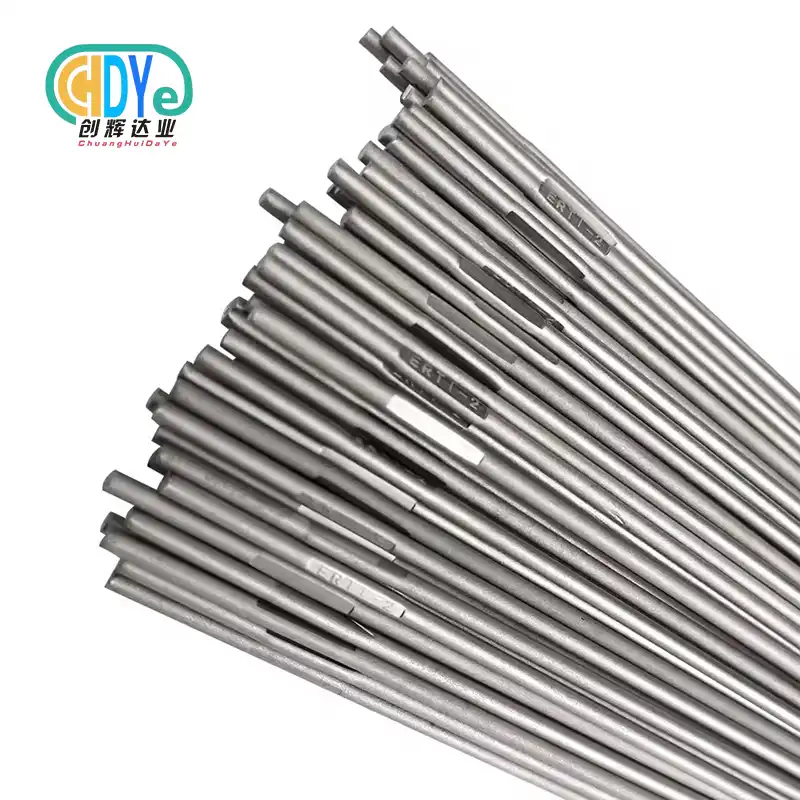
You can get titanium welding wire that is cut to the exact size you need for Original Equipment Manufacturer (OEM) projects that need precise measurements and excellent metal qualities. These customized filler metals are different from standard welding supplies because they are made to meet the specific needs of industries like aircraft, chemical processing, and medical device production, where standard wire sizes can't provide the best weld quality. Customizing the size makes sure that it works perfectly with automatic welding systems, unique joint shapes, and specific heat input needs that are necessary to keep titanium's high rust resistance and mechanical integrity in demanding situations.
Understanding Custom-Sized Titanium Welding Wire for OEM Applications
Welding wire options that are made to order came about because titanium and its alloys have special metalworking needs. Modern OEM manufacturing needs exact control over the behavior of the weld pool, the properties of the heat-affected zone, and the stability of the joint in a wide range of industrial settings.
Fundamental Properties and Characteristics
Titanium is unstable at high temperatures, so it needs special ways to be welded that normal wire sizes can't always handle. The material is very resistant to rust and most organic and inorganic compounds, which makes it very useful in places where chemicals are processed. It is stronger than steel and lighter, and it can still be used in medical settings because it is biocompatible.
Custom wire sizes let makers get the most heat into each unit of length, which controls the rate of cooling and the growth of the microstructure that follows. When welding thin-section parts or complicated shapes where thermal distortion must be kept to a minimum, this level of accuracy is very important.
Grade Classifications and Performance Impacts
Different grades are available, ranging from commercially pure types (Gr1, Gr2, Gr3, Gr4) to advanced alloys (Gr5, Gr7, Gr9, Gr23). Each grade matches a different ERTi rating under AWS A5.16 standards. The choice of grade affects the fluidity of the weld pool, the way it penetrates, and the end qualities of the joint.
The titanium business knows these groups based on the amount of oxygen and alloying elements present. Lower oxygen grades are better at being shaped, and higher-strength metals are better at not wearing down over time. Engineers can match certain types of wire with the best feeding rates for stable arcs by using custom wire sizes.
Applications Across Industrial Sectors
Aerospace companies use custom wire specs to fix rotor blades and put together structural parts where reducing weight is a design goal. The aircraft industry needs materials that can handle a wide range of temperatures, from cold fuel systems to high-temperature exhaust parts.
Custom-sized titanium welding wire is used to join heat exchangers, reaction tanks, and pipe systems that are exposed to harsh chemicals in chemical processing plants. Being able to define accurate wire sizes keeps wall thickness constant and stops corrosion paths from developing in welded joints.
How to Choose the Right Titanium Welding Wire for Your OEM Project
To choose the right welding supplies, you need to carefully look at the factors that are specific to the project, the working conditions, and the performance standards. This organized method lowers the risks of buying while improving scientific results.
Assessment of Welding Conditions and Environment
Environmental factors have a big effect on the choice of material and the conditions for welding. For projects that will be used in marine settings, better corrosion protection is needed. For high-temperature uses, thermal stability is needed. Both grade choice and measurement requirements are based on understanding these factors.
When melting titanium, atmospheric pollution is a big problem. Oxygen, nitrogen, and hydrogen can quickly lower the quality of a weld, so it's important to use the right protective gas and follow the right wire storage rules. Custom wire size makes sure that gas flows smoothly around the weld pool.
Process Compatibility Considerations
Gas Tungsten Arc Welding (GTAW/TIG) is still the most common way to put titanium parts together, but Gas Metal Arc Welding (GMAW/MIG) and laser welding are becoming more popular. For best performance, each process needs a different kind of line.
Wire width has a direct effect on how much current it can carry, how fast it deposits, and how much heat it lets in. For thin-section welding, smaller diameters allow for more accurate control, while bigger diameters support high-productivity uses. Custom specs fill in the blanks between what's available off the shelf and what an application needs.
Quality Metrics and Certification Requirements
Professionals in charge of buying things have to check how well suppliers can control chemical makeup, meet size requirements, and make sure the surface is smooth. The ASTM B863 and AWS A5.16 guidelines set the minimum requirements, but OEM users usually need more details.
For aircraft and medical uses where material pedigree affects regulatory compliance, traceability paperwork is a must. Suppliers must show consistent quality control at every stage of the manufacturing process, from choosing the raw materials to inspecting the finished product.
Procuring Custom Titanium Welding Wire: Best Practices for B2B Buyers
Procurement strategies that work well balance technical needs with business needs. This makes sure that there are solid supply chain partnerships that support long-term manufacturing goals.
Supplier Identification and Qualification
Suppliers with a good reputation for titanium welding wire show that they consistently control quality by having ISO 9001:2015 recognition and industry-specific accreditations. The site of the factory affects both the costs and the difficulty of handling. For example, places that have been making titanium for a long time have better infrastructure.
When doing a technical capability review, you should look at things like manufacturing tools, quality control systems, and engineering support resources. Suppliers must show that they know how to draw unique wire, treat the surface, and package items in a way that works with automatic welding systems.
Bulk Ordering and Logistics Planning
When making custom wire, there are usually minimum order amounts that take into account the cost of setup and the speed of production. Strategic sellers organize what is needed for multiple projects so that they can get the best prices and keep their supplies flexible.
Thinking about packaging affects both how well things stay fresh and how quickly they can be handled. Straight wire lengths work well with automatic feeding systems, while coiled wire configurations take up less space. Different surface treatments, such as pickled and bright finishes, can be used for different purposes.
Quality Control and Inspection Protocols
Incoming inspection methods should check the accuracy of the dimensions, the state of the surface, and the chemical makeup. Statistical sample plans, especially for high-volume uses, find a balance between the costs of checking and the goals of quality assurance.
Continuous quality growth comes from working with providers to make processes better. Supply chain dependability is maintained through regular checks and performance reviews, which also look for ways to cut costs or add to capabilities.
Optimizing Welding Performance with Custom Titanium Welding Wire
Titanium welding wire optimization fixes common production problems by changing parameters and customizing sizes in a planned way. With this method, difficult applications can be turned into reliable production methods.
Addressing Common Weld Defects
The most common flaws in titanium welding are holes and cracks, which are usually caused by pollution from the air or high temperatures. Standard wire sizes might not give the best heat spread, which can cause the weld pool to behave in different ways.
Custom wire size lets you precisely control the heat input, which lowers the risk of burning and makes sure there is enough penetration. Welding with smaller sizes requires less heat, which is very important for thin-section uses that need to keep distortion to a minimum.
Parameter Optimization Strategies
To get the best results, the welding current, movement speed, and shielding gas flow rates must all be carefully adjusted. Custom wire measurements let engineers fine-tune these factors for different types of joints and material thicknesses.
With the right-sized wire, you can more precisely control the length of the arc, which makes it easier to control the direction of the arc and lessens the formation of splatter. The link between the diameter of the wire and the features of the arc has a direct effect on the profile of the weld bead and its mechanical qualities.
Aerospace Sector Case Study
A big aircraft company had problems with holes in titanium fuel system parts that used standard wire sizes over and over again. The diameter of the custom wire was cut by 15%, which allowed for less heat intake while still meeting output needs.
After the changes were made, a study showed that the number of defects dropped by 40% and radiography acceptance went up by 25%. The improvement got rid of expensive rework processes and sped up delivery times for important parts.
Advantages of Using Custom Titanium Welding Wire in OEM Manufacturing
Custom wire specifications improve performance in a way that can be measured. This gives OEM makers in a wide range of industries a clear competitive edge.
Understanding the specific benefits helps procurement pros show that it's worth the money to spend on custom solutions. The advantages extend beyond how well the welding works right away; they also include how efficiently and reliably the product works in the long run.
Superior Environmental Resistance
In harsh settings where regular materials break down quickly, specially made titanium welding wire keeps exceptional corrosion resistance. The material's inactive oxide layer fixes itself when it gets broken, protecting it from most corrosive substances.
Because it is resistant to heat, it can be used in settings hotter than 600°C without losing much of its strength. This thermal stability is very important in places like power generation equipment, chemical reactor parts, and exhaust systems for airplanes, where changing temperatures can damage materials.
Process Efficiency Improvements
Lower failure rates directly lead to lower production costs because less work needs to be redone, review time is cut, and less material is wasted. Custom wire specs improve feeding features, which lowers arc gaps and raises operator output.
Consistent wire shape and surface quality are good for automated welding systems because they allow for faster movement speeds and better joint quality. During large-scale production runs, these changes add up to big savings on costs.
Long-term Reliability Enhancement
A longer working life means less maintenance is needed, which makes the tools work better overall. Titanium is biocompatible, which means it can be used in medical devices where long-term placement requires the material to be completely stable.
The image of a brand and how happy customers are with it are directly linked to how long parts last. When manufacturers use high-quality welding tools, their goods stand out because they work better and last longer.
Conclusion
Custom-sized titanium welding wire is a smart move for OEM makers who want to improve the performance of welding while also dealing with specific application issues. You can precisely control the quality of the weld and the speed of production by giving accurate measurements, surface treatments, and packaging arrangements. Manufacturers can get big changes in defect rates, productivity, and the long-term dependability of their parts by carefully choosing their suppliers and optimizing the welding settings in a planned way. When you invest in customized solutions, you get measured returns in the form of less work that needs to be redone, happier customers, and a stronger place in competitive industrial markets.
FAQ
Q: What specifications should I consider when ordering custom titanium welding wire?
A: The diameter range of 0.4 to 6.0 mm makes it suitable for a wide range of uses. The grade can be chosen based on the strength needs and the weather conditions. You can choose between pickled and bright finishes for the surface, and you can package it in straight wire, natural coils, or standard coil configurations (D100/D300). Quality stability is ensured by following ASTM B863 and AWS A5.16.
Q: How do custom wire dimensions improve welding performance compared to standard sizes?
A: Custom sizes allow for better control of heat input, which lowers thermal distortion and makes the weld pool properties better. Precise size makes the arc more stable, stops dust from forming, and lets you better control the depth. This leads to fewer flaws, better mechanical qualities, and higher productivity because less work needs to be redone.
Q: What quality assurance measures ensure consistent wire performance?
A: The ISO 9001:2015 certification shows that quality management is done in a planned way, and material test records make it possible to track each production lot. Chemical makeup analysis checks that the grade is met, and dimensional checking makes sure that the feeding is consistent. Surface quality is kept up throughout the supply chain by following the right rules for keeping and handling.
Partner with Chuanghui Daye for Superior Custom Titanium Welding Wire Solutions
You can trust Shaanhui Chuanghui Daye Metal Material Co., Ltd. to make high-quality titanium welding wire. They have been making rare metals for 30 years and have state-of-the-art production facilities in China's Titanium Capital. Our custom-sized solutions meet the exact needs of your OEM by giving you precise control over dimensions, high-quality surfaces, and full certification support. Get in touch with our engineering team at info@chdymetal.com to talk about the details of your project. Our ISO 9001:2015-certified manufacturing processes, low factory-direct prices, and ability to handle global logistics will help you stick to your production schedules.
References
1. American Welding Society. "Specification for Titanium and Titanium Alloy Bare Welding Rods and Electrodes." AWS A5.16/A5.16M-2018 Standard.
2. ASTM International. "Standard Specification for Titanium and Titanium Alloy Wire." ASTM B863-17 Annual Book of Standards.
3. Leyens, Christoph und Peters, Manfred. "Titanium and Titanium Alloys: Fundamentals and Applications." Wiley-VCH Metallurgy Series, 2003.
4. Donachie, Matthew J. "Titanium: A Technical Guide, Second Edition." ASM International Materials Selection and Design Series, 2000.
5. Boyer, Rodney, and Welsch, Gerhard. "Materials Properties Handbook: Titanium Alloys." ASM International Reference Publications, 1994.
6. Lucas, William, and Howse, Duncan. "Activating Flux - Increasing the Performance and Productivity of the TIG and Plasma Processes." Welding & Metal Fabrication International Journal, 1996.
Learn about our latest products and discounts through SMS or email