- English
- French
- German
- Portuguese
- Spanish
- Russian
- Japanese
- Korean
- Arabic
- Greek
- German
- Turkish
- Italian
- Danish
- Romanian
- Indonesian
- Czech
- Afrikaans
- Swedish
- Polish
- Basque
- Catalan
- Esperanto
- Hindi
- Lao
- Albanian
- Amharic
- Armenian
- Azerbaijani
- Belarusian
- Bengali
- Bosnian
- Bulgarian
- Cebuano
- Chichewa
- Corsican
- Croatian
- Dutch
- Estonian
- Filipino
- Finnish
- Frisian
- Galician
- Georgian
- Gujarati
- Haitian
- Hausa
- Hawaiian
- Hebrew
- Hmong
- Hungarian
- Icelandic
- Igbo
- Javanese
- Kannada
- Kazakh
- Khmer
- Kurdish
- Kyrgyz
- Latin
- Latvian
- Lithuanian
- Luxembou..
- Macedonian
- Malagasy
- Malay
- Malayalam
- Maltese
- Maori
- Marathi
- Mongolian
- Burmese
- Nepali
- Norwegian
- Pashto
- Persian
- Punjabi
- Serbian
- Sesotho
- Sinhala
- Slovak
- Slovenian
- Somali
- Samoan
- Scots Gaelic
- Shona
- Sindhi
- Sundanese
- Swahili
- Tajik
- Tamil
- Telugu
- Thai
- Ukrainian
- Urdu
- Uzbek
- Vietnamese
- Welsh
- Xhosa
- Yiddish
- Yoruba
- Zulu
Why Choose Titanium Anode Basket for Electroplating Systems?
Titanium anode baskets are now an important part of modern electroplating because they hold the electrodes securely and have a direct effect on the quality of the plating and the speed of the process. If you buy the right anode basket, you'll get stable product quality, less downtime, and a lower total cost of ownership. Titanium anode baskets are the most durable and high-performing electroplating solution for procurement managers and engineers looking at different options. They offer measurable competitive benefits across industries, from high-precision electronics manufacturing to decorative plating for cars.
Understanding Titanium Anode Baskets: Design, Materials, and Working Principles
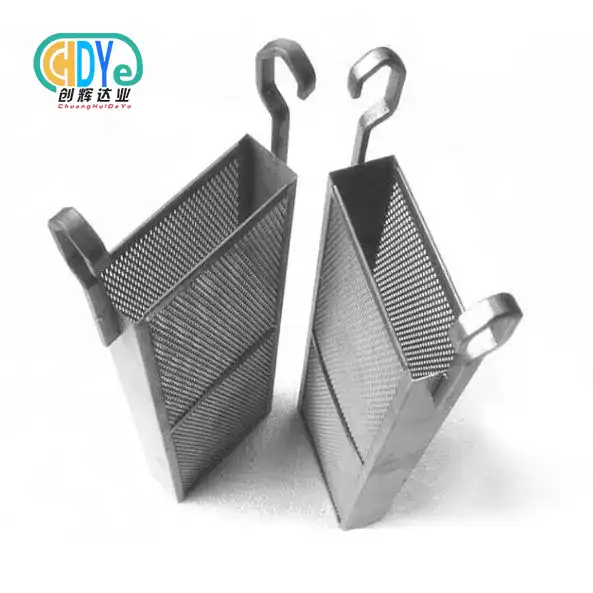
Titanium anode baskets are crucial parts of electroplating cells because they hold and spread anode material, which is usually nickel balls, copper bits, or other metal pieces, throughout the plating bath. Electricity flows through the basket during electroplating, which starts electrochemical reactions that evenly and precisely place metal layers on cathode workpieces.
Material Composition and Structural Design
Titanium anode baskets made by our company are made only from commercially pure titanium Grade 1 (Gr1) and Grade 2 (Gr2), which meet ASTM B265 standards. Grade 2 titanium, which must be at least 99.6% pure, is very resistant to corrosion in both acidic and alkaline coating baths and keeps its shape even when electrical stress is applied for a long time. The baskets have expanded mesh or perforated designs with holes that are usually between 6×3 mm and 12.5×4.5 mm in size. This allows the electrolyte to flow through freely and stops the anode from becoming polarised.
The shape of the basket changes depending on the use. In industry, cylindrical and rectangular shapes are most common and can be changed to fit different tank sizes and current needs. You should pay extra attention to hook designs because solid titanium is good at resisting rust, but it's only about 3% as good at conducting electricity as the International Annealed Copper Standard (IACS). Titanium-clad copper hooks are excellent for higher-amperage uses because they combine copper's better conductivity with titanium's chemical inertness to keep things from getting too hot and save energy.
TIG Welding Process and Quality Standards
TIG (Tungsten Inert Gas) welding with argon protection is the first step in making sure of the quality of the product. This controlled environment stops oxidation while welding, which stops the formation of alpha-cases that weaken the joint. Welds that are made with our method are silver or light straw-coloured, which means that the heat is being controlled correctly and there isn't much air contact. Titanium embrittlement is shown by blue or purple weld darkening. This is a serious quality problem that we always avoid by using strict welding settings and giving our operators training that meets AWS D1.9 standards.
Based on the customer's CAD or PDF models, each basket goes through mechanical processing that includes being cut, drilled, and bent. After putting together the parts, a full quality check makes sure of the chemical makeup, mechanical performance, resistance to rust, and accuracy of the measurements. Material Test Certificates (MTC) are sent with every package to show that the materials meet certain standards and can be tracked all the way through the production process.
Advantages of Titanium Anode Baskets Over Traditional Anode Materials
When you look at the different types of materials, you can see why titanium-based solutions are replacing graphite and platinum solutions more and more in electroplating processes. The benefits go beyond the price of the original purchase and include the product's lifetime value, its impact on the environment, and its dependability in use.
Superior Durability and Corrosion Resistance
Titanium naturally makes a protective oxide film when it comes in contact with air. This film acts as a shield against chemical attack from harsh plating chemicals. Titanium anode baskets last a very long time compared to graphite baskets, which break down over time due to rust and mechanical wear and need to be replaced often. Titanium anode baskets that aren't coated usually last between five and ten years in normal nickel, copper, and ornamental chrome baths. Their life is limited more by mechanical damage than chemical breakdown. This longer service life lowers the cost of replacing them, keeps production running smoothly, and cuts down on upkeep work.
The ability to prevent corrosion is especially useful in pools with fluoride and high-chloride settings, where regular materials break down quickly. Passivation can happen if the working voltage is higher than the titanium oxide film breakdown potential, which is usually above 10–12 volts in some chemistries. However, this doesn't happen if the process is controlled correctly and mixed metal oxide (MMO) coats are used. MMO-coated baskets can be used as insoluble anodes, and the coats on the catalysts last between one and five years, based on the current density, before they need to be reapplied.
Enhanced Electrical Performance and Energy Efficiency
In high-volume plating processes, electrical efficiency has a direct effect on running costs. Titanium's protective oxide film works like a semiconductor, letting electrons move while stopping the base from breaking down. Together with improved hook designs, titanium anode baskets keep low resistance at busbar contact points, which lowers energy use and voltage drop. Titanium is thermally stable, so its dimensions don't change while it's working. This keeps the distance between the anode and cathode constant, which makes sure that the current is spread out evenly and the plating is thick.
Unlike graphite electrodes, which add particles to plating pools, titanium anode baskets don't react with chemicals, so the bath stays clean, and you don't have to filter it as often. This cleanliness means fewer flaws, higher first-pass yield rates, and lower repair costs, all of which have a big effect on the total cost of production.
Environmental and Safety Benefits
As regulations get stricter and companies try to be more environmentally friendly, environmental concerns are becoming more important in the buying decisions they make. Titanium anode baskets create less dangerous trash than graphite anodes that need to be thrown away after use because they leave behind carbon residue. The fact that the material can be recycled fits with the ideas of the circular economy; titanium that has reached the end of its useful life still has a lot of worth that can be used again.
Cutting down on the use of platinum-group metals (PGMs) in anode applications can help with both price changes and worries about ethical sources. Titanium is easy to find and doesn't change in price, which is good for planning because it eliminates the supply chain risks that come with conflict minerals and other materials that are sensitive to geopolitics. These moral and environmental issues make companies more socially responsible and help them obtain green manufacturing licenses.
Applications and Use Cases of Titanium Anode Baskets in Various Industries
Electroplating is used in many different types of industries, and each one has its own specific technical needs that Titanium Anode Baskets can meet. Knowing these application settings helps procurement teams choose the right setups and guess how they will work.
Electronics and PCB Manufacturing
For high-density interconnect (HDI) designs that use microvias and fine-pitch electronics, it is very important that the plating be very regular when making printed circuit boards (PCBs). For acid copper electrodeposition, vertical continuous plating (VCP) lines use titanium anode baskets that hold phosphorus-copper balls. As the copper melts, the baskets keep the anode surface area steady. This keeps the current flowing evenly, which is important for void-free via filling and through-hole plating. Any change in dimensions or interruption in the current causes flaws that stop expensive multilayer boards from working. This is why basket dependability is so important to the economy of production.
Automotive Decorative Plating
Automobile parts like trim pieces, wheel covers, and logos need finishes that are bright, long-lasting, and resistant to damage from the environment. Watts nickel or sulfamate nickel baths are used in decorative chrome and nickel plating. Titanium anode baskets allow for constant round nickel refilling without stopping production. The structural stability of the baskets keeps the anode-to-cathode gaps exact. This provides the constant throwing power needed for even brightness and levelling across complicated part shapes. This level of stability is required by automotive OEM quality standards for millions of parts every year, making basket reliability a basic production need.
Industrial Hard Chrome Applications
Heavy-duty hard chrome plating at high current densities and long cycle times is needed to make rotogravure cylinders and fix hydraulic parts. Titanium anode baskets can handle these tough conditions and keep their shape, which is important for making sure that the layer is the same thickness and strength all over. After switching from graphite to titanium anode basket systems, industrial users say that coating consistency and reject rates have gotten a lot better. This directly improves return on investment through higher yields and less material loss.
Similar benefits have been seen in our work with companies that make chemical handling tools. To put corrosion-resistant layers on reactor tanks and heat exchanger parts, you need frames that can handle the same harsh chemicals that the layers do. Titanium is naturally compatible with these conditions, so the basket isn't a possible source of pollution or failure. This makes the process more reliable.
How to Choose and Procure the Best Titanium Anode Basket for Your Operation?
To choose the best anode baskets, you have to balance technical requirements with buying factors. A methodical evaluation technique makes sure that new systems will work with current ones and lowers the overall cost of ownership.
Technical Specification Criteria
Getting correct tank measurements and busbar configurations is the first step in meeting dimensional standards. The basket's depth must allow for enough anode material volume so that it can run for longer periods of time without having to be refilled often. The basket's width and length must also keep the right distance between the cathodes and the tank walls to avoid short circuits. The openings in the mesh must be smaller than the smallest diameter of the anode pellets at the point where they dissolve completely. A standard 10x5mm mesh works well for most nickel and copper ball uses, while finer designs work better for smaller particles.
The hook's design and cross-sectional size are based on its current ability. Titanium-clad copper hooks are usually needed for high-amperage lines that go over 3,000 amps to keep them from burning. Solid titanium construction works fine for lower-current ornamental lines. Depending on the operating voltage and bath chemistry, either normal Grade 2 titanium is enough or an MMO layer is needed to stop passivation. Our technical team helps with these evaluations by looking at your unique plating factors and suggesting the best combinations.
Customisation and Manufacturing Lead Times
Standard basket designs can be shipped in two weeks, but unique designs can take anywhere from four to six weeks, based on how complicated they are. We can work with customer models in either CAD or PDF format, and our engineering review process turns specs into fabrication parameters. This way of working together finds possible design improvements early on and sometimes suggests changes that make the product work better or cost less to make without affecting its usefulness.
Supplier Evaluation and Quality Assurance
Buying choices include more than just the specs of the product. They also include the capabilities and dependability of the seller. Our ISO 9001:2015 certification shows that we handle quality in a planned way throughout the whole manufacturing process, from inspecting the raw materials to packing them up at the end. Our facility is located in the Baoji High-tech Development Zone, which is known as China's "Titanium Capital". It has established supply networks and specialised production infrastructure that ensure the quality of our materials is always high, and our prices are low.
Every order comes with material tracking paperwork that includes reports on the chemical makeup, mechanical test results, and dimensional inspections. This paperwork meets the needs of customer quality systems and government regulations, and it also lets you keep track of performance throughout the duration of a basket. When speed problems occur, written-down material features make it easy to quickly find the root cause and resolve the problem.
When choosing a provider, you should think about the warranty terms and repair services. Titanium anode baskets can be fixed by replacing the hooks and welding back together any mesh pieces that have come loose. MMO-coated baskets can be recoated after the catalyst wears off, which increases their useful life by many repair rounds. We offer repair evaluation services that look at the state of the basket and tell you whether it would be cheaper to fix it instead of replace it based on how much service life is left.
Conclusion
Titanium anode baskets are a smart investment in the performance of an electroplating system because they improve longevity, process consistency, and overall running costs. The material is very stable and doesn't rust easily, so it can be used reliably in a wide range of plating chemicals and working situations, from high-precision electronics to heavy industrial settings. When making a buy choice, it's better to look at the total cost of ownership over a product's entire life, not just the original cost. For example, titanium's long life, low maintenance needs, and energy efficiency usually result in big savings compared to other materials. If you choose a provider with a lot of experience, full technical support, quality certifications, and the ability to customise, you can be sure that the basket specifications will meet your unique operating needs.
FAQ
Q: What causes titanium anode baskets to passivate and stop conducting?
A: Passivation happens when the working voltage is higher than the titanium oxide film's breakdown potential. This is usually above 10–12 volts in some bath chemicals, especially those that contain fluorides. This situation can be avoided by keeping chloride levels at the right amount and using anti-passivation coatings like mixed metal oxide or platinum. The best way to keep this from happening is to keep the process power under control.
Q: How long do titanium anode baskets typically last in industrial service?
A: Service life depends on how the basket is built and how it is used. Standard nickel or copper baths with uncoated baskets usually last five to ten years, with mechanical damage or hook rust being the main causes of failure rather than chemical breakdown. For solid anode uses, MMO-coated baskets need to be recoated every one to five years, based on the current density. However, the titanium structure underneath lasts much longer.
Q: Can damaged titanium baskets be repaired economically?
A: Titanium anode baskets help fix that without costing a lot of money. Replacing hooks and rewelding mesh pieces that have come loose are common fixes. Once the catalyst wears off, MMO-coated baskets can be sanded, acid-pickled, and re-coated, which restores usefulness at a fraction of the cost of replacing them. We check the state of the basket and suggest repairs based on how much it would cost to make a new one and how strong the structure is still.
Contact Chuanghui Daye for Custom Titanium Anode Basket Solutions
Everyone at Shaanxi Chuanghui Daye has worked with rare metals for 30 years, and that knowledge shows in every titanium anode basket we make. Our facility is in Baoji, which is known as China's Titanium Capital. It has state-of-the-art processing tools and quality systems that are ISO 9001:2015 approved to provide reliable and affordable electroplating solutions. We are experts at making unique baskets that fit your tank's size, plating chemistry, and amperage needs. For accurate manufacturing, we can use CAD or PDF plans. Our expert team is here to help you, from reviewing your specifications to providing service after the sale, whether you need a prototype for study purposes or a large quantity for high-volume production. As a reputable titanium anode basket maker, we offer low factory-direct prices while maintaining high-quality standards and full material tracking. Email our team at info@chdymetal.com to talk about your electroplating needs and get full product specs that fit your business.
References
1. Davis, J.R. (2000). ASM Speciality Handbook: Nickel, Cobalt, and Their Alloys. ASM International, Materials Park, Ohio.
2. Gamburg, Y.D. & Zangari, G. (2011). Theory and Practice of Metal Electrodeposition. Springer Science+Business Media, New York.
3. Kanani, N. (2004). Electroplating: Basic Principles, Processes and Practice. Elsevier Advanced Technology, Oxford.
4. Schutz, R.W. & Thomas, D.E. (1987). "Corrosion of Titanium and Titanium Alloys." In Metals Handbook, Volume 13: Corrosion, 9th Edition, ASM International.
5. Schlesinger, M. & Paunovic, M. (2010). Modern Electroplating, Fifth Edition. John Wiley & Sons, Hoboken, New Jersey.
6. Zhang, L.C. & Chen, L.Y. (2019). "A Review on Biomedical Titanium Alloys: Recent Progress and Prospect." Advanced Engineering Materials, Volume 21, Issue 4.

Learn about our latest products and discounts through SMS or email